


Canadian couple builds world’s largest snow maze

1 / 5
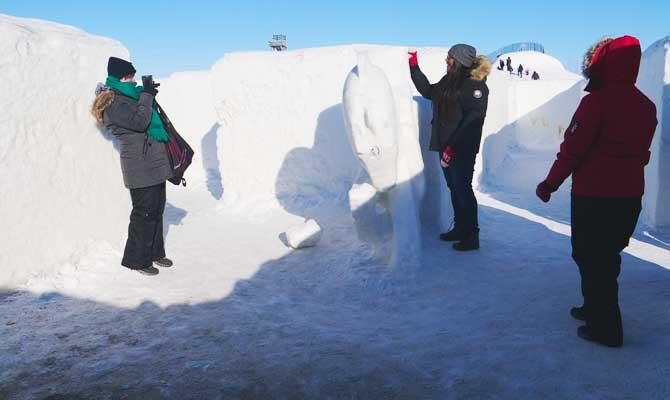
People take pictures near a statue carved out of snow and located within the world's largest snow maze in ST. Adolphe, Manitoba, Canada, on March 2, 2019. (AFP)
2 / 5
Clint Masse, farmer and owner of the maze, which took his family and employees more than three weeks to design and build poses at the entrance in ST. Adolphe, Manitoba, Canada, on March 2, 2019. (AFP)
3 / 5
People play in a maze built by farmers Clint and Angie Masse in St. Adolphe, Canada, on March 3, 2019. (AFP)
4 / 5
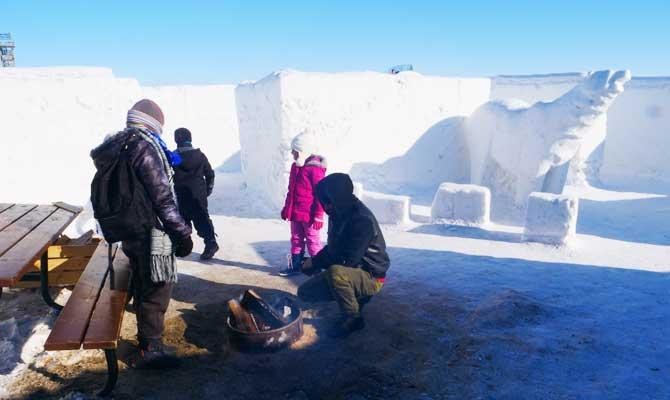
A family rests and warms near a firepit located within the snow maze in St. Adolphe, Manitoba, Canada, on March 2, 2019. (AFP)
5 / 5
A sign welcomes visitors at the world's largest snow maze in St. Adolphe, Manitoba, Canada, on March 2, 2019. (AFP)
Updated 06 March 2019
Follow

Canadian couple builds world’s largest snow maze

  • The couple used commercial computer-aided design and drafting software

ST. ADOLPHE, Canada: A-maze-ing: a snow labyrinth in the frigid, windswept prairies of Western Canada has broken the record for the world’s biggest.
According to Guinness World Records, the whopping 2,789.11 square meters (30,0021.73 square feet) of terrain dwarfs the previous Canadian record holder at the Fort William Historical Park in Thunder Bay, Ontario.
For years, farmers Clint and Angie Masse would ring in the fall harvest by building a corn maze on their property just outside of the small town of St. Adolphe, a short drive from Winnipeg, Manitoba.
With a long, cold winter in the Canadian forecast, they decided late last year to try to extend the experience of finding one’s way through the network of paths and hedges by several months.
And despite temperatures plunging to a low of -40 degrees Celsius (-40 Fahrenheit) in January, people kept coming in droves.
But it was no easy feat, Clint Masse told AFP. He said building the maze required weeks of planning, tens of thousands of dollars and 370 truckloads of snow to supplement the relatively thin powder on their fields.
“Making snow is really expensive,” he said, pointing to the cost of renting generators, tractors and other equipment, fuel and weeks of labor.
There were design challenges too.
“You’re not designing a path, what you are is designing walls and every wall has a double duty: it’s got a path on this side and a path on that side,” Masse said.
“I wanna say it took me a better part of a week. The corn maze I think I could do in a day and a half so it’s a lot of more work to design.”

The couple used commercial computer-aided design and drafting software.
Inside the labyrinth, visitors walk between walls of snow that are 1.8 meters (six feet) high, and atop a layer of snow packed tightly to prevent it from melting too soon into slush under the pedestrian traffic.
They are greeted by ice sculptures around several corners, and benches have been set up around campfires burning in five nooks to allow visitors to warm up before continuing on and trying to solve the puzzle.
The fire pits also act as markers, which first-timers Jillian Crooks and Cassidy Wegner said were indispensable for finding their way.
“It was fun,” Crooks said. “We just kept turning every which way. It took us a while. We didn’t time it, we should have. Maybe like half an hour? Yep!“
That bested the posted average of 30-45 minutes.
If cold temperatures hold, the labyrinth could stay open for a few more weeks, by which time Clint Masse said he hopes to have had more than 10,000 visitors and turn a small profit.


Valentino, designer whose gowns made royals and movie stars feel beautiful, dies at 93

Updated 39 sec ago
Follow

Valentino, designer whose gowns made royals and movie stars feel beautiful, dies at 93

  • Valentino’s designs were beloved by royals, first ladies, and movie stars, including Jackie Kennedy Onassis and Julia Roberts
  • His creations were a staple on the red carpet for nearly 50 years, from the 1960s until his retirement in 2008
MILAN: Valentino Garavani, the jet-set Italian designer whose high-glamor gowns — often in his trademark shade of “Valentino red” — were fashion show staples for nearly half a century, died Monday. He was 93.
“Valentino Garavani was not only a constant guide and inspiration for all of us, but a true source of light, creativity and vision,″ the foundation founded by Valentino and his partner Giancarlo Giammetti said in a statement posted on social media. The foundation said he died at his Rome residence but did not mention the cause.
Universally known by his first name, Valentino was adored by generations of royals, first ladies and movie stars, from Jackie Kennedy Onassis to Julia Roberts and Queen Rania of Jordan, who swore the designer always made them look and feel their best.
“I know what women want,” he once remarked. “They want to be beautiful.”
Though Italian-born and despite maintaining his atelier in Rome, he mostly unveiled his collections in Paris, and spoke French with his Italian partner Giammetti, an entrepreneur.
Alessandro Michele, the current creative director of the Valentino fashion house, wrote in Instagram that he continues to feel Valentino’s “gaze” as he works on the next collection, which will be presented March 12 in Rome, departing from the usual venue of Paris. Michele remembered Valentino as “a man who expanded the limits of the possible” and possessing “a rare delicacy, with a silent rigor and a limitless love for beauty.”
Another of Valentino’s successors, Pierpaolo Piccoli, placed a broken heart emoji under the announcement of his death. Former supermodel Cindy Crawford wrote that she was “heartbroken,” and called Valentino “a true master of his craft.”
Condolences also came in from the family of the late designer Giorgio Armani, who died in September at the age of 91, and Donatella Versace, who posted two photos of Valentino, saying “he will forever be remembered for his art.”
Italian Premier Giorgia Meloni remembered Valentino as “an indisputable maestro of eternal style and elegance of Italian high fashion.”
Never one for edginess or statement dressing, Valentino made precious few fashion faux pas throughout his nearly half-century career, which stretched from his early days in Rome in the 1960s through to his retirement in 2008.
His fail-safe designs made Valentino the king of the red carpet, the go-to man for A-listers’ awards ceremony needs. His sumptuous gowns have graced countless Academy Awards, notably in 2001, when Roberts wore a vintage black and white column to accept her best actress statue. Cate Blanchett also wore Valentino — a one-shouldered number in butter-yellow silk — when she won the Oscar for best supporting actress in 2005.
Valentino was also behind the long-sleeved lace dress Jacqueline Kennedy wore for her wedding to Greek shipping magnate Aristotle Onassis in 1968. Kennedy and Valentino were close friends for decades, and for a spell the one-time US first lady wore almost exclusively Valentino.
He was also close to Diana, Princess of Wales, who often donned his sumptuous gowns.
Beyond his signature orange-tinged shade of red, other Valentino trademarks included bows, ruffles, lace and embroidery; in short, feminine, flirty embellishments that added to the dresses’ beauty and hence to that of the wearers.
Perpetually tanned and always impeccably dressed, Valentino shared the lifestyle of his jet-set patrons. In addition to his 152-foot (46-meter) yacht and an art collection including works by Picasso and Miro, the couturier owned a 17th-century chateau near Paris with a garden said to boast more than a million roses.
Valentino and his longtime partner Giammetti flitted among their homes — which also included places in New York, London, Rome, Capri and Gstaad, Switzerland — traveling with their pack of pugs. The pair regularly received A-list friends and patrons, including Madonna and Gwyneth Paltrow.
“When I see somebody and unfortunately she’s relaxed and running around in jogging trousers and without any makeup ... I feel very sorry,” the designer told RTL television in a 2007 interview. “For me, woman is like a beautiful, beautiful flower bouquet. She has always to be sensational, always to please, always to be perfect, always to please the husband, the lover, everybody. Because we are born to show ourselves always at our best.”
Valentino was born into a well-off family in the northern Italian town of Voghera on May 11, 1932. He said it was his childhood love of cinema that set him down the fashion path.
“I was crazy for silver screen, I was crazy for beauty, to see all those movie stars being sensation, well dressed, being always perfect,” he explained in the 2007 television interview.
After studying fashion in Milan and Paris, he spent much of the 1950s working for established Paris-based designer Jean Desses and later Guy Laroche before striking out on his own. He founded the house of Valentino on Rome’s Via Condotti in 1959.
From the beginning, Giammetti was by his side, handling the business aspect while Valentino used his natural charm to build a client base among the world’s rich and fabulous.
After some early financial setbacks — Valentino’s tastes were always lavish, and the company spent with abandon — the brand took off.
Early fans included Italian screen sirens Gina Lollobrigida and Sophia Loren, as well as Hollywood stars Elizabeth Taylor and Audrey Hepburn. Legendary American Vogue editor-in-chief Diana Vreeland also took the young designer under her wing.
Over the years, Valentino’s empire expanded as the designer added ready-to-wear, menswear and accessories lines to his stable. Valentino and Giammetti sold the label to an Italian holding company for an estimated $300 million in 1998. Valentino would remain in a design role for another decade.
In 2007, the couturier feted his 45th anniversary in fashion with a 3-day blowout in Rome, capped with a grand ball in the Villa Borghese gallery.
Valentino retired in 2008 and was briefly replaced by fellow Italian Alessandra Facchinetti, who had stepped into Tom Ford’s shoes at Gucci before being sacked after two seasons.
Facchinetti’s tenure at Valentino proved equally short. As early as her first show for the label, rumors swirled that she was already on her way out, and just about one year after she was hired, Facchinetti was indeed replaced by two longtime accessories designers at the brand, Maria Grazia Chiuri and Pierpaolo Piccioli.
Chiuri left to helm Dior in 2016, and Piccioli continued to lead the house through a golden period that drew on the launch of the Rockstud pump with Chiuri and his own signature color, a shade of fuchsia called Pink PP. He left the house in 2024, later joining Balenciaga, and has been replaced by Michele, who revived Gucci’s stars with romantic, genderless styles.
Valentino is owned by Qatar’s Mayhoola, which controls a 70 percent stake, and the French luxury conglomerate Kering, which owns 30 percent with an option to take full control in 2028 or 2029. Richard Bellini was named CEO last September.
A public viewing will be held at the Valentino Garavani and Giancarlo Giammetti Foundation on Wednesday and Thursday, and a funeral will be held Friday in the Basilica di Santa Maria degli Angeli e dei Martiri in central Rome.