

Indonesia’s Aceh whips unmarried couples after hotel raid

1 / 6
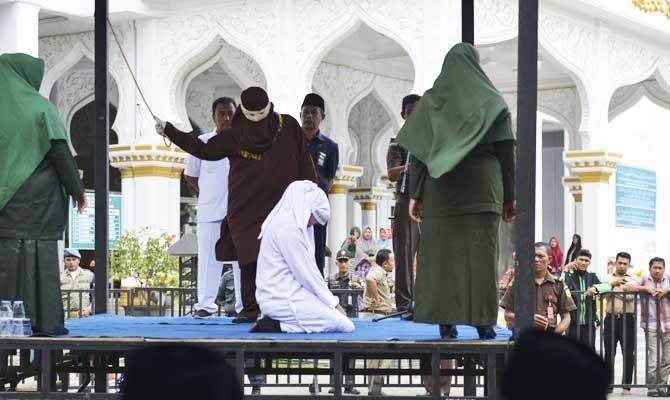
An Indonesian woman gets taken away after she was whipped in public in Banda Aceh on March 4, 2019. (AFP)
2 / 6
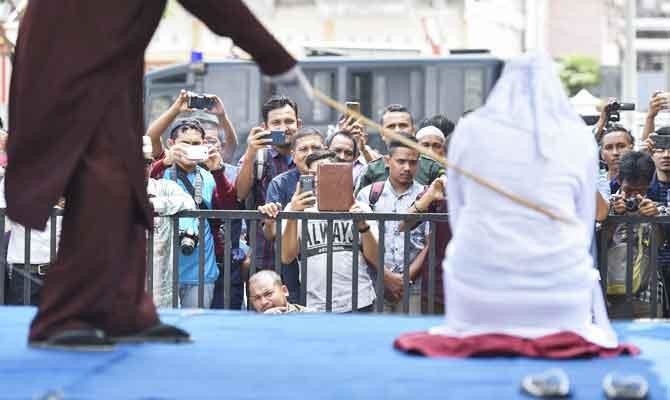
An Indonesian woman is whipped in public in Banda Aceh on March 4, 2019. (AFP)
3 / 6
An Indonesian woman is whipped in public in Banda Aceh on March 4, 2019. (AFP)
4 / 6
An Indonesian woman gets taken away after she was whipped in public in Banda Aceh on March 4, 2019. (AFP)
5 / 6
An Indonesian woman is whipped in public in Banda Aceh on March 4, 2019. (AFP)
6 / 6
An Indonesian man is whipped in public in Banda Aceh on March 4, 2019. (AFP)
Updated 05 March 2019
Follow

Indonesia’s Aceh whips unmarried couples after hotel raid

  • In December, two men caught having sex with underage girls were whipped 100 times each
  • Aceh adopted religious law after it was granted special autonomy in 2001, an attempt by the central government to quell a long-running separatist insurgency

BANDA ACEH, Indonesia: Six couples were publicly whipped in Indonesia’s conservative Aceh province Monday for relations outside marriage, with at least two women unable to walk after the painful punishment.
Flogging is common for a range of offenses in the region at the tip of Sumatra island, including gambling, drinking alcohol, and having gay sex.
It is the only province in the world’s biggest Muslim-majority country that imposes Islamic law.
The twelve people whipped Monday were arrested late last year during a raid on a hotel in the province’s capital Banda Aceh.
Four people were each flogged seven times after being found with a member of the opposite sex who wasn’t a relation.
The others — who were caught in more compromising positions — received between 17-25 strokes for having intimate relations outside of marriage, an official said.
All 12 also served several months in prison before the public punishment.
Some women cried out in pain as a masked sharia officer lashed them, and at least two had to be carried from the scene by sharia officers.
Dozens of spectators and journalists watched quietly. Some winced occasionally after the blows, while others used smartphones and tablets to film the spectacle.
“This law is designed to have a deterrent effect, not only for the offenders but for the spectators who watch the caning,” said the head of the local public order agency, Marwan, who like many Indonesian goes by one name.

He added: “The pain of being flogged is not that bad, the embarrassment is worse.”
Rights groups have slammed public caning as cruel, and Indonesia’s President Joko Widodo has called for it to end.
But the practice has wide support among Aceh’s mostly Muslim population — around 98 percent of its five million residents practice Islam.
Aceh adopted religious law after it was granted special autonomy in 2001, an attempt by the central government to quell a long-running separatist insurgency.
In December, two men caught having sex with underage girls were whipped 100 times each.


St. Francis relics go on public show for first time in Italy

Updated 22 February 2026
Follow

St. Francis relics go on public show for first time in Italy

Assisi, Italy: Saint Francis of Assisi’s skeleton is going on public display from Sunday for the first time for the 800th anniversary of his death, drawing hundreds of thousands of visitors.
Inside a nitrogen-filled plexiglass case with the Latin inscription “Corpus Sancti Francisci” (The Body of St. Francis), the remains are being shown in the Italian hill town’s Basilica of St. Francis of Assisi.
St. Francis, who died on October 3, 1226, founded the Franciscan order after renouncing his wealth and devoting his life to the poor.
Giulio Cesareo, director of communications for the Franciscan convent in Assisi said he hoped the display could be “a meaningful experience” for believers and non-believers alike.
Cesareo, a Franciscan friar, said the “damaged” and “consumed” state of the bones showed that St. Francis “gave himself completely” to his life’s work.
His remains, which will be on display until March 22, were transferred to the basilica built in the saint’s honor in 1230.
But it was only in 1818, after excavations carried out in utmost secrecy, that his tomb was rediscovered.
Apart from previous exhumations for inspection and scientific examination, the bones of Saint Francis have only been displayed once, in 1978, to a very limited public and for just one day.
Usually hidden from view, the transparent case containing the relics since 1978 was brought out on Saturday from the metal coffer in which it is kept, inside his stone tomb in the crypt of the basilica.
The case is itself inside another bullet-proof and anti-burglary glass case.
Surveillance cameras will operate 24 hours a day for added protection of the remains.
St. Francis is Italy’s patron saint and the 800th anniversary commemorations of his death will also see the restoration of an October 4 public holiday in his honor.
The holiday had been scrapped nearly 50 years ago for budget reasons.
Its revival is also a tribute to late pope Francis who took on the saint’s name.
Pope Francis died last year at the age of 88.

‘Not a movie set’

Reservations to see the saint’s remains already amount to “almost 400,000 (people) coming from all parts of the world, with of course a clear predominance from Italy,” said Marco Moroni, guardian of the Franciscan convent.
“But we also have Brazilians, North Americans, Africans,” he added.
During this rather quiet time of year, the basilica usually sees 1,000 visitors per day on weekdays, rising to 4,000 on weekends.
The Franciscans said they were expecting 15,000 visitors per day on weekdays and up to 19,000 on Saturdays and Sundays for the month-long display of the remains.
“From the very beginning, since the time of the catacombs, Christians have venerated the bones of martyrs, the relics of martyrs, and they have never really experienced it as something macabre,” Cesareo said.
What “Christians still venerate today, in 2026, in the relics of a saint is the presence of the Holy Spirit,” he said.
Another church in Assisi holds the remains of Carlo Acutis, an Italian teenager who died in 2006 and who was canonized in September by Pope Leo XIV.
Experts said the extended display of St. Francis’s remains should not affect their state of preservation.
“The display case is sealed, so there is no contact with the outside air. In reality, it remains in the same conditions as when it was in the tomb,” Cesareo said.
The light, which will remain subdued in the church, should also not have an effect.
“The basilica will not be lit up like a stadium,” Cesareo said. “This is not a movie set.”