

Saudi Arabia rules out diplomatic ties with Syria until stability restored

1 / 4
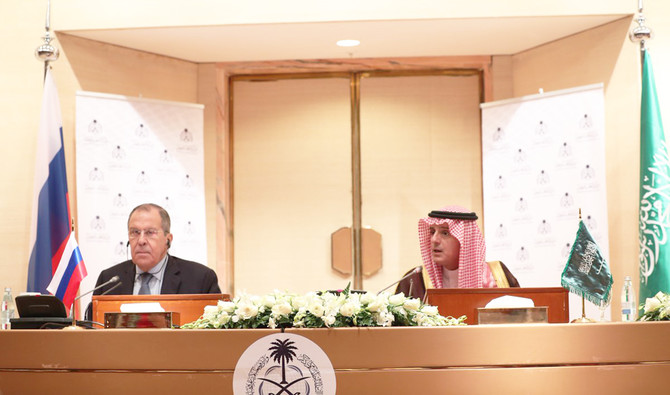
Saudi Arabia's Minister of State for Foreign Affairs Adel Al-Jubeir received Russia's foreign minister Sergei Lavrov on Monday in Riyadh. (Saudi Arabia Ministry of Foreign Affairs)
2 / 4
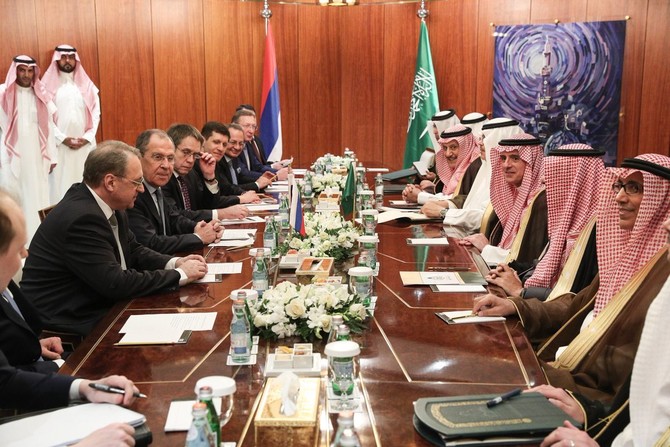
Saudi Arabia's Minister of State for Foreign Affairs Adel Al-Jubeir received Russia's foreign minister Sergei Lavrov on Monday in Riyadh. (Saudi Arabia Ministry of Foreign Affairs)
3 / 4
Saudi Arabia's Minister of State for Foreign Affairs Adel Al-Jubeir received Russia's foreign minister Sergei Lavrov on Monday in Riyadh. (Saudi Arabia Ministry of Foreign Affairs)
4 / 4
Saudi Arabia's Minister of State for Foreign Affairs Adel Al-Jubeir received Russia's foreign minister Sergei Lavrov on Monday in Riyadh. (Saudi Arabia Ministry of Foreign Affairs)
Updated 04 March 2019
Follow

Saudi Arabia rules out diplomatic ties with Syria until stability restored

  • No reconstruction before progress on political process to end war, Al-Jubeir says

RIYADH: Saudi Arabia on Monday ruled out restoring diplomatic relations with Syria or reinstating Damascus to the Arab League without progress on a political process to end the eight-year-old war.

Riyadh will also not take part in any reconstruction efforts until stability is restored in Syria, Minister of State for Foreign Affairs Adel Al-Jubeir said.

Saudi Arabia was committed to finding a political solution to the Syrian conflict but reopening the embassy was “related to progress on the political process, so it is still early,” Al-Jubeir told a joint press conference with Russian Foreign Minister Sergei Lavrov.

Asked whether Riyadh would assist in the reconstruction of Syria, Al-Jubeir said: “Reconstruction cannot happen until the war is over and there is stability and security in Syria.”

He said it was also “too early” for Syria to be reinstated to the Arab League, from which it was suspended seven years ago. The Arab League has said reinstatement would require consensus among member states.

Lavrov said: “We are helping the Syrian political parties to form a constitutional committee, but it is the Syrian people who will decide the form of their political system.”

He said challenges such as the fight against terrorism and the situations in Syria and Yemen could be resolved only through the implementation of UN resolutions.

On other issues, Al-Jubeir said he believed Canada would honor a $13 billion deal to sell armored vehicles to the Kingdom, despite a suggestion by Canadian Prime Minister Justin Trudeau that Ottawa was looking for a way out of the agreement.

Trudeau’s remarks were “for domestic consumption,” Al-Jubeir said. “We see the Canadian government going ahead with the deal.”

Lavrov said Moscow hoped to contribute to the Saudi civilian nuclear energy program.

“We have pointed out that there is a Saudi nuclear program for peaceful uses,” he said. 

“We hope that Russian experience and its level of expertise and the level of security provided during the construction of power stations in different parts of the world will interest Saudi Arabia.” 

Al-Jubeir said the Kingdom would use atomic power to produce “peaceful energy,” and had for years been working with other nations to develop the latest technologies and safest production methods for generating nuclear energy at competitive prices.


Economic growth and resilience at heart of 2nd AlUla Emerging Market Economies Conference

Updated 03 February 2026
Follow

Economic growth and resilience at heart of 2nd AlUla Emerging Market Economies Conference

  • Event on Feb. 8 and 9 will bring together ministers, governors of central banks, policymakers, economic experts and international financial institutions
  • Emerging-market economies a ‘pivotal element’ in global economic system due to effect they have on growth and stability, says Saudi Finance Minister Mohammed Al-Jadaan

RIYADH: The second annual AlUla Conference for Emerging Market Economies, which Saudi Arabia will host next week, offers a platform to exchange views on global developments and discuss policies and reforms that support inclusive growth and strengthen economic resilience, the Kingdom’s finance minister said.

The event on Feb. 8 and 9 will bring together finance ministers, governors of central banks and policymakers, alongside economic experts and representatives of international financial institutions.

Organized by the Saudi Ministry of Finance in partnership with the International Monetary Fund, it takes place as emerging-market economies face mounting challenges amid rapid global economic change.

Finance Minister Mohammed Al-Jadaan said the decision to host the conference reflects Saudi Arabia’s ongoing commitment to efforts that support global financial and economic stability, and highlights the growing influence of emerging economies on worldwide growth.

Emerging-market economies represent a “pivotal element” in the global economic system due to the direct impact they have on economic growth and stability, he added.

“The AlUla Conference for Emerging Market Economies provides a unique platform for exchanging views on global economic developments, and discussing policies and reforms that will support inclusive growth and enhance economic resilience, in light of broader international cooperation that contributes to confronting common challenges,” Al-Jadaan said.

Kristalina Georgieva, managing director of the IMF, said the event would help emerging economies deal with growing uncertainty driven by technological change, demographic shifts and geopolitical tensions.

“The AlUla conference provides a vital platform for emerging economies to discuss how they can navigate the risks and embrace the opportunities ahead,” she said.

“In these times of sweeping transformations in the global economy, policymakers face a more challenging and uncertain environment. Countries should work together to strengthen resilience through sound macroeconomic and financial policies.”