

At least 23 dead in Alabama tornado, toll expected to rise

1 / 3
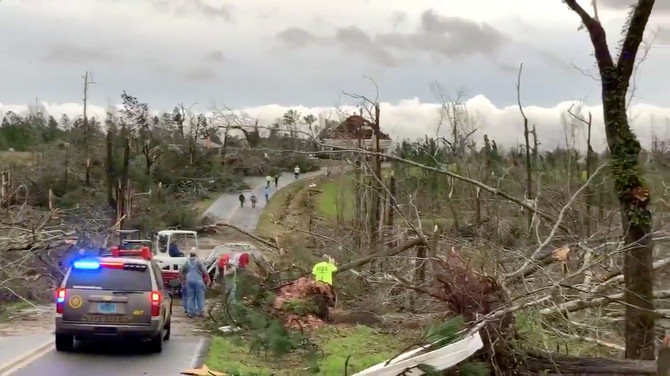
People clear fallen trees and debris on a road following a tornado in Beauregard, Alabama in this March 3, 2019 still image obtained from social media video. (Reuters)
2 / 3
Limestone County Sheriff Office’s information officer Stephen Young talks to a driver on a section of Mooresville Road, between Humphrey Road and Old Hwy 20 that was partially flooded and closed to traffic on Friday, Feb. 22, 2019, in Decatur, Alabama. (AP)
3 / 3
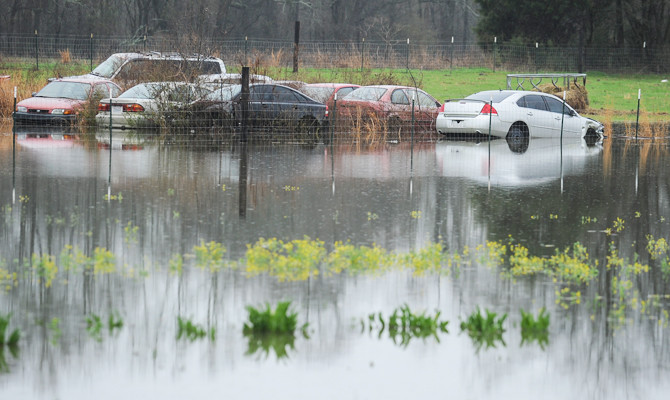
A backyard on Pryor Road in Limestone County is flooded on Friday, Feb. 22, 2019, in Decatur, Ala. More than 30 school districts in Alabama, Mississippi and Tennessee closed Friday, in part because school buses couldn't navigate flooded roads. (AP)
Updated 04 March 2019
Follow

At least 23 dead in Alabama tornado, toll expected to rise

  • Emergency workers faced a grim night of pulling the dead and injured from the wreckage of homes and businesses
  • ‘We’ve still got people being pulled out of rubble’

SACRAMENTO, California: At least 23 people, some of them children, died after a tornado swept through Lee County, Alabama on Sunday, and the death toll was expected to rise as rescuers searched through the rubble of destroyed homes, authorities and media said.

Emergency workers faced a grim night of pulling the dead and injured from the wreckage of homes and businesses.

“The challenge is the sheer volume of the debris where all the homes were located,” Lee County Sheriff Jay Jones said in an interview with CNN. “It’s the most I’ve seen that I can recall.”

Storms, including at least one apparent tornado, uprooted trees and destroyed homes in neighboring Georgia, initially knocking out power to 21,000 customers, said Georgia Power spokeswoman Meredith Stone.

On Twitter, US President Donald Trump urged residents of Alabama and other areas affected by the storms to be “careful and safe.”

“Tornadoes and storms were truly violent and more could be coming,” Trump wrote. “To the families and friends of the victims, and to the injured, God bless you all!”

In Alabama, Lee County Coroner Bill Harris said the death toll could rise.

“We’ve still got people being pulled out of rubble,” he told the Birmingham News newspaper early on Sunday evening. “We’re going to be here all night.”

The East Alabama Medical Center in Opelika said in a statement that it was treating more than 40 patients as a result of the tornado and expected to receive more. Some patients had been sent to other hospitals, it added.

Severe weather unleashed one of many possible tornadoes that threatened the Southern United States on Sunday afternoon. Tornado warnings and watches were in effect for parts of Georgia and Alabama through Sunday evening.

Video footage from the small community of Beauregard in Lee County showed homes reduced to piles of wreckage, felled trees, and debris from blasted buildings scattered across roads.

Photos posted on social media from a highway near Smiths Station, about 20 miles (32 km) east of Beauregard, showed a large bar called the Buck Wild Saloon with its roof torn off and missing most of a wall after the storm swept through.

Alabama Governor Kay Ivey warned residents on Twitter that more severe weather might be on the way.

A state of emergency for Alabama, issued on Feb. 23 to deal with flooding, would be extended, she said.

“Our hearts go out to those who lost their lives in the storms that hit Lee County today,” Ivey wrote. “Praying for their families & everyone whose homes or businesses were affected.”

Lee County Schools announced on Twitter that campuses in the county would be closed on Monday.

The National Weather Service office in Birmingham, Alabama, said it was sending three survey teams out on Monday to assess damage in Autauga, Macon, Lee and Barbor counties.

“Please stay out of damaged areas so first responders can do their job,” the NWS office said on Twitter.

The storm initially left 17,000 customers without power in Alabama, but crews were able to reduce that number to 6,000 by about 9 p.m. EST on Sunday, said Michael Sznajderman, spokesman for the utility Alabama Power.

As thousands faced a night without power, temperatures looked set to fall to near freezing following the storm.

“Colder air will sweep into the Southeast behind the severe weather with temperatures dropping into the 30s (1 C) southward to central Georgia and across most of Alabama by Monday morning,” AccuWeather meteorologist Kristina Pydynowski said.

“Those without power who rely on electric heat need to find ways to stay warm,” she added.


World not ready for rise in extreme heat, scientists say

A man drinks water under the sun on a beach in Puerto Madryn, Chubut province, Argentina on January 26, 2024. (AFP)
Updated 5 sec ago
Follow

World not ready for rise in extreme heat, scientists say

  • In a new study, they looked at different global warming scenarios to project how often people in the future might experience temperatures considered uncomfortably hot or cold

PARIS: Nearly 3.8 billion people could face extreme heat by 2050, and while tropical countries will bear the brunt, cooler regions will also need to adapt, scientists said Monday.

Demand for cooling will “drastically” increase in large countries like Brazil, Indonesia, and Nigeria, where hundreds of millions of people lack air conditioning or other means to beat the heat.

But even a moderate increase in hotter days could have a “severe impact” in nations not accustomed to such conditions, such as Canada, Russia, and Finland, said scientists from the University of Oxford.

In a new study, they looked at different global warming scenarios to project how often people in the future might experience temperatures considered uncomfortably hot or cold.

They found “that the population experiencing extreme heat conditions is projected to nearly double” by 2050 if global average temperatures rise 2°C above preindustrial times.

But most of the impact would be felt this decade as the world fast approaches the 1.5°C mark, said the study’s lead author Jesus Lizana.

“The key takeaway from this is that the need for adaptation to extreme heat is more urgent than previously known,” said Lizana, an environmental scientist.

“New infrastructure, such as sustainable air conditioning or passive cooling, needs to be built out within the next few years to ensure people can cope with dangerous heat.”

Prolonged exposure to extreme heat can overwhelm the body’s natural cooling systems, causing symptoms ranging from dizziness and headaches to organ failure and death.

It is often called a silent killer because most heat deaths occur gradually as high temperatures and other environmental factors work together to undermine the body’s internal thermostat.

Climate change is making heatwaves longer and stronger, and access to cooling — especially air conditioning — will be vital in the future.

The study, published in the journal Nature Sustainability, projected that 3.79 billion people worldwide could be exposed to extreme heat by mid century.

This would “drastically” increase energy demand for cooling in developing nations where the gravest health consequences would be felt. India, the Philippines, and Bangladesh would be among the countries with the largest populations affected.

The most significant change in “cooling degree days” — temperatures hot enough to require cooling, such as air conditioning or fans — was projected in tropical or equatorial countries, particularly in Africa.

Central African Republic, Nigeria, South Sudan, Laos, and Brazil saw the biggest rise in dangerously hot temperatures.

“Put simply, the most disadvantaged people are the ones who will bear the brunt of this trend, our study shows for ever hotter days,” said urban climate scientist and research co-author Radhika Khosla.

But wealthier countries in traditionally cooler climates also “face a major problem — even if many do not realize it yet,” she added.

Countries like Canada, Russia, and Finland may experience steep drops in “heating degree days” — temperatures low enough to require indoor heating — under a 2°C scenario.

But even a moderate rise in hotter temperatures would be felt more acutely in countries not designed to withstand heat, the authors said.

In these countries, homes and buildings are usually built to maximize sunlight and minimize ventilation, and public transport runs without air conditioning.

Some cold-climate nations may see a drop in heating bills, Lizana said, but over time these savings would likely be replaced by cooling costs, including in Europe, where air conditioning is still rare.

“Wealthier countries cannot sit back and assume they will be OK — in many cases, they are dangerously underprepared for the heat that is coming over the next few years,” he said.