KUFR AQAB: Palestinian residents of Kufr Aqab, just north of Jerusalem, could be forgiven for thinking they live under two governments at once, or perhaps none at all.
They pay taxes to Israel, which collects their trash and theoretically plans their roads. But electricity and water come from Palestinian companies, and when the police come to the often-lawless area, they too are Palestinian.
Both the Israeli and Palestinian authorities say they provide services to the area, but residents say in reality no one is in control.
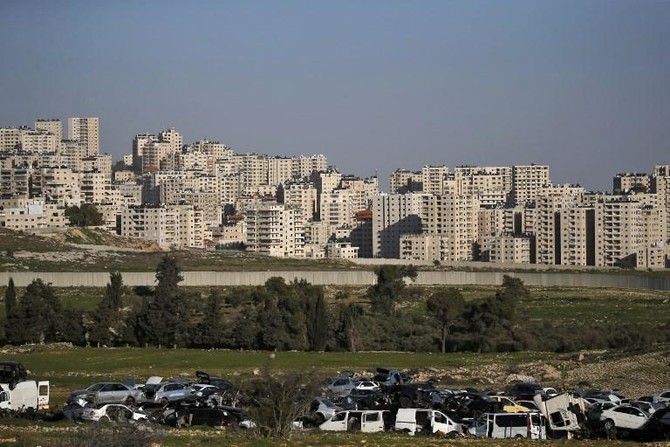
They say the result is an often chaotic nowhere-land where high-rise buildings are constructed only a few meters apart and rubbish piles up on roadsides.
“Life here has become unbearable,” said shop owner Abu Mohammed, who has lived in the area for 25 years.
Kufr Aqab is among a handful of locations that occupy a unique and bizarre status in the Israeli-Palestinian conflict.
Israel considers the area part of Jerusalem, which it fully controls. But Kufr Aqab lies on the other side of Israel’s separation barrier dividing Jerusalem from the occupied West Bank.
As such, the Israeli government has only partial control over the area, operating through contractors and a community administration.
Its police officers rarely, if ever, patrol, though the army is known to enter to carry out arrests.
Around 100,000 people live in the five-square-kilometer (two-square-mile) area, hit by high rates of crime and poverty.
On a recent visit AFP saw trash piled on the side of streets next to buildings without proper sewage systems.
“The fugitives from Israel come here and the fugitives from the Palestinian Authority come here and there is no one to control them,” said Abu Mohammed.
Why then, do the residents remain? The key lies in the unique status of the area.
Unlike their counterparts in the West Bank, Palestinians from Jerusalem hold ID cards that grant them access to the city and all of Israel.
West Bank ID holders, on the other hand, have to apply for permits to enter Jerusalem.
If Palestinians from Jerusalem are proved by Israeli authorities to be living beyond the wall, they can be stripped of their Jerusalem IDs — but not in locations like Kufr Aqab.
Palestinian figures estimate that around 85 percent of Kufr Aqab residents are Jerusalem ID holders.
Homes are also far more affordable there than inside Jerusalem.
Yusef Qassam, 63, can’t live in Jerusalem because he has a West Bank ID, but his wife is from the city and their four children have Jerusalem IDs.
So, the family lives in an apartment in Kufr Aqab.
“If the Israelis prove that she lives in the West Bank, she will lose her Jerusalem ID. We know that Israel is emptying Jerusalem of Palestinians,” he said.
This is a common Palestinian accusation about the disputed city — one that Israel denies.
Israel occupied east Jerusalem in the 1967 Six-Day War and later annexed it in a move never recognized by the international community.
It sees the entire city as its capital, while the Palestinians want the eastern sector as the capital of their future state.
Ben Avrahami, senior adviser for east Jerusalem affairs to Israel’s Jerusalem mayor, said the municipality treats Kufr Aqab as “an inseparable part of Jerusalem.”
“There is a lot of influence and involvement in infrastructure: paving roads, planning and construction,” he said, denying that residents were paying taxes without receiving any services.
The Palestinian Authority also has representation in the area.
“We are different to the Israeli municipality because we are working here to protect the Palestinian presence in the region,” said Ashraf Al-Ramuni from the Palestinian Kufr Aqab municipality.
He said it spends around $1 million annually on infrastructure projects there.
Munir Zughair, who has been campaigning to improve the situation in the area for years, says he has filed cases against the Jerusalem municipality demanding it prevent unregulated building works.
He estimates there are more than 300 buildings over 10 stories high in the area, none of which are subject to any licensing laws.
Residents may have moved “to escape the cost of living in Jerusalem,” he said, but “at the same time they are obliged to pay the municipal taxes” and should be given the same services.


![]()
![]()
![]()

On Jerusalem’s edge, a ‘nowhere land’ for Palestinians

On Jerusalem’s edge, a ‘nowhere land’ for Palestinians
- ‘Life here has become unbearable,’ says shop owner Abu Mohammed, who has lived in the area for 25 years
- Kufr Aqab is among a handful of locations that occupy a unique and bizarre status in the Israeli-Palestinian conflict


Latest updates


Recommended


© 2026 SAUDI RESEARCH & PUBLISHING COMPANY, All Rights Reserved And subject to Terms of Use Agreement.