KARACHI: Experts at a research lab said five children from a single family and their aunt who died in the Pakistani city of Karachi last week were most likely killed by a toxic chemical gas, contradicting an earlier suggestion by authorities that they had died of food poisoning.
The children, aged 2 to 9, were on a family vacation and died in their sleep at a government guesthouse not long after consuming food from a famous Karachi restaurant chain, sparking widespread claims they had died of food poisoning and leading to public outrage about national food safety laws.
But on Saturday, experts at Karachi’s Hussain Ebrahim Jamal (HEJ) Research Institute of Chemistry said the ‘highly likely’ cause of death was a toxic gas released from pest control tablets found at the guesthouse.
The pesticide used contained aluminum phosphide, a chemical that creates poisonous phosphine gas when mixed with water.
Dr. Shakil Ahmed from the HEJ lab said an off-white substance believed to be aluminum phosphide was found in a guest room as well as a storage facility at the Qasr-e-Naz federal lodges in Karachi’s Saddar Town.
“Although the management of the lodges denies there was any such substance, upon search with the help of police, we found a bottle of aluminum phosphide from one of the stores used for keeping fumigants,” the official said, adding that it was illegal to store the substance in non-industrial settings.
“The children and their aunt were sleeping on the floor,” Ahmed said “Aluminum phosphide, which is heavy in weight and settles to the ground … [is] highly likely to be the cause of the deaths.”
Ahmed said conclusive findings would be revealed once the lab issued its final report on Monday.
Sikandar Khan, a manager at the government lodge, declined comment. Spokespersons for the provincial Sindh and federal governments could not be reached for comment despite several attempts.
Pir Muhammad Shah, a senior police official responsible for the jurisdiction in which the deaths occurred, said it would take at least five days to reach a conclusive understanding of what had happened.
“Till then the case is open and we can say that the deaths could be either from food poisoning or caused by the phosphide substances found in the lodges room,” Shah said.
The Kakar family — five children, their parents and an aunt — arrived in Karachi from their hometown of Pishin in southwestern Pakistan late Thursday evening and were staying in a single room at the government guesthouse.
Police said Kakar’s wife showed symptoms of what he thought was a heart attack in the early hours of Friday morning and was rushed to the hospital. The children were left in the care of their aunt.
When the couple returned at approximately 8 a.m, the children were unconscious. They were taken to Aga Khan Hospital but were declared dead on arrival. Their aunt died after several hours in critical condition at the hospital.
The children were identified as eighteen-month-old Abdul Ali, Aziz, 4, Aliya, 6, Tauheed, 7 and Salwa, 9.
“My children had some days of winter vacation left so I brought them to Karachi to visit some places and enjoy themselves,” bereaved father Faisal Kakar told Arab News via phone from Pishin. “But their trip ended hardly before it started. It’s the government’s responsibility to find and punish those responsible for the criminal neglect which has taken my children from me.”
Medico-legal officer Dr. Ijaz Khokhar said an autopsy revealed that the children died due to a blockade in the breathing tract caused by vomiting. But what caused the vomiting itself, he said, would be determined by additional forensic exams for which samples had been sent to the Punjab Forensic Science Agency in Lahore. The agency is expected to take seven days to issue a report.
The Sindh food authority has also collected 37 samples of food consumed by the family and sent it to a Swiss government laboratory in Karachi’s Qur’angi area.
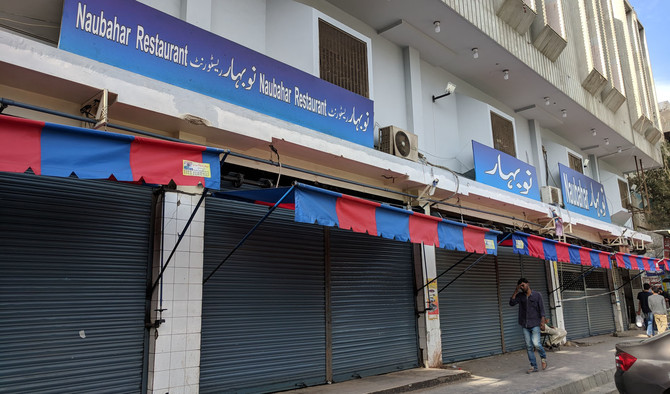
On Thursday, the family had eaten a biryani rice dish ordered from the Naubahar restaurant of the Karachi Biryani chain.
“We are still waiting for the results of samples we have collected from the eateries,” said Amjad Leghari, the director general of the Sindh Food Authority. “However we have found that the kitchens of both restaurants, the Biryani Center and its chain Naubahar, and that of the government lodges, were highly unhygienic.”


Experts say five children, aunt killed by toxic chemical gas in Karachi


Experts say five children, aunt killed by toxic chemical gas in Karachi
- Toxic gas released from pest control tablets likely the cause of death, experts say at Karachi lab
- Authorities had earlier claimed the deaths were caused by food poisoning

Pakistan launches crypto testing framework to regulate digital assets
- Regulatory ‘sandbox’ to let firms test crypto products under supervision
- Move comes amid broader push to formalize Pakistan’s digital asset sector
ISLAMABAD: Pakistan’s Virtual Assets Regulatory Authority (PVARA) on Friday launched a crypto testing framework to regulate digital assets, allowing firms to trial new products and services under official supervision.
The initiative, formally structured as a regulatory “sandbox,” creates a controlled environment where companies can test crypto-related services under the oversight of the regulator before full-scale approval.
According to PVARA, the sandbox will support real-world use cases including tokenization, stablecoins, remittances and on- and off-ramp infrastructure.
Tokenization refers to converting real-world assets into digital tokens on a blockchain, while stablecoins are cryptocurrencies pegged to a fiat currency to maintain a stable value. On- and off-ramp infrastructure allows users to convert between fiat money and digital assets, enabling the practical use of virtual asset products.
“The Pakistan Virtual Assets Regulatory Authority has formally approved and launched its Regulatory Sandbox for virtual assets,” PVARA said in a post on X. “Sandbox Guidelines and the application process will be published shortly on our website.”
The move comes as the government seeks to build a formal regulatory framework for digital assets while attracting investment and strengthening oversight of the sector.
Pakistan has stepped up efforts recently to regulate its digital asset sector and is exploring digital currency initiatives as part of broader measures to reduce cash usage.
In January, Pakistan signed a memorandum of understanding with a company affiliated with World Liberty Financial, a crypto-based finance platform launched in September 2024 and linked to US President Donald Trump’s family to explore the use of a dollar-linked stablecoin for cross-border payments.