

Yemen’s Houthis to quit two ports Monday under peace deal

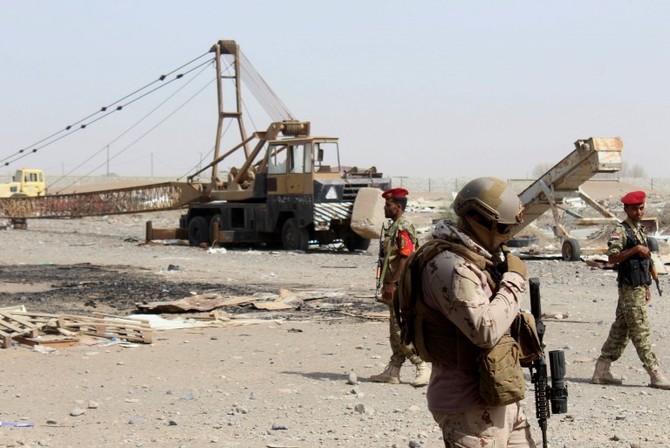
The Red Sea Mills contain grains that feed 30 million Yemenis. Above, soldiers aligned with the coalition stand outside a damaged warehouse belonging to the Red Sea Mills. (AFP/File)
Updated 24 February 2019
Follow

Yemen’s Houthis to quit two ports Monday under peace deal

  • The parties have been unable to decide who will control the Red Sea Mills
  • The Yemeni government said they need to verify the Houthi redeployment before moving to step two

DUBAI: Iranian-aligned Houthi forces have agreed to draw back from two Yemeni ports on Monday while withdrawal from the main Hodeidah port will occur later alongside a retreat by coalition-backed forces massed outside the city, UN and Yemeni sources said.

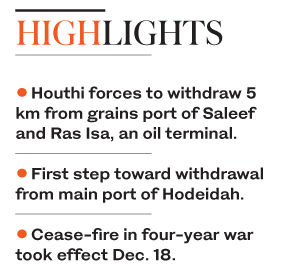
Houthi forces will withdraw 5 km from the ports of Saleef, used for grain, and Ras Isa, an oil terminal, as a first step agreed with the internationally recognized government, three sources said.

The Houthi withdrawal from Hodeidah port and the pull-back by coalition forces 1 km away from the city’s “Kilo 7” eastern suburb would take place as a second step, they said.

An orderly troop withdrawal from Hodeidah, now a focus of an almost four-year war, is key to UN-led efforts to avert a full-scale assault on the port and pave the way for political negotiations.

The conflict has killed tens of thousands of people and pushed Yemen to the brink of famine.

The United Nations has been trying to salvage a truce deal agreed at peace talks in December between the Houthis and the Saudi-backed government. That process has stalled over who would control of Hodeidah, a Red Sea port used to feed Yemen’s 30 million people.
Hodeidah is held by the Houthis while other Yemeni forces backed by the Saudi-led coalition loyal to ousted President Abd-Rabbu Mansour Hadi are positioned on the edges of the city.

Hadi’s top negotiator, Foreign Minister Khalid Al-Yamani, said the initial Houthi redeployment must be verified before further progress can be made and humanitarian corridors reopened.

“This is what was agreed by the Yemeni government: we verify the first step before implementing the second,” he told Asharq Al-Awsat newspaper in remarks published on Sunday.

A small team of UN observers arrived in Hodeidah after the cease-fire went into effect on Dec. 18 to oversee troop redeployments by both sides.

The deal calls for local authorities to assume control of Hodeidah but did not detail the process, leaving it open to interpretation.

The Western-backed Sunni Muslim coalition led by Saudi Arabia and the United Arab Emirates intervened in Yemen in 2015 to try to restore Hadi’s government after it was ousted from power in the capital Sanaa in late 2014.

The conflict, widely seen in the region as a proxy war between Saudi Arabia and Iran, has been locked in military stalemate.

The Houthis, who say their revolution is against corruption, control most urban centers including Sanaa. Hadi’s government holds the southern port of Aden and a string of coastal towns.


Fledgling radio station aims to be ‘voice of the people’ in Gaza

Updated 15 February 2026
Follow

Fledgling radio station aims to be ‘voice of the people’ in Gaza

  • The electricity crisis is one of the most serious and difficult problems in the Gaza Strip, says Shereen Khalifa Broadcaster

DEIR EL-BALAH: From a small studio in the central city of Deir El-Balah, Sylvia Hassan’s voice echoes across the Gaza Strip, broadcast on one of the Palestinian territory’s first radio stations to hit the airwaves after two years of war.

Hassan, a radio host on fledgling station “Here Gaza,” delivers her broadcast from a well-lit room, as members of the technical team check levels and mix backing tracks on a sound deck. “This radio station was a dream we worked to achieve for many long months and sometimes without sleep,” Hassan said.

“It was a challenge for us, and a story of resilience.”

Hassan said the station would focus on social issues and the humanitarian situation in Gaza, which remains grave in the territory despite a US-brokered ceasefire between Israel and Hamas since October.

“The radio station’s goal is to be the voice of the people in the Gaza Strip and to express their problems and suffering, especially after the war,” said Shereen Khalifa, part of the broadcasting team.

“There are many issues that people need to voice.” Most of Gaza’s population of more than 2 million people were displaced at least once during the gruelling war.

Many still live in tents with little or no sanitation.

The war also decimated Gaza’s telecommunications and electricity infrastructure, compounding the challenges in reviving the territory’s local media landscape. “The electricity problem is one of the most serious and difficult problems in the Gaza Strip,” said Khalifa.

“We have solar power, but sometimes it doesn’t work well, so we have to rely on an external generator,” she added.

The station’s launch is funded by the EU and overseen by Filastiniyat, an organization that supports Palestinian women journalists, and the media center at the An-Najah National University in Nablus, in the occupied West Bank.

The station plans to broadcast for two hours per day from Gaza and for longer from Nablus. It is available on FM and online.

Khalifa said that stable internet access had been one of the biggest obstacles in setting up the station, but that it was now broadcasting uninterrupted audio.

The Gaza Strip, a tiny territory surrounded by Israel, Egypt, and the Mediterranean Sea, has been under Israeli blockade even before the attack on Oct. 7, 2023, which sparked the war. Despite the ceasefire, Israel continues to strictly control the entry of all goods and people to the territory.

“Under the siege, it is natural that modern equipment necessary for radio broadcasting cannot enter, so we have made the most of what is available,” she said.