

Family of Pakistani inmate killed in Indian jail appeals to Pope Francis

1 / 3
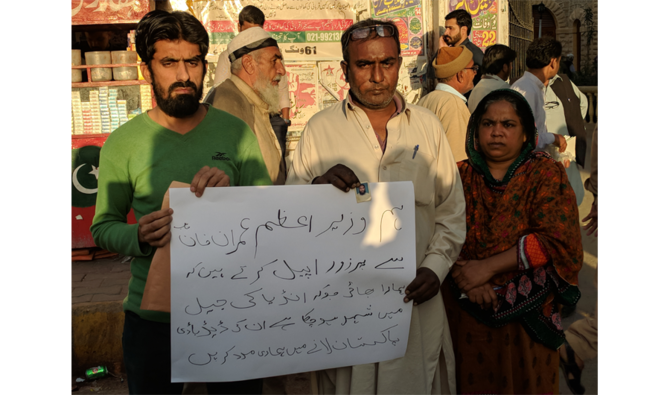
Shehzad Gulfam, flanked by his wife Rubina Shehzad, is speaking to Arab News here on Thursday, February 21, 2019 (AN Photo)
2 / 3
Shehzad Gulfam and his wife Rubina Shehzad are protesting outside Karachi press Club here on Thursday, February 21, 2019 (AN Photo)
3 / 3
Shehzad Gulfam is holding photo of his bother Shakirullah (AN Photo)
Updated 22 February 2019
Follow

Family of Pakistani inmate killed in Indian jail appeals to Pope Francis

  • Urges Pakistani prime minister to help get Shakirullah’s body from India
  • Shakirullah was serving a life sentence in India’s Jaipur Central Jail 

KARACHI: The brother of a Pakistani prisoner killed this week in a jail in neighbouring India said on Friday the family had appealed to Pope Francis to help bring the killers of their brother to justice. 

Pakistan’s foreign office said Pakistani inmate Shakirullah, 47, had died at the Jaipur Central Jail on Wednesday after a “scuffle” with Indian inmates. 

The news of his death comes amid escalating tensions between arch-rivals Pakistan and India over a suicide bombing last week in the disputed Kashmir region in which at least 40 Indian troopers were killed. Jaish-e-Muhammed, a group said to be based in Pakistan, accepted responsibility for the attack. India says the group has the Pakistani state’s backing but Islamabad denies any complicity. 
Media carried varying reports of when Shakirullah was arrested and what he was charged with but his family said he had been missing since 2003 and was innocent. The Pakistani foreign office did not provide any details of India’s charges against Shakirullah. The BBC reported that he was believed to have been an operative of Lashkar-e-Taiba, the group India blames for attacks in Mumbai in 2008 in which 166 people perished. 
“We appeal to the Pope to help us,” Shakirullah’s brother Shehzad Gulfam told Arab News. He also urged Pakistani Prime Minister Imran Khan to “take personal interest in getting us the dead body of our brother.”
Shakirullah’s family, from Jessarwala village on the outskirts of the central Pakistani city of Sialkot, belongs to the Christian minority faith. Shakirullah had converted to Islam, according to his brother, and his Christian name was Shakir Jalil. 

Gulfam said Shakirullah had a history of mental illness and had disappeared once before as a child while the family was visiting relatives in Karachi. He had returned home but in 2003, he went missing again and the family did not know about his whereabouts until they learnt about his death through media reports. 

Gulfam could not explain why the family had never filed a police report about their missing family member. 

“We had no clue; I searched for him in all nearby villages but in vain,” Gulfam said. “But when I saw his photo on news channels, I came to know that he had actually crossed the border and was languishing in jail in India.”

He conjectured that Shakirullah might have travelled with friends to a shrine on the Pakistan-India border and “probably mistakenly crossed the border.” 

There are an estimated 357 Pakistanis in Indian jails, according to a report submitted by the ministry for foreign affairs to the Pakistani Supreme Court last year. Many Pakistanis and Indians inadvertently cross the border each year and have to endure long ordeals in the absence of a mechanism aimed at ensuring their early return.

“We played together during our childhood, we grew up together and spent a long time together before he went missing sixteen years ago,” said Gulfam, who has since shifted with his family from Sialkot to the port city of Karachi. “I’m dead sure he cannot fight with anyone,” he added, referring to claims by Indian authorities that Shakirullah had been killed in a fight with inmates.

Instead, Gulfam said he was sure the killing was in “revenge” for last week’s suicide attack in disputed Kashmir which India has blamed on Pakistan. 

Human rights activist Ansar Burney said his organization, the Ansar Burney Trust International, had sent letters to the governments of India and Pakistan to ensure that Shakirullah’s body was delivered to his relatives at the “earliest.”
“Whether it’s the result of scuffle or deliberate attack on the prisoner, it was responsibility of the authorities to protect the life of a prisoner,” Burney told Arab News. “The government of India shouldn’t only ensure earliest transfer of the dead body, take firm action against those involved in the murder but also pay compensation to the family of deceased.”

In his letter to the Indian government, Burney requested that “necessary directions may also be issued to facilitate the transportation of dead body of deceased Shakirullah back to Pakistan to be buried in his homeland at the hand of his family, for as soon as possible.”

Gulfam said no one from the Pakistan government had as yet contacted the family with information about his brother. “We only ask for his body to be returned,” he said, “He was like my son. I could not see him while he was alive; at least I should be allowed to see his dead body.”
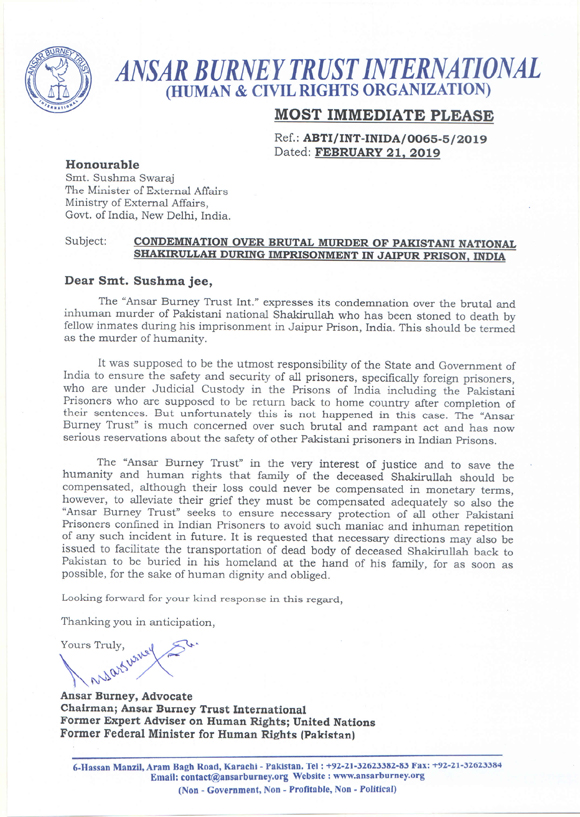


Ansar Burney trust’s letter to Indian Minister of External Affairs Sushma Swaraj
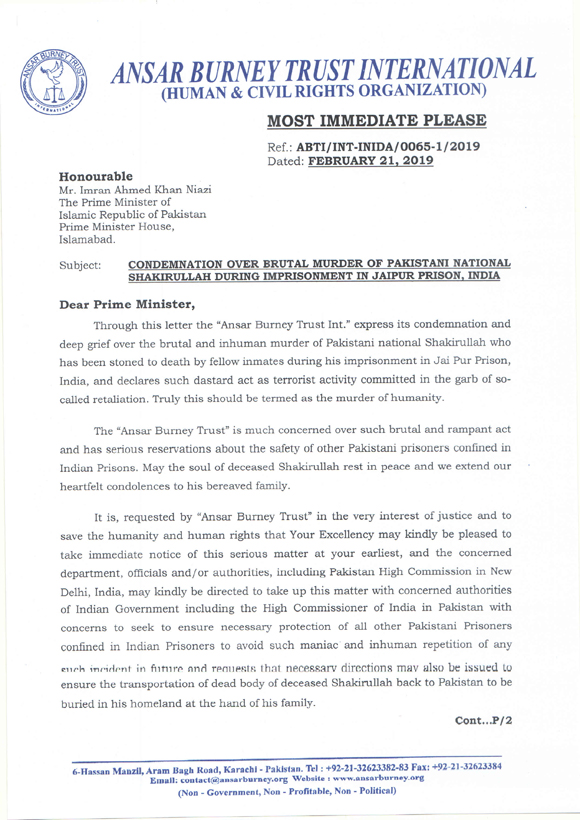


Ansar Burney trust’s letter to PM Imran Khan
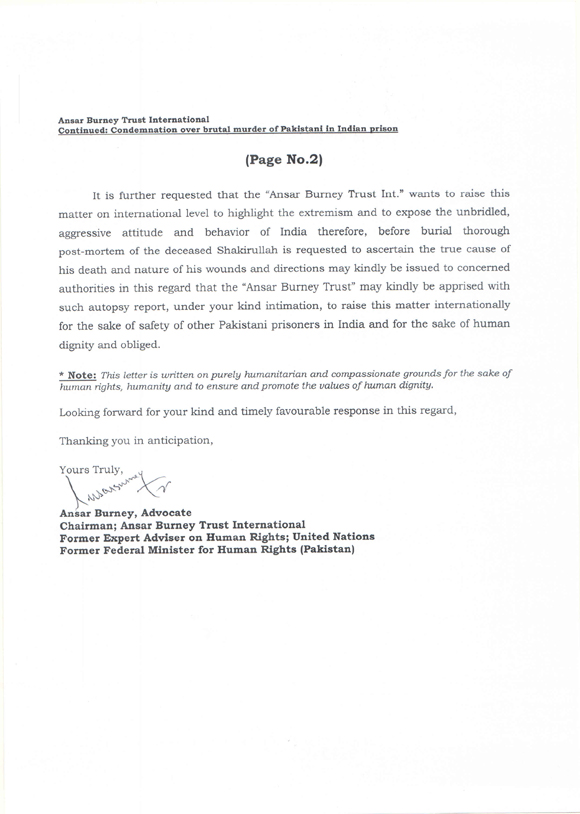


Ansar Burney trust’s letter to PM Imran Khan (Page 2)


Pakistan showcases fiscal turnaround, reform agenda at Saudi-hosted AlUla forum

Updated 6 sec ago
Follow

Pakistan showcases fiscal turnaround, reform agenda at Saudi-hosted AlUla forum

  • Pakistan has delivered successive primary surpluses and reduced its fiscal deficit from around 8 percent of GDP to approximately 5.4 percent
  • Muhammad Aurangzeb says fiscal space created through consolidation, reforms is being directed toward priority growth-enabling sectors

KARACHI: Finance Minister Muhammad Aurangzeb on Monday highlighted Pakistan’s recent fiscal progress, ongoing reforms and strategy to build buffers while sustaining growth at the AlUla Conference for Emerging Market Economies, underscoring the importance of institutional strengthening in navigating economic and climate-related shocks.

The second edition of the annual AlUla conference was launched by the Saudi Arabia’s Ministry of Finance and the International Monetary Fund (IMF) on Sunday. The conference brings together economic decision-makers, finance ministers, central bank governors, leaders of international financial institutions and a select group of experts and specialists from around the world.

Pakistan, which nearly defaulted on its foreign debt obligations in 2023, is currently making efforts to stabilize its economy under a $7 billion International Monetary Fund (IMF) program. The program, agreed in Sept. 2024, accompanied reforms such as privatization of loss-making, state-owned enterprises (SOEs), tax regime overhaul and ending various subsidies for fiscal consolidation.

Attending a high-level panel discussion “Fiscal Policy in a Shock‑Prone World” on the 2nd day of the AlUla Conference, Aurangzeb shared Pakistan’s experience in managing structural constraints, strengthening revenue mobilization, reducing debt vulnerabilities, and responding to shocks while protecting priority development spending.

“Pakistan’s fiscal strategy has been shaped by a history of boom-and-bust cycles, persistent structural deficits, high debt levels, and limited fiscal space,” he said, stressing that it has been critical to carefully safeguard the fiscal progress achieved over the past two to three years.

“Pakistan has delivered successive primary surpluses and reduced its fiscal deficit from around 8 percent of GDP (gross domestic product) to approximately 5.4 percent, with the current trajectory pointing toward a further reduction below five percent.”

This year’s conference highlighted the rapid transformations in the global economy and challenges and the opportunities they presented for emerging market economies, particularly in international trade, monetary and financial systems.

Aurangzeb stressed the discussion around fiscal buffers is not academic for Pakistan but rooted in lived experience as a climate-vulnerable country.

Recalling the catastrophic floods of 2022, he noted that Pakistan was forced to make an immediate international appeal even for rescue and relief operations. In contrast, he said, the country was able to mobilize its own resources despite limited fiscal space during the large-scale floods affecting multiple provinces and river systems this year, demonstrating the practical value of rebuilding fiscal buffers to absorb exogenous shocks.

On the revenue side, he outlined sustained efforts to expand the tax base and strengthen compliance.

“Pakistan’s tax-to-GDP ratio has risen from below 10 percent to close to 12 percent,” the minister said, highlighting the transformation of the tax authority through reforms in people, processes and technology, including the use of AI-led production monitoring systems across various sectors to improve enforcement, curb leakages and reduce corruption by minimizing human intervention.

“The tax policy function has been separated from tax collection and placed within the Ministry of Finance to ensure that budgetary decisions are guided by economic value and policy considerations rather than purely arithmetic targets, while maintaining overall fiscal discipline.”

About expenditure management, the finance minister noted that Pakistan’s federal structure adds complexity, requiring close coordination between the federation and provinces. He shared that a national fiscal framework has been agreed upon and that work is ongoing to strengthen fiscal coordination and discipline across all tiers of government.

“Pakistan’s debt-to-GDP ratio, which had reached around 74 percent, has been reduced to approximately 70 percent,” he said, underscoring ongoing domestic liability management operations aimed at lowering debt servicing costs, which remain the single largest expenditure item in the budget.

“Continued fiscal discipline would further ease debt pressures and help create additional fiscal space.”

Pakistan faced a prolonged economic crisis in recent years, marked by fiscal pressure, high debt levels and balance-of-payments difficulties. Officials now say that decreasing levels of inflation and higher foreign exchange reserves reflect the government’s prudent fiscal policies and debt management.

“The fiscal space created through consolidation and reforms is being directed toward priority growth-enabling sectors, including human capital development, agriculture, information technology, and other areas with strong growth potential,” Aurangzeb said, adding that rebuilding buffers, dampening pro-cyclicality, and sustaining growth require persistence, institutional reform and disciplined policymaking, particularly for countries facing repeated structural and climate-related shocks.