JEDDAH: The number of nationals working in the retail sector has risen to 260,000 and 48 percent of them are women, according to data issued by the General Authority for Statistics.
Around 44,000 Saudis joined the sales sector between the end of the first quarter of 2017 and the end of 2018’s third quarter, representing an increase of around 20 percent.
A labor market bulletin said the total number of sales staff in the Kingdom was 537,281, of which 48.4 percent were Saudis. The remaining workers were foreigners.
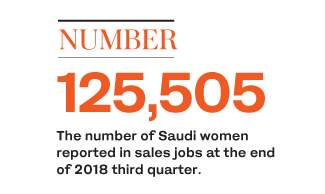
The bulletin also said that the number of Saudi women in sales was 125,505 by the end of 2018’s third quarter, giving them a 48 percent market share of the national workforce in this sector.
The total number of male Saudis in sales increased by 15 percent to 134,692 by the end of the third quarter of 2018, from 116,589 at the end of the first quarter of 2017.
Earlier this year, the Ministry of Labor and Social Development announced it would be providing Saudis with job opportunities in an attempt to reduce unemployment, especially in sales roles, the Saudi Press Agency reported.

Saudi women now occupy nearly half of retail jobs, says report
- The total number of male Saudis in sales increased by 15 percent to 134,692 by the end of the third quarter of 2018, from 116,589 at the end of the first quarter of 2017
Children’s Theater Festival opens in Qassim region
- To develop future ‘cultural architects,’ says CEO Khaled Al-Baz
- ‘Nurture creativity, aesthetic awareness and sense of belonging’
BURAIDAH: The Qassim Children’s Theater Festival opened on Tuesday bringing together professionals from across Saudi Arabia and the Gulf.
The event is being held under the patronage of Prince Dr. Faisal bin Mishaal bin Saud bin Abdulaziz, governor of Qassim, at the Science Center in Unaizah governorate.
It has been Organized by the Theater and Performing Arts Association and executed by the Unaizah Theater Association, the Saudi Press Agency reported.
Running until Jan. 31, it features shows, panel discussions, as well as training workshops to develop children’s theater and strengthen professional skills in the field.
Khaled Al-Baz, CEO of the Theater and Performing Arts Association, told the SPA the festival forms part of a broader strategy to position children’s theater as a distinct cultural sector.
“Children today constitute genuine audiences — tomorrow’s cultural architects,” Al-Baz said.
Ahmed Al-Humaimidi, president of the Unaizah Theater Association, said it was an investment in young people, noting that it extends beyond performances to include cultural and educational programming.
He said the initiative aims to nurture creativity, aesthetic awareness and a sense of belonging, while also identifying emerging talent and encouraging knowledge exchange among theater practitioners.
“Our association recognizes children’s theater as foundational to cultivating aware, creative character,” he said.
The festival serves as both an artistic showcase and a platform for professional dialogue, reflecting the Kingdom’s expanding cultural landscape and growing focus on children’s theater as an educational and cultural tool, the SPA noted.
This occurs alongside support for signature initiatives and performing arts promotion as quality-of-life enhancement.