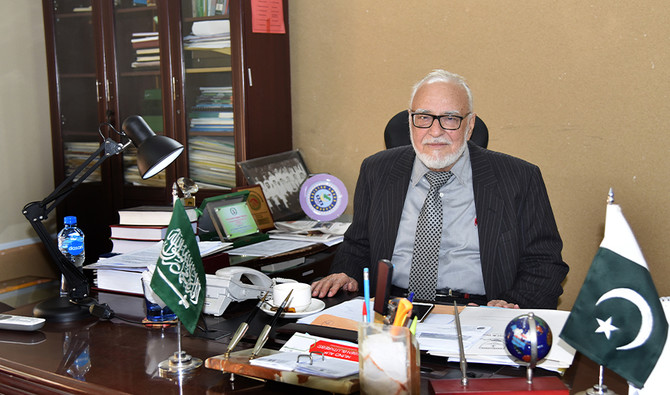

ISLAMABAD: In 1986, Dr. Ghulam Akbar Khan Niazi was serving as the head of the King Khalid National Guard Hospital in Jeddah when he had the honour of receiving Princess Diana and Prince Charles at the facility.
As Niazi toured the hospital with the royal couple and gave briefings and attended functions, many Saudi doctors and officials were miffed that a non-national was not just heading the prestigious institute but had also gotten the opportunity to host Diana and Charles.
The complaint, Niazi told Arab News in a wide-ranging interview in January, was forwarded to then Crown Prince Prince Abdullah Bin Abdul Aziz, who in 2005 would become King of Saudi Arabia and the Custodian of the Two Holy Mosques.
"One fine morning, Crown prince Abdullah summoned me in the royal court,” octogenarian Niazi said in an interview in his office on the outskirts of Islamabad. “I was frightened thinking that I may have committed a blunder.”
But to his surprise the crown prince asked: “You have been living here for so many years, why shouldn't I grant you nationality of Saudi Arabia?"
“This was indeed a pleasant surprise for me and I bowed my head to express consent,” Niazi said. “He granted me the nationality, saying ‘Go and serve my people as a Saudi citizen and nobody now will call you a foreigner or a non-Saudi national’.”
Niazi was hired as a doctor in Saudi Arabia, along with several other Pakistani doctors, on a two year-contract in 1963. Later, Prince Abdullah appointed him to the medical services team of the Saudi National Guards.
“I was the first ever Pakistani doctor to have the honour to serve with Prince Abdullah Bin Abdul Aziz in the National Guards,” Niazi said. “When Prince Abdullah was elevated to King, he took me along with him as a family doctor.”
Niazi returned to Pakistan in 1997 with King Abdullah’s permission and opened a private medical college, the Islamabad Medical and Dental College, on “the advice of King Abdullah”.
He described King Abdullah as a “kind-hearted” man who was deeply invested in the progress and unity of the Muslim world, as was visible in his efforts to develop education and healthcare across the Muslim world by giving generous grants and scholarships.
“King Abdullah was one of the best friends and well-wishers of Pakistan,” Niazi said, adding that the Kingdom had always stood by Pakistan in difficult times, whether it was during wars with archrival India or natural disasters such as flash floods and earthquakes. The Kingdom, he said, had also granted financial support to Pakistan in the form of cash and oil on deferred payments after the United States imposed sanctions on the country after it tested nuclear weapons in May 1998.
“It is a historic fact that all kings and princes of Saudi Arabia have been well-wishers of Pakistan and contributed generously toward its prosperity and progress,” Niazi said.
Commenting on the upcoming visit of Saudi Crown Prince Mohammed Bin Salman, Niazi said the tour would further deepen strategic and economic ties between the two countries.
“Keeping in view the tradition of the Saudi rulers, I am sure the crown prince will announce some major investments in Pakistan to help the country’s fragile economy,” he said.