

King Abdullah’s first Pakistani doctor says bilateral ties in the pink of health

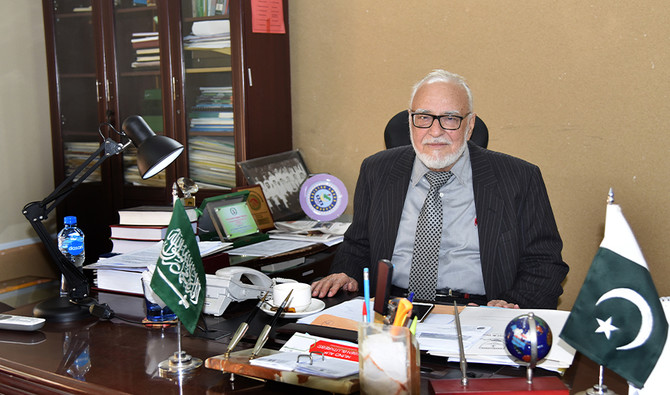
Dr. Ghulam Akbar Khan Niazi, who served as director of Saudi National Guards medical services western wing, says that Saudi Arabia has been a time tested friend of Pakistan and has played important role in progress of the Islamic Republic. (AN Photo)
Updated 17 February 2019
Follow

King Abdullah’s first Pakistani doctor says bilateral ties in the pink of health

  • Arab News interviews Dr. Niazi about his experience working in Saudi Arabia for over 30 years
  • Says crown prince’s visit will further strengthen economic and strategic relations

ISLAMABAD: In 1986, Dr. Ghulam Akbar Khan Niazi was serving as the head of the King Khalid National Guard Hospital in Jeddah when he had the honour of receiving Princess Diana and Prince Charles at the facility.

As Niazi toured the hospital with the royal couple and gave briefings and attended functions, many Saudi doctors and officials were miffed that a non-national was not just heading the prestigious institute but had also gotten the opportunity to host Diana and Charles.

The complaint, Niazi told Arab News in a wide-ranging interview in January, was forwarded to then Crown Prince Prince Abdullah Bin Abdul Aziz, who in 2005 would become King of Saudi Arabia and the Custodian of the Two Holy Mosques.

"One fine morning, Crown prince Abdullah summoned me in the royal court,” octogenarian Niazi said in an interview in his office on the outskirts of Islamabad. “I was frightened thinking that I may have committed a blunder.”

But to his surprise the crown prince asked: “You have been living here for so many years, why shouldn't I grant you nationality of Saudi Arabia?"

“This was indeed a pleasant surprise for me and I bowed my head to express consent,” Niazi said. “He granted me the nationality, saying ‘Go and serve my people as a Saudi citizen and nobody now will call you a foreigner or a non-Saudi national’.”

Niazi was hired as a doctor in Saudi Arabia, along with several other Pakistani doctors, on a two year-contract in 1963. Later, Prince Abdullah appointed him to the medical services team of the Saudi National Guards.

“I was the first ever Pakistani doctor to have the honour to serve with Prince Abdullah Bin Abdul Aziz in the National Guards,” Niazi said. “When Prince Abdullah was elevated to King, he took me along with him as a family doctor.”

Niazi returned to Pakistan in 1997 with King Abdullah’s permission and opened a private medical college, the Islamabad Medical and Dental College, on “the advice of King Abdullah”.

He described King Abdullah as a “kind-hearted” man who was deeply invested in the progress and unity of the Muslim world, as was visible in his efforts to develop education and healthcare across the Muslim world by giving generous grants and scholarships. 

“King Abdullah was one of the best friends and well-wishers of Pakistan,” Niazi said, adding that the Kingdom had always stood by Pakistan in difficult times, whether it was during wars with archrival India or natural disasters such as flash floods and earthquakes. The Kingdom, he said, had also granted financial support to Pakistan in the form of cash and oil on deferred payments after the United States imposed sanctions on the country after it tested nuclear weapons in May 1998.

“It is a historic fact that all kings and princes of Saudi Arabia have been well-wishers of Pakistan and contributed generously toward its prosperity and progress,” Niazi said.

Commenting on the upcoming visit of Saudi Crown Prince Mohammed Bin Salman, Niazi said the tour would further deepen strategic and economic ties between the two countries.

“Keeping in view the tradition of the Saudi rulers, I am sure the crown prince will announce some major investments in Pakistan to help the country’s fragile economy,” he said.


Pakistan to launch AI screening in January to target fake visas, agent networks

Updated 05 December 2025
Follow

Pakistan to launch AI screening in January to target fake visas, agent networks

  • New system to flag forged-document travelers before boarding and pre-verify eligibility
  • Move comes amid increasing concern over fake visas, fraudulent agents, forged papers

ISLAMABAD: Pakistan will roll out an AI-based immigration screening system in Islamabad from January to detect forged documents and prevent illegal overseas travel, the government said on Thursday. 

The move comes amid increasing concern over fake visas, fraudulent agents and forged papers, with officials warning that such activity has contributed to deportations, human smuggling and reputational damage abroad. Pakistan has also faced scrutiny over irregular migration flows and labor-market vulnerability, particularly in the Gulf region, prompting calls for more reliable pre-departure checks and digital verification.

The reforms include plans to make the protector-stamp system — the clearance required for Pakistani citizens seeking overseas employment — “foolproof”, tighten labor-visa documentation, and cancel the passports of deportees to prevent them from securing visas again. The government has sought final recommendations within seven days, signalling a rapid enforcement timeline.

“To stop illegal immigration, an AI-based app pilot project is being launched in Islamabad from January,” Interior Minister Mohsin Naqvi said following a high-level meeting chaired by him and Minister for Overseas Pakistanis Chaudhry Salik Hussain.

Naqvi said the new screening technology is intended to determine travelers’ eligibility in advance, reducing airport off-loads and closing loopholes exploited by traffickers and unregistered agents.

The interior minister added that Pakistan remains in contact with foreign governments to improve the global perception and ranking of the green passport, while a uniform international driving license will be issued through the National Police Bureau.

The meeting also approved zero-tolerance measures against fraudulent visa brokers, while the Overseas Pakistanis Ministry pledged full cooperation to streamline the emigration workflow. Minister Hussain said transparency in the protector process has become a “basic requirement,” particularly for labor-migration cases.

Pakistan’s current immigration system has long struggled with document fraud, with repeated cases of passengers grounded at airports due to forged papers or agent-facilitated travel. The launch of an AI screening layer, if implemented effectively, could shift the burden from manual counters to pre-flight verification, allowing authorities to identify risk profiles before departure rather than after arrival abroad.

The reforms also come at a moment when labor mobility is tightening globally. Gulf states have begun demanding greater documentation assurance for imported labor, while European and Asian destinations have increased scrutiny following trafficking arrests and irregular-entry routes from South Asia. For Pakistan, preventing fraudulent departures is increasingly linked to protecting genuine workers, reducing deportation cycles and stabilizing the country’s overseas employment footprint.