SATTAHIP, Thailand: With weapons drawn camouflaged troops leapt out of amphibious assault craft while explosions sounded and parachutists glided in from above as the annual Cobra Gold war games took over a placid Thai beach Saturday.
Now in its 38th year, Cobra Gold is one of the largest military exercises in Asia, bringing thousands of forces from the United States, Thailand and other countries together for 11 days of training on Thai shores.
This year’s drill includes some 2,000 US Marines, 1,000 US soldiers and hundreds from the country’s Navy and Air Force.
On Saturday US, Thai and South Korean forces descended on Namsai beach in Chonburi province in a joint drill intended to simulate securing the territory.
Captain Melvin Spiese said the goal was to “bring power from ship to shore” and be ready for “any kind of future crisis we might need to respond to with our Thai counterparts.”
Helicopters buzzed overhead and fighter jets roared across the skies.
Cobra Gold exercises span air, land and sea and feature a jungle survivalist session where participants take turns drinking blood from a severed cobra and snacking on insects and scorpions.
Singapore, Japan, Indonesia and Malaysia also took part in the war games.
A 2014 army coup in Thailand tested ties with Washington and the kingdom tilted towards China with high-profile arms buys.
But US military sales continued and the two countries have upped their engagement under US President Donald Trump, who has stepped back on human rights issues and invited junta chief Prayut Chan-O-Cha to the White House.
Prayut, who led the 2014 coup, is standing for prime minister in elections set for March 24.


Cobra Gold: One of Asia’s largest war drills opens in Thailand

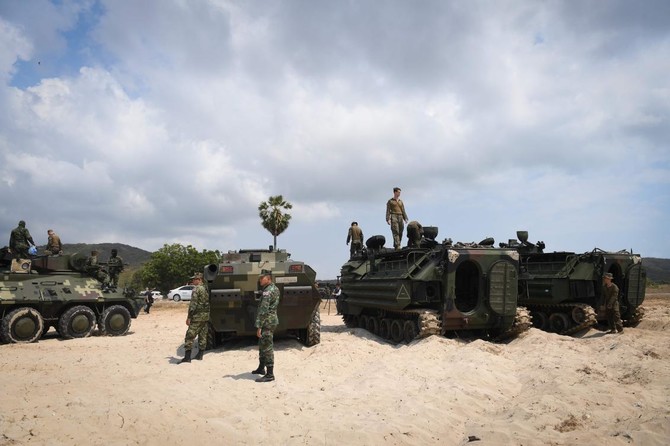
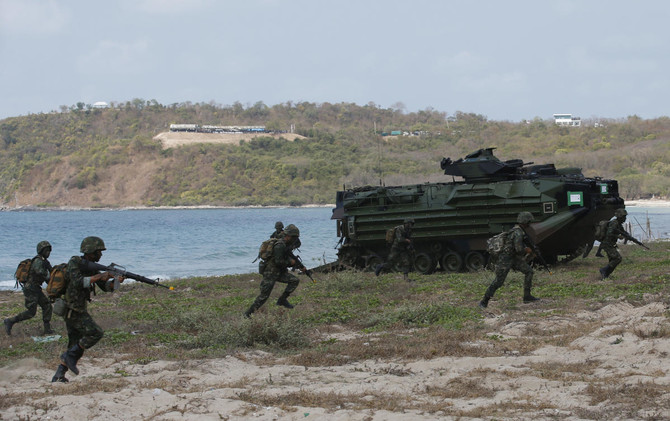
Cobra Gold: One of Asia’s largest war drills opens in Thailand
- Cobra Gold is one of the largest military exercises in Asia
- On Saturday US, Thai and South Korean forces descended on Namsai beach in Chonburi province in a joint drill intended to simulate securing the territory


UNICEF warns of rise in sexual deepfakes of children
- The findings underscored the use of “nudification” tools, which digitally alter or remove clothing to create sexualized images
UNITED NATIONS, United States: The UN children’s agency on Wednesday highlighted a rapid rise in the use of artificial intelligence to create sexually explicit images of children, warning of real harm to young victims caused by the deepfakes.
According to a UNICEF-led investigation in 11 countries, at least 1.2 million children said their images were manipulated into sexually explicit deepfakes — in some countries at a rate equivalent to “one child in a typical classroom” of 25 students.
The findings underscored the use of “nudification” tools, which digitally alter or remove clothing to create sexualized images.
“We must be clear. Sexualized images of children generated or manipulated using AI tools are child sexual abuse material,” UNICEF said in a statement.
“Deepfake abuse is abuse, and there is nothing fake about the harm it causes.”
The agency criticized AI developers for creating tools without proper safeguards.
“The risks can be compounded when generative AI tools are embedded directly into social media platforms where manipulated images spread rapidly,” UNICEF said.
Elon Musk’s AI chatbot Grok has been hit with bans and investigations in several countries for allowing users to create and share sexualized pictures of women and children using simple text prompts.
UNICEF’s study found that children are increasingly aware of deepfakes.
“In some of the study countries, up to two-thirds of children said they worry that AI could be used to create fake sexual images or videos. Levels of concern vary widely between countries, underscoring the urgent need for stronger awareness, prevention, and protection measures,” the agency said.
UNICEF urged “robust guardrails” for AI chatbots, as well as moves by digital companies to prevent the circulation of deepfakes, not just the removal of offending images after they have already been shared.
Legislation is also needed across all countries to expand definitions of child sexual abuse material to include AI-generated imagery, it said.
The countries included in the study were Armenia, Brazil, Colombia, Dominican Republic, Mexico, Montenegro, Morocco, North Macedonia, Pakistan, Serbia, and Tunisia.


