Khyber Pakhtunkhwa excited about Saudi crown prince’s Pakistan visit

1 / 5
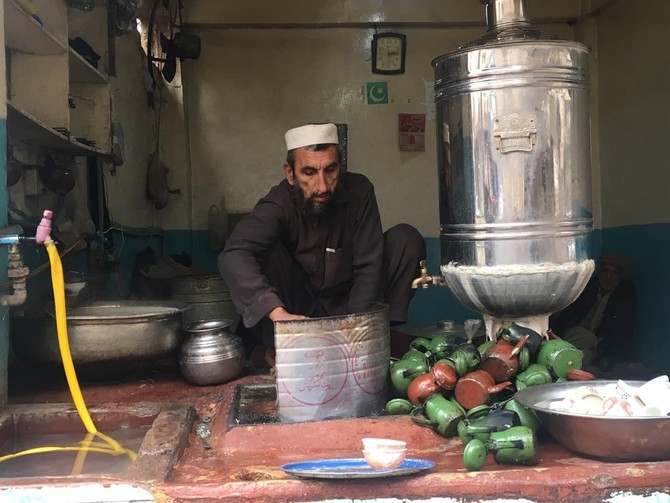
Jalal, a tea stall owner, expects the dawn of a new era of economic and cultural relations between KSA and Pakistan with the upcoming visit of Saudi’s crown prince to the country. (AN photo)
2 / 5
Syed Bacha has spent more than three decades in KSA and now runs his own barber shop in Peshawar. He believes that the relations between the two countries will be stronger going forward. (AN photo)
3 / 5
Rickshaw driver Amjad Khan expects Saudi Crown Prince Mohammed bin Salman to extend further support to Prime Minister Imran Khan’s government. (AN photo)
4 / 5
KSA and Pakistan share many cultural and Islamic values. These should be stronger for the future generations, Jalal said. (AN photo)
5 / 5
A dry fruit vendor, Anwar Shah, said that Saudi Arabia is a highly-revered place by Pakistanis and the royal’s visit is a moment of pride for the country. (AN photo)
Updated 16 February 2019
Follow

Khyber Pakhtunkhwa excited about Saudi crown prince’s Pakistan visit

  • Pakistanisl who once lived in the Gulf country nostalgically recall their time in the Kingdom
  • Crown Prince Mohammed bin Salman's visit seen as a step toward greater economic and defense relations

PESHAWAR: The stage is set, as are the residents of Pakistan, for the historic visit of Saudi Arabia’s Crown Prince Mohammed bin Salman on February 16.

Syed Jalal, a 57-year-old tea stall owner in Peshawar’s busy Super Market termed the visit as the beginning of a new era of mutual trust. “The relationship between Pakistan and KSA has been colorless in the past few years,” he said, adding that the new government wants “respectable, cordial and brotherly relations with the most important and sacred Saudi Arabian government.”

A thought that was echoed by other returnees from the Gulf country.

Rickshaw driver Amjad Khan, 30, has few years of experience working in Saudi Arabia which he described as the best of his life. “I was a laborer in Pakistan but earned enough in Saudi Arabia to own three rickshaws and feed my family without any difficulty,” he said. 

Thousands of Pakistanis work in the health, education, construction and other developmental sectors of the Kingdom. According to the Bureau of Emigration and Overseas Employment website, in December last year, 1,00,091 Pakistanis were employed in various sectors of the country.

In January this year, overseas Pakistanis contributed $403.92 million in remittances, as per statistics revealed by the State Bank of Pakistan. Remittances from KSA are the highest followed by those from the UAE, UK and the US. 

For decades, the Saudi government has assisted Pakistan and its people in the worst of its times, Khan said, adding that this time, too, the crown prince’s visit was “to support Imran Khan’s government in this bad spell.”

“Imran Khan wants to get rid of it’s dependency on the Americans and the International Monetary Fund (IMF) and the crown prince’s visit is a step toward greater economic and defense relations,” Anwar Shah, a dry fruit vendor, said, adding that the “Pakistani people would be in the front line, if any country dares a misadventure against Saudi Arabia”.

“Narrowing the gap between Arab countries and Pakistan is much needed now, the moderate crown prince would knot both nations accurately this time”, fruits vendor Iqbal Shah, 43, stated. “We are of the same belief and share alike Islamic values and culture, lets stand with each other against enemies” he added. 

Said Bacha hails from the Khyber district of the erstwhile Federally Administered Tribal Areas (FATA) and worked for more than 30 years in KSA as a barber. “I have seen splendid rulers,” he said. “The crown prince’s visit will further strengthen the warm, friendly and affectionate relations of both the Muslim nations.”

Beside the bilateral and trade ties, a huge number of Pakistanis visit the Kingdom to perform Umrah and Hajj holy cities.


Pakistan PM gives 48 hours to draft fuel-saving plan as global oil prices surge

Updated 07 March 2026
Follow

Pakistan PM gives 48 hours to draft fuel-saving plan as global oil prices surge

  • Government warns against hoarding after sharp fuel price hike amid Middle East tensions
  • PM wants provinces to enforce anti-profiteering measures and prevent public exploitation

ISLAMABAD: Prime Minister Shehbaz Sharif has asked his administration to formulate a strategy for fuel conservation and austerity in government affairs within 48 hours after a sharp rise in global oil prices pushed the country to increase domestic fuel rates, a senior minister said on Saturday.

The directive comes a day after the government raised petrol and diesel prices by Rs55 ($0.20) per liter, citing a surge in international energy prices triggered by escalating conflict in the Middle East after Israel and the United States launched attacks on Iran. The situation has rattled global oil markets and threatened key shipping routes.

Pakistan’s Information Minister Ataullah Tarar said Sharif had instructed officials to urgently prepare a practical plan aimed at reducing fuel consumption and promoting austerity across government institutions.

“The prime minister has given 48 hours to formulate an actionable strategy on savings, austerity and simplicity in government affairs,” he said in a social media post on X.

Tarar said Finance Minister Muhammad Aurangzeb and Petroleum Minister Ali Pervaiz Malik had also been tasked with consulting the country’s four provincial chief ministers to coordinate measures against fuel hoarding and ensure strict enforcement of government directives.

He informed the ministers had been asked to ensure that speculation and profiteering in fuel markets were prevented, adding that authorities would take strict action against violators.

“The prime minister has directed that no leniency be shown to elements involved in exploiting the public,” he said, warning that licenses of those petrol pumps violating government orders could be revoked.

Tarar also urged the public not to pay attention to rumors regarding petroleum supplies or pricing, saying the government and relevant ministries would continue to release verified information as the situation evolves.

He said Pakistan was not alone in facing rising energy costs, noting that many countries were grappling with similar pressures due to volatility in global oil markets.

Pakistan relies heavily on imported fuel to meet its energy needs and is particularly vulnerable to global price shocks, which can quickly push up inflation and strain the country’s fragile external accounts.