Houthi violations of Yemen’s Hodeidah truce lead to 76 civilian deaths

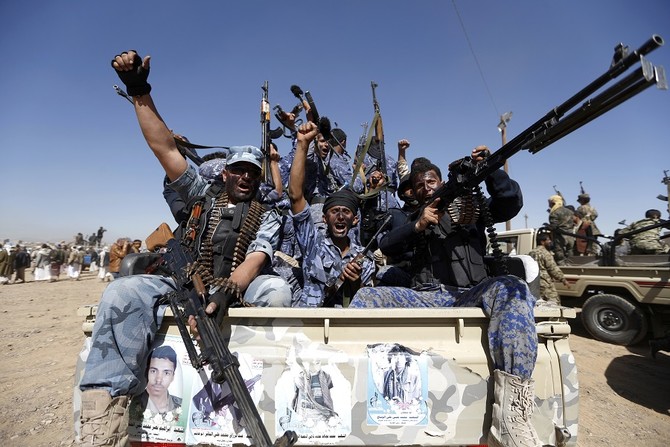
The Houthis continued to target civilian homes, public areas and army positions, using a variety of weapons. (File/AFP)
Updated 13 February 2019
Follow

Houthi violations of Yemen’s Hodeidah truce lead to 76 civilian deaths

  • The Houthis continued to target civilian homes, public areas and army positions, using a variety of weapons
  • Houthi militia have committed 1,112 violations since the Hodeidah agreement came into force on Dec. 18, 2018, leading to 76 civilian deaths and 492 injuries

DUBAI: Houthi militia have committed 1,112 violations since the Hodeidah agreement came into force on Dec. 18, 2018, leading to 76 civilian deaths and 492 injuries, according to Saudi state-news agency SPA.

The report said the Houthis continued to target civilian homes, public areas and army positions, using a variety of weapons.

The report confirmed the continued escalation of the militia’s activities, highlighting its targeting of the International Mission for the Implementation of the Stockholm Agreement, which is responsible for redeployment, and its recent targeting of United Nations mills used to store wheat, flour and other relief items.

The report added that the militia continue to strengthen their defensive positions by laying mines and digging trenches and that the militia continued to provoke the Yemeni National Army and the Yemeni Legal Support Coalition in a deliberate attempt to thwart the Stockholm agreement.


Iran unrest persists, top judge warns protesters

Updated 08 January 2026
Follow

Iran unrest persists, top judge warns protesters

  • Demonstrations sparked by soaring inflation
  • Western provinces worst affected

DUBAI: Iran’s top judge warned protesters on Wednesday there would be “no ​leniency for those who help the enemy against the Islamic Republic,” while accusing Israel and the US of pursuing hybrid methods to disrupt the country.
The current protests, the biggest wave of dissent in three years, began last month in Tehran’s Grand Bazaar by shopkeepers condemning the currency’s free fall. 
Unrest has since spread nationwide amid deepening distress over economic hardships, including rocketing inflation driven by mismanagement and Western sanctions, and curbs on political and ‌social freedoms.
“Following announcements ‌by Israel and the US president, there is no excuse for those coming ‌to the ​streets for ‌riots and unrest, chief justice Gholamhossein Mohseni Ejei, the head of Iran’s judiciary, was quoted as saying by state media.
“From now on, there will be no leniency for whoever helps the enemy against the Islamic Republic and the calm of the people,” Ejei said.
Iranian authorities have not given ‌a death toll for protesters, but have said at least two members of the security services have died and more than a dozen have been injured.
Iran’s western provinces have witnessed the most violent protests.
“During the funeral of two people ​in Malekshahi on Tuesday, a number of attendees began chanting harsh, anti-system slogans,” said Iran’s Fars, news agency.
After the funeral, Fars said, “about 100 mourners went into the city and trashed three banks ... Some started shooting at the police trying to disperse them.”
The semi-official Mehr news agency said protesters stormed a food store and emptied bags of rice, which has been affected by galloping inflation that has made ordinary staples increasingly unaffordable for many Iranians.