Looming world recession likely to hit by next year, Nobel Prize Laureate warns

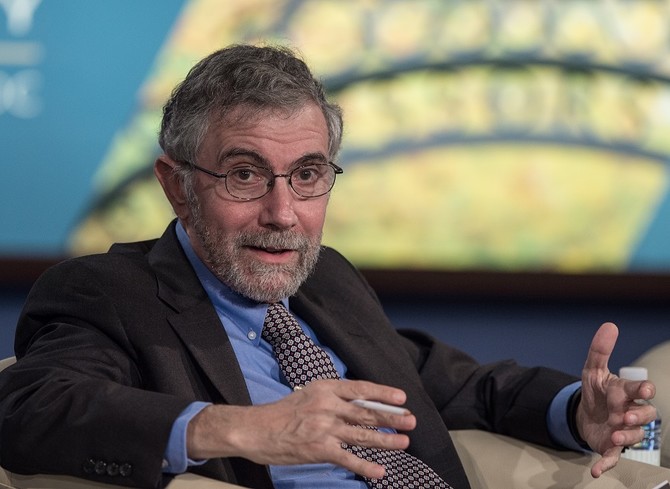
Economist Paul Krugman says recession likely by next year at the latest. (AFP/File)
Updated 12 February 2019
Follow

Looming world recession likely to hit by next year, Nobel Prize Laureate warns

  • Krugman says there is a major backlash against globalization
  • Policy makers seem unaware of the concerns voiced by people, Krugman warns

DUBAI: The world will likely enter a recession by next year as the backlash against globalization continues to grow, economist Paul Krugman predicted on Monday.

Speaking at the World Government Summit in Dubai, Krugman warned that world was witnessing a landscape of stagnant wages, growing inequalities, and a loss of confidence in the world’s business leaders which in turn led to a populist backlash against globalization.

“The result is clear: forward motion on globalization has stopped, but it was slowing anyway,” Krugman said.

And he said there is “quite a good chance that we will have a recession late this year or next year.”

He said there was a general lack of preparedness among economic policymakers.

“The main concern has always been that we don’t have an effective response if things slow down…we don’t seem to have a safety net.”

Krugman said central banks lacked the tools required to protect against market turmoil, and planning for risk has been minimal.

Instead, trade wars and growing protectionism continue to dominate policy agendas, deferring attention and resources from what should be the real priorities.

“I don’t see the iceberg out there, but if we do hit one, I know for sure this liner is not unsinkable,” Krugman said, comparing the global economy to the Titanic.

He said people felt short changed by the previous generation of economic growth, but he said those discussing a solution seemed not to be touching on the issue.

“The question is what they want as the solution…turns out that’s not as clear,” Krugman said, highlighting what he called the gap leaders needed to fill in order to avert another “Great Depression.”

On what many are calling the Fourth Industrial Revolution, Krugman warned that, contrary to popular belief “technological change is actually relatively sluggish right now.”

And he said he doubted the claims that technology was so advanced it would soon change the way we work and live, adding “this is not a transformative revolutionary era.”

Krugman concluded that despite the technological advancements of the last 25 years, the way we work “had not changed all that much.”



Saudi Arabia’s foreign reserves rise to a 6-year high of $475bn

Updated 10 sec ago
Follow

Saudi Arabia’s foreign reserves rise to a 6-year high of $475bn

RIYADH: Saudi Arabia’s foreign reserves climbed 3 percent month on month in January to SR1.78 trillion, up SR58.7 billion ($15.6 billion) from December and marking a six-year high.

On an annual basis, the Saudi Central Bank’s net foreign assets rose by 10 percent, equivalent to SR155.8 billion, according to data from the Saudi Central Bank, Argaam reported.

The reserve assets, a crucial indicator of economic stability and external financial strength, comprise several key components.

According to the central bank, also known as SAMA, the Kingdom’s reserves include foreign securities, foreign currency, and bank deposits, as well as its reserve position at the International Monetary Fund, Special Drawing Rights, and monetary gold.

The rise in reserves underscores the strength and liquidity of the Kingdom’s financial position and aligns with Saudi Arabia’s goal of strengthening its financial safety net as it advances economic diversification under Vision 2030.

The value of foreign currency reserves, which represent approximately 95 percent of the total holdings, increased by about 10 percent during January 2026 compared to the same month in 2025, reaching SR1.68 trillion.

The value of the reserve at the IMF increased by 9 percent to reach SR13.1 billion.

Meanwhile, SDRs rose by 5 percent during the period to reach SR80.5 billion.

The Kingdom’s gold reserves remained stable at SR1.62 billion, the same level it has maintained since January 2008.

Saudi Arabia’s foreign reserve assets saw a monthly rise of 5 percent in November, climbing to SR1.74 trillion, according to the Kingdom’s central bank.

Overall, the continued advancement in reserve assets highlights the strength of Saudi Arabia’s fiscal and monetary buffers. These resources support the national currency, help maintain financial system stability, and enhance the country’s ability to navigate global economic volatility.

The sustained accumulation of foreign reserves is a critical pillar of the Kingdom’s economic stability. It directly reinforces investor confidence in the riyal’s peg to the US dollar, a foundational monetary policy, by providing SAMA with ample resources to defend the currency if needed.

Furthermore, this financial buffer enhances the nation’s sovereign credit profile, lowers national borrowing costs, and provides essential fiscal space to navigate global economic volatility while continuing to fund its ambitious Vision 2030 transformation agenda.