International skiers take to the slopes in Pakistan

1 / 4
The Naltar Ski Resort has been at the heart of Pakistan’s efforts to draw winter sport tourists. (AFP)
2 / 4
Pakistan remains off-piste for most winter sports enthusiasts after years of conflict and a lack of infrastructure. (AFP)
3 / 4
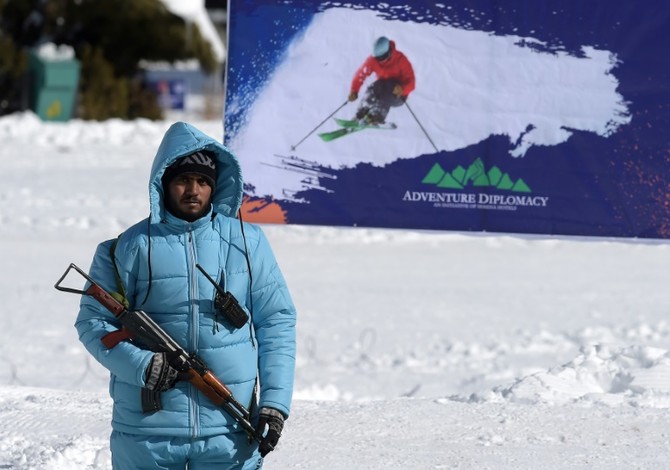
Security has dramatically improved across Pakistan following a crackdown on militant groups in recent years. (AFP)
4 / 4
Skiers at the Naltar event were hosted by the Pakistan Air Force, who own the ski resort. (AFP)
Updated 11 February 2019
Follow

International skiers take to the slopes in Pakistan

  • Pakistan boasted unrivaled ski conditions, says International Ski Federation official
  • Naltar Ski Resort attracts winter sport tourists to Pakistan

NALTAR, Pakistan: Skiers descend in long, rhythmic swoops down pristine white slopes in northern Pakistan, braking in a spray of snow as soldiers carrying semi-automatic weapons watch impassively.
Dozens of athletes took part at a rare international competition in the South Asian country, which boasts some of the world’s highest mountains but remains off-piste for most winter sports enthusiasts after years of conflict and a lack of infrastructure.
Nestled in the Karakoram mountain range, the Naltar Ski Resort has been at the heart of Pakistan’s efforts to draw winter sport tourists since the first international competition was held there in 2015.
“Pakistan has a lot of things to learn but with every year it’s getting better,” said Ukrainian skier Anastasiia Gorbunova, who admitted she used to think it was a “pretty dangerous country.”
“Now I know it’s a cliche because as I saw, people are sweet, they are nice, they try to make you feel like you’re at home and I appreciate that.”
Security has dramatically improved across Pakistan following a crackdown on militant groups in recent years.
Authorities recently re-opened another resort in the nearby Swat Valley that had been closed for years by insurgent activity, while other ski facilities are being developed elsewhere in the country.
Laura Moore, a representative of the International Ski Federation with the Azerbaijan team, said Pakistan boasted unrivalled ski conditions.
But she added that lengthy road travel and the regular grounding of flights during inclement weather made access to ski fields a tricky prospect — “off-piste and maybe with a helicopter.”
“I think it’s definitely more for the adventurer,” Moore said at Sunday’s competition.
Pakistan is home to several peaks higher than 8,000 meters including K2, the second-tallest mountain in the world.
Skiers at the Naltar event were hosted by the Pakistan Air Force, who own the ski resort and facilitated their transport from the capital Islamabad.
“Not all countries have mountains like this,” Berkin Usta, a Turkish skier who won the men’s Grand Slalom event. “It’s really good.”


Pakistan reviews austerity measures amid Middle East crisis, urges strict nationwide implementation

Updated 11 March 2026
Follow

Pakistan reviews austerity measures amid Middle East crisis, urges strict nationwide implementation

  • Deputy Prime Minister Ishaq Dar chairs review meeting of austerity steps
  • Officials briefed on salary cuts, school closures, four‑day week, petrol conservation

ISLAMABAD: Pakistan’s government on Wednesday assessed progress on a sweeping set of austerity measures introduced to mitigate the country’s economic strain from sharply rising global oil prices and supply disruptions linked to the ongoing war in the Middle East.

Prime Minister Shehbaz Sharif this week announced a series of austerity steps, including a four‑day work week for government offices, requiring 50  percent of staff to work from home, cutting fuel allowances for official vehicles by half, grounding up to 60  percent of the government fleet and closing all schools for two weeks to conserve fuel amid the global oil crisis.

The measures were unveiled in response to global oil market volatility triggered by the conflict involving the United States, Israel and Iran, which has disrupted supply routes such as the Strait of Hormuz and pushed crude prices sharply higher, straining Pakistan’s heavily import‑dependent energy sector.

“The meeting stressed the importance of strict and transparent adherence to the austerity measures, promoting fiscal responsibility and prudent use of public resources,” Deputy Prime Minister and Foreign Minister Senator Mohammad Ishaq Dar said in a statement.

He was chairing a meeting of the Committee for Monitoring and Implementation of Conservation and Additional Austerity Measures, constituted under the directions of the PM, bringing together federal and provincial officials to review execution of the broad cost‑cutting plan. 

Dar emphasized the government’s commitment to enforcing the PM’s austerity steps nationwide. The committee’s review also covered reductions in departmental expenditure, deductions from salaries of senior officials earning over Rs. 300,000 ($1,120), and coordination with provincial administrations to ensure uniform implementation of the plan.

Participants at the meeting reiterated that all ministries and divisions must continue strict monitoring and reporting, with transparent oversight mechanisms, as Pakistan navigates the economic pressures from the prolonged Middle East crisis and its fallout on global energy and trade markets.