

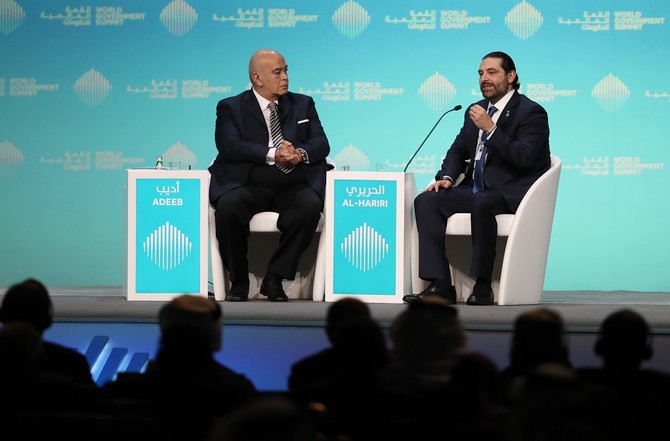

DUBAI: Lebanon faces its last chance to leave the economic crisis it is currently in, the country’s Prime Minister Saad Al-Hariri said on Sunday.
“We have collective support from all political factions to create reforms and new laws. We have no issues in passing new reforms in government," Hariri said, speaking to a packed conference hall at the World Government summit in Dubai
Hariri said he was optimistic for the country’s future, but warned: “either we make it or break it.”
Hariri touched on the development reforms and programs that have been set by the CEDRE economic conference in Paris last year that aimed at encouraging foreign investors to trust placing their money in the Mediterranean country, saying that “our new reforms and laws will ensure that we overcome our economic crisis.”
Last year, the global ratings agency Moody’s gave Lebanon’s economy a “low (+)” grade, due to “the deterioration in the regional economic and political environment.” This, and the fear of a real estate collapse, have taken the country to the brink.
On Thursday, a draft government policy statement set the main policy objectives of Hariri’s national unity government, which committed to bringing down the debt-to-GDP ratio by boosting the size of the economy and reducing the budget deficit.
He also spoke of the need to eliminate corruption, an ever-present thorn that has drained the country over the years. According to the World Economic Forum’s Global Competitiveness Index, Lebanon sits at 120 out of 140 countries in terms of corruption.
"Most importantly for me is to develop a clear program to confront corruption and to make the necessary reforms to support Lebanon economically,” he said.
Lebanon last week formed a government after nine months of political wrangling among politicians over ministerial votes.
Hariri was also hailed by moderator Emad El-Din Adeeb for his role in pushing women to the forefront, after recently appointing Raya El-Hassan as the country’s Minister of Interior - the first woman to hold such a post in the Arab world.
“Women in Lebanon represent 54 percent of society and not employing them and involving them in the work will be a loss to the GDP,” he said, adding that “I believe women in the Arab world and Lebanon can do a better job than men even.”
Among the audience was Dubai Ruler and UAE’s Vice President and Prime Minister Sheikh Mohammed bin Rashid al Maktoum, who recently revealed in his latest book that he had wanted to make Dubai like Beirut since he visited the city as a child.
When the moderator asked the audience for a show of hands for who wants to visit Lebanon, Sheikh Mohammed raised his.
The Lebanese PM referred to the sectarian strife targeting the region, as a “disease.”
“I am optimistic that the Lebanese youth can rebuild Lebanon the way Rafic Hariri wanted it to be,” he added, referring to his father – the country’s former prime minister who was assassinated 14 years ago.


