Merged tribal areas to get police stations as KP police chief suddenly transferred

1 / 2
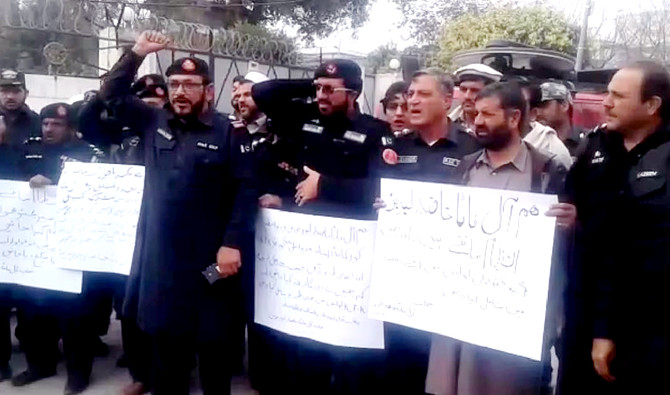
Khan Zeb Afridi, a senior Khasadar official talks to personnel in Peshawar, demanding thousands of Khasadar force be merged with Khyber Pakhtunkhwa (KP) police. The force has now been merged with the provincial police. (AN Photo)
2 / 2
Hundreds of personnel of Khasadar force held protest demonstration last week in Peshawar, demanding the force be merged with Khyber Pakhtunkhwa (KP) police. The force has now been merged with the provincial police. (AN Photo)
Updated 09 February 2019
Follow

Merged tribal areas to get police stations as KP police chief suddenly transferred

  • Local paramilitary forces to be merged with provincial police
  • Police merger will receive “great setback” after chief’s transfer

PESHAWAR: The newly-merged, once semi-autonomous tribal areas of northwest Pakistan are to get an operational police force as soon as district police officers are deputed to their posts, Khyber Pakhtunkhwa (KP) ex-police chief, Inspector General Salahuddin Mehsud told Arab News on Friday evening.

On Saturday, Mehsud, a local from the once tribal region of South Waziristan who was serving his second term after being personally appointed by Prime Minister Imran Khan, was suddenly transferred from his post according to a government notification.

Last month, the provincial police announced that thousands of existing local paramilitary personnel, the Khasadars and Levies, would be merged with the new provincial police force as the province undergoes a structural transition from its prevailing tribal administrative set-up. This, after a constitutional amendment last year merged the federally administered tribal areas (FATA) with neighbouring KP province and the Supreme Court abolished draconian colonial era laws under which entire tribes were held responsible for the crime committed by an individual.

In his interview with Arab News prior to his transfer, Mehsud said plans had been devised to recruit local people who understand local dynamics but did not elaborate on a timeline for when the police stations would be established.

But another senior KP police officer who requested anonymity said between one and two police stations would be made functional in every tribal district within the next month.

“Police stations will be established proportionally, keeping in view the population and geography of each tribal district,” he said. 

For over a decade, Taliban and other militants used the FATA as a sanctuary for attacks inside Pakistan and neighboring Afghanistan because the tribal areas had no government writ. But a series of Pakistani military operations preceding the constitutional merger flushed out insurgents from an area once infested by militancy.

As the region undertakes the mammoth and historic task of restructuring old mindsets and administrative departments, it remains unclear how much Mehsud’s transfer will affect the implementation of the KP police merger. 

According to Rehmat Khan, retired additional inspector general of KP police, Mehsud’s transfer at this time has “stunned everyone.”

He added that Mehsud was doing a commendable job streamlining the police system in the newly merged tribal districts. 

"Look, Mehsud is widely viewed as an efficient and honest police officer. His presence in KP at a time when the ill-equipped and ill-trained Khasadar force was being merged into KP police is of paramount importance. The entire process will receive a great setback and create a sense of alienation among tribal people," he said.

In an earlier interview with Arab News, Mehsud had said that over 20,000 personnel of Khasadar and levy force of FATA would be absorbed into KP police within the next six months. 

Initial speculations about Mehsud’s sudden departure point to a conflict between the ex-police chief and KP government officers over issues with the Khasadar merger.


Fitch affirms Pakistan’s ‘B-’ rating, flags debt risks

Updated 4 sec ago
Follow

Fitch affirms Pakistan’s ‘B-’ rating, flags debt risks

  • Rating agency assigns ‘RR4’ recovery score under new criteria
  • Future rating moves tied to debt reduction and reserve recovery

ISLAMABAD: Fitch Ratings on Wednesday affirmed Pakistan’s long-term sovereign debt rating at “B-,” keeping the country in high-risk territory but signaling no immediate default threat, and assigned a “RR4” recovery rating, a measure of how much investors might recover if the country were to default, following a review under its updated sovereign rating criteria.

Fitch is one of the world’s three major credit rating agencies and its sovereign ratings are closely watched by investors because they affect a country’s access to international capital markets and the cost of borrowing.

Pakistan’s rating was last upgraded in April 2025 to “B-” from “CCC+,” reflecting improved macroeconomic stability after a period of severe financial stress.

“Fitch Ratings has affirmed Pakistan’s long-term debt ratings at ‘B-’ and assigned a Recovery Rating of ‘RR4,’” the agency said in a statement.

It said the action reflects the application of its new Sovereign Rating Criteria, effective September 2025, and the inclusion of recovery assumptions in sovereign debt ratings for the first time.

A “B-” rating means the country remains vulnerable to economic shocks but is currently meeting its debt obligations. The “RR4” recovery rating suggests “average recovery prospects” for holders of Pakistan’s bonds and sukuk if the country were to default.

The agency warned Pakistan’s rating could be downgraded if public debt and debt-servicing costs fail to remain on “a firm downward path,” or if external liquidity weakens.

On the positive side, it said an upgrade could be supported by “significant declines in government debt and debt-servicing burdens,” structural improvements in tax revenue collection, and a “sustained recovery in foreign-currency reserves” beyond current forecasts.

Pakistan is implementing structural economic reforms under a $7 billion International Monetary Fund (IMF) loan program agreed after prolonged political and economic turmoil.
While the country has faced high inflation, currency pressure and weak growth in recent years, authorities say tighter fiscal policy and external support have helped improve key macroeconomic indicators.