

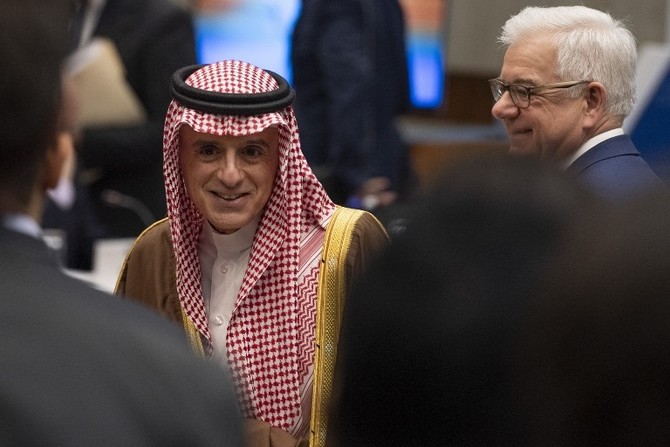
Al-Jubeir meets member states of Global Coalition fighting terrorist organizations

Saudi Arabia's Minister of State of Foreign Affairs Adel al-Jubeir (L) attends the Meeting of the Ministers of the Global Coalition to Defeat ISIS at the Department of State in Washington, DC, on February 6, 2019. (File/AFP)
Updated 08 February 2019
Follow

Al-Jubeir meets member states of Global Coalition fighting terrorist organizations

  • Minister of State for Foreign Affairs Adel Al-Jubeir led a Saudi delegation at the ministerial meeting in Washington of the member states of the Global Coalition to defeat ISIS
  • During the meeting, member states discussed issues of common interest, ways of enhancing cooperation and developing bilateral relations

Saudi Arabia’s Minister of State for Foreign Affairs Adel Al-Jubeir led a Saudi delegation at the ministerial meeting in Washington of the member states of the Global Coalition to defeat ISIS, Saudi state agency SPA reported.

“The International Coalition to Fight ISIS was established in 2014 and consists of 12 countries. My country was one of the founding countries and one of the first countries that participated actively in the military operations against the organization,” Jubeir said, referring to Daesh.

“My government will continue its fight against terrorism and its sponsoring countries, and pledge to support all international and regional efforts to eliminate terrorist organizations, terrorism and the activities of destabilizing states in the region,” he said.

“We believe that our war against terrorism must include combating its funding and rhetoric that justifies violence and terrorism. For this reason, my country has established a center to combat terrorism and extremism and its sources of funding. We also underscore the importance of continuing this alliance so that we can all ensure an effective and lasting defeat, he added.

During the meeting, member states discussed issues of common interest, ways of enhancing cooperation and developing bilateral relations.


Iranian ambassador thanks Saudi for not allowing territory to be used during

Updated 8 sec ago
Follow

Iranian ambassador thanks Saudi for not allowing territory to be used during

  • Alireza Enayati tells AFP Iran appreciates Kingdom's pledge not to allow its 'airspace, waters, or territory' to be used in US attacks
  • Envoy also denies that his country hit the US embassy in Riyadh this week with drones
RIYADH: Iran’s ambassador to Saudi Arabia Alireza Enayati said on Thursday his country remained appreciative of Saudi Arabia’s pledge to not allow its airspace or territory to be used during the ongoing war with the US and Israel.
“We appreciate what we have repeatedly heard from Saudi Arabia — that it does not allow its airspace, waters, or territory to be used against the Islamic Republic of Iran,” he told AFP.
Before the outbreak of war, Riyadh had thrown its support behind diplomatic efforts to diffuse tensions between Tehran and Washington and vowed that its airspace would not be allowed to be used for attacks against Iran.
Enayati also categorically denied that his country hit the US embassy in Riyadh this week, after Saudi officials said Iran targeted the compound with drones.
Saudi Arabia has repeatedly accused Tehran of launching missile salvos and drone attacks at its territory and warned that the kingdom reserved the right to defend itself, including by retaliating.
Iran had earlier denied attacking the sprawling Ras Tanura refinery — one of the largest in the Middle East — which Riyadh had also accused Tehran of targeting twice with drones.
Enayati added to the denial, saying Iran also had no hand in the targeting of the US embassy that triggered a fire at the compound.
“We confirmed that Iran has no role in the attack on the US embassy in Riyadh,” the ambassador told AFP.
“If the operations command in Tehran attacks somewhere, it takes responsibility for it.”
The war in the Middle East has engulfed the otherwise stable Gulf region as Iran retaliates over US and Israeli strikes that killed its supreme leader, launching strikes at Israel, the wider region and beyond.
At least 13 people have been killed in the Gulf, including seven civilians, since Iran began its attacks on Saturday.
Enayati, however, denied that Iran was waging a regional war as retaliation for the attacks on his country by the US and Israel.
“This is not a regional war and it is not our war. It was imposed on the region,” he told AFP.