

Greece’s Muslim minority complain of ‘marginalization’ in Komotini

1 / 5
A man sits outside his shop in the old market of Komotini, northeastern Greece, on the eve of the Greek's Prime Minister's official visit to Turkey, on February 4, 2019. (AFP)
2 / 5
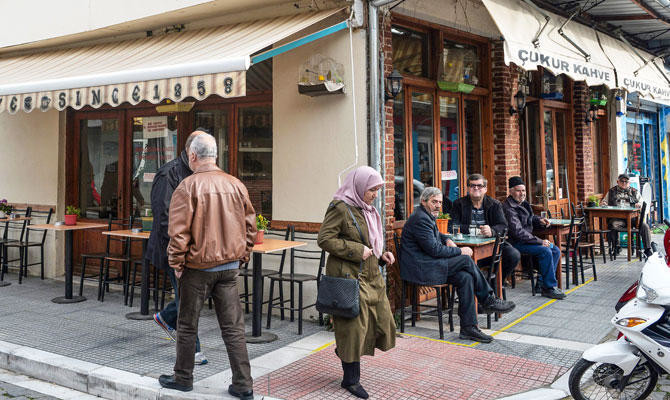
People sit outside a cafe in the old market in Komotini in northern Greece, on the eve of the Greek's Prime Minister's visit to Turkey, on February 4, 2019. (AFP)
3 / 5
A Muslim woman and a man chat outside a shop in Komotini, northern Greece, on the eve of the Greek's Prime Minister's visit to Turkey, on February 4, 2019. (AFP)
4 / 5
Muslims women walk towards the Eski Mosque located in the old market in Komotini in northern Greece, on the eve of the Greek's Prime Minister's visit to Turkey, on February 4, 2019. (AFP)
5 / 5
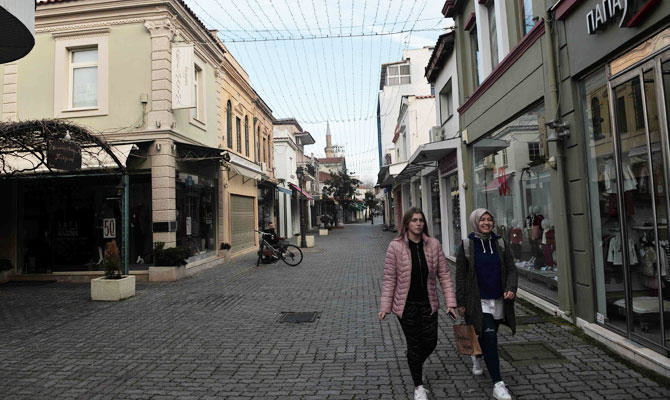
Women walk along a street in the old market in Komotini in northern Greece, on the eve of the Greek's Prime Minister's visit to Turkey, on February 4, 2019. (AFP)
Updated 05 February 2019
Follow

Greece’s Muslim minority complain of ‘marginalization’ in Komotini

  • A young Muslim recounted how her family was criticized for putting their children in Greek schools, saying: “In their eyes, we had become traitors”

KOMOTINI, Greece: Outwardly, Komotini looks like other Greek cities, but there is a major difference: it has nine mosques whereas there are none in Athens.
The northeastern city has existed from the second century and was captured by Ottoman-era Turkey in the 14th. It was an important hub connecting the capital city of Constantinople, as Istanbul was then known, with the European part of the empire.
Now it is home to nearly 30,000 Muslims, many of whom complain of marginalization.
Greece has for centuries had a testy relationship with Turkey, with a slew of disputes ranging from Aegean sea issues to the long-running Cyprus problem.
“The minority Muslims and their Greek compatriots cohabit but each side lives in its own corner,” said Mustafa Mustafa, a lawmaker from Prime Minister Alexis Tsipras’s party, speaking in this frontier city of some 60,000 people.
Tsipras visits Turkey on Tuesday in a bid to improve relations.
“Relations deteriorated in the 1960s and until 1990 many villages in the area were ringed by military barricades,” Mustafa, who is in his sixties, said.
“We could not access our properties or get a driving license,” he said.

“We would like to be a bridge of peace and friendship and not act as a brake.”
The issue of the Muslim minority is one of the sensitive areas in ties between the two neighbors.
Turkish President Recep Tayyip Erdogan, during a historic trip to Greece in 2017 — the first by a Turkish leader in 65 years — visited the Thrace region and called for the respect of the Muslim minority, railing against “discrimination” by the Greek government.
“It’s sad that we are being used,” said a young Muslim woman, speaking on condition of anonymity.
“These are normal people like us who are paying the price of politics,” she said of residents of Komotini, which lies about 100 kilometers from the border.
There are up to 150,000 Muslims in Greece’s western Thrace region, who were given minority status after the 1923 Treaty of Lausanne following the end of a war between Turkey and Greece which rang the death knell for the Ottoman empire.
The treaty provided for the application of sharia law to settle family disputes and the use of Turkish in educational institutions.
The presence of a Turkish consulate in the region adds to tensions.
“It would be better for everyone if the consulate stops serving the interests of the Turkish foreign ministry,” Komotini’s mayor Giorgos Petridis said.

“What characterises this population is a plural identity,” said Thalia Dragona from the Athens National University.
“The new generation is educated and wants to break free from being slotted,” she said.
A young Muslim recounted how her family was criticized for putting their children in Greek schools, saying: “In their eyes, we had become traitors.”
Chatitze Molla Sali, who is in her seventies, lived in Komotini before relocating to Istanbul. She had inherited her husband’s house under Greek law but her sisters-in-law contested the decision, evoking sharia.
The European Court of Human Rights ruled in her favor in December.
“The decision clarifies the situation since it makes it impossible to apply Muslim law on European citizens,” her lawyer Yanis Ktistakis said.
In a deeply orthodox society where 76 percent of Greeks see Christianity as a central part of their identity, according to the Pew Research Center, “many people associate Islam with Turkey,” said Giorgos Kalantzis, the general secretary of religious affairs.
“The country has suffered at the hands of Turkey and this still brings up painful memories,” he said.


Egypt reveals restored colossal statues of pharaoh in Luxor

Updated 14 December 2025
Follow

Egypt reveals restored colossal statues of pharaoh in Luxor

  • Amenhotep III, one of the most prominent pharaohs, ruled during the 500 years of the New Kingdom, which was the most prosperous time for ancient Egypt

LUXOR: Egypt on Sunday revealed the revamp of two colossal statues of a prominent pharaoh in the southern city of Luxor, the latest in the government’s archeological events that aim at drawing more tourists to the country.
The giant alabaster statues, known as the Colossi of Memnon, were reassembled in a renovation project that lasted about two decades. They represent Amenhotep III, who ruled ancient Egypt about 3,400 years ago.
“Today we are celebrating, actually, the finishing and the erecting of these two colossal statues,” Mohamed Ismail, secretary-general of the Supreme Council of Antiquities, said ahead of the ceremony.
Ismail said the colossi are of great significance to Luxor, a city known for its ancient temples and other antiquities. They’re also an attempt to “revive how this funerary temple of King Amenhotep III looked like a long time ago,” Ismail said.
Amenhotep III, one of the most prominent pharaohs, ruled during the 500 years of the New Kingdom, which was the most prosperous time for ancient Egypt. The pharaoh, whose mummy is showcased at a Cairo museum, ruled between 1390–1353 BC, a peaceful period known for its prosperity and great construction, including his mortuary temple, where the Colossi of Memnon are located, and another temple, Soleb, in Nubia.
The colossi were toppled by a strong earthquake in about 1200 BC that also destroyed Amenhotep III’s funerary temple, said Ismail.
They were fragmented and partly quarried away, with their pedestals dispersed. Some of their blocks were reused in the Karnak temple, but archeologists brought them back to rebuild the colossi, according to the Antiquities Ministry.
In late 1990s, an Egyptian German mission, chaired by German Egyptologist Hourig Sourouzian, began working in the temple area, including the assembly and renovation of the colossi.
“This project has in mind … to save the last remains of a once-prestigious temple,” she said.
The statues show Amenhotep III seated with hands resting on his thighs, with their faces looking eastward toward the Nile and the rising sun. They wear the nemes headdress surmounted by the double crowns and the pleated royal kilt, which symbolizes the pharaoh’s rule.
Two other small statues on the pharaoh’s feet depict his wife, Tiye.
The colossi — 14.5 meters and 13.6 meters respectively — preside over the entrance of the king’s temple on the western bank of the Nile. The 35-hectare complex is believed to be the largest and richest temple in Egypt and is usually compared to the temple of Karnak, also in Luxor.
The colossi were hewn in Egyptian alabaster from the quarries of Hatnub, in Middle Egypt. They were fixed on large pedestals with inscriptions showing the name of the temple, as well as the quarry.
Unlike other monumental sculptures of ancient Egypt, the colossi were partly compiled with pieces sculpted separately, which were fixed into each statue’s main monolithic alabaster core, the ministry said.
Sunday’s unveiling in Luxor came just six weeks after the inauguration of the long-delayed Grand Egyptian Museum, the centerpiece of the government’s bid to boost the country’s tourism industry. The mega project is located near the famed Giza Pyramids and the Sphinx.
In recent years, the sector has started to recover after the coronavirus pandemic and amid Russia’s war on Ukraine — both countries are major sources of tourists visiting Egypt.
“This site is going to be a point of interest for years to come,” said Tourism and Antiquities Minister Sherif Fathy, who attended the unveiling ceremony. “There are always new things happening in Luxor.”
A record number of about 15.7 million tourists visited Egypt in 2024, contributing about 8 percent of the country’s GDP, according to official figures.
Fathy, the minister, has said about 18 million tourists are expected to visit the country this year, with authorities hoping for 30 million visitors annually by 2032.