LAHORE: Publishers from Saudi Arabia and the Middle East attended a book fair in the eastern Pakistani city of Lahore this weekend for the first time in the fair’s history, showcasing growing people-to-people contact between Gulf countries and Pakistan.
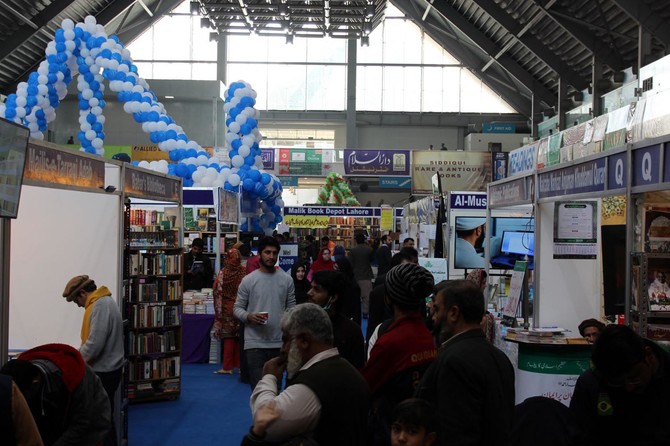
The 33rd Lahore International Book Fair is being held at the Expo Center in Lahore from February 1-5, bringing together under one roof bibliophiles and local and international academic and research institutes and think-tanks, publishers, retailers, wholesalers and marketers.
Academic and literary links between Pakistan and Saudi Arabia have always been weak but serious attempts are now underway to strengthen them, particularly through visits by Saudi heads of various think tanks, including Dr. Mohammad Al-Sulami and former ambassador Dr. Ali Saeed Awadh Asseri, who recently visited and spoke at policy institutions in Islamabad.
Zubair Saeed, Chairman of the Lahore International Book Fair Trust, told Arab News this was the first time think-tanks and a publishing house from Saudi Arabia and the Middle East were participating in the fair.
“We invite more think-tanks, research institutes and publishers from Saudi Arabia and Middle East and all over the world to join the Lahore International Book Fair every year,” he said.
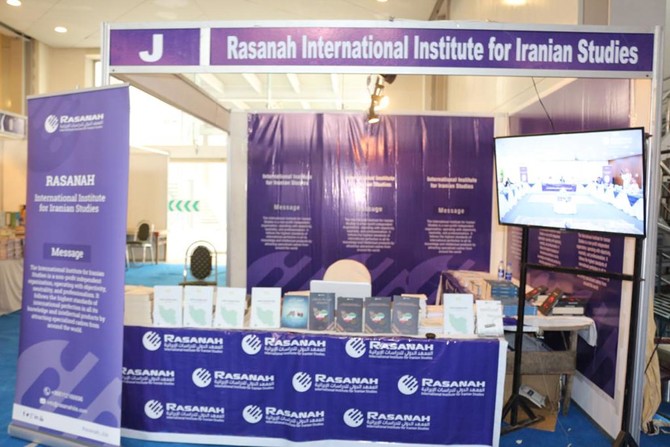
“Our Pakistani brethren have shown great love and warmth and embraced me like a guest with their traditional hospitality,” Hashr Al-Badrani, a representative of the Riyadh-based Rasanah International Institute for Iranian Studies told Arab News. “The [Pakistani] students have shown keen interest and appetite for knowledge about Iran, Saudi Arabia and Middle East,” he said, adding that Pakistani masters and doctoral students were buying English and Arabic editions of the books on display.
Darussalam Publishers, an Islamic publishing house with its headquarter in Riyadh, had also set up stall with books on religion in Arabic, Urdu, English, French and Spanish. A representative of the publishing house, Okasha Mujahid, said the organization’s aim was to “familiarize people with Islamic history and teachings.”
“Since social media is spoiling our young generation, it is our duty to bring our children to such exhibitions and divert their attention toward books,” Ali Ahmad, a professor of international relations at a local university, said as he looked at books at Rasanah’s stall. He said book-lovers should read Arabic, Persian and other languages to learn about the people, politics, literature and culture of the region.
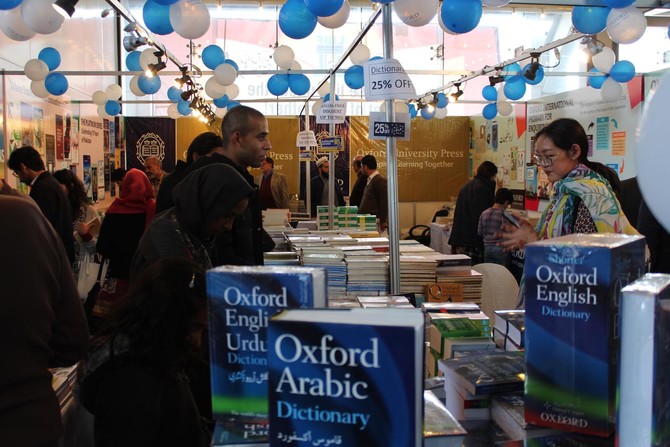
The 270 stalls at the fair showcased a variety of books on literature, poetry, art and culture, medical, engineering, science, general knowledge, history, social sciences, geography and religion. International publishers in attendance included John Wiley & SWons, Jones & Bartlett and Pearson Education from the United States, Oxford University Press from the UK, Springer Nature from Germany, as well as Cengage Learning, CBS Publishers and Distributors, Walters Kluwer, Khel Sahitya Kendra and S. Chand & Company, AITBS Publishers and Random House Publication.


![]()
![]()
![]()
![]()
![]()

Saudi, middle eastern publishers debut at Lahore book fair


Saudi, middle eastern publishers debut at Lahore book fair
- The 33rd Lahore International Book Fair to run from Feb 1 to Feb 5
- Saudi think-tanks set up stalls to strengthen academic and literary links
Latest updates




© 2026 SAUDI RESEARCH & PUBLISHING COMPANY, All Rights Reserved And subject to Terms of Use Agreement.