MOSUL: A raven perched on the shoulder of a woman with flaming hair is Iraqi artist Marwan Fathi’s symbol for the terrible events he and his home city Mosul have had to endure.
Three years under the oppressive and violent rule of Daesh and the military campaign which drove it out in 2017 left much of the northern city in ruins. Thousands were killed, rendered homeless or maimed. Those who survived are deeply traumatized.
“I still jump awake at night thinking an air strike is about to hit or that they are coming to take one of us,” Fathi, 36, said. “Everyday is a struggle.”
Fathi’s work is on display in “Return to Mosul” — the city’s first art exhibition since before it was seized by Daesh, whose ultra hard-line version of Sunni Islam prohibits most art forms.
Artists from across Iraq are taking part in the six-day show, including many who lived in Mosul when it was in the militants’ grip.
Hawkar Riskin’s haunting work ‘destruction’ depicts a giant skeleton standing on one leg, while Mohammad Al Kinani’s series of paintings — ‘Caliphate I’, ‘Caliphate II’ and ‘Caliphate III’ represents the beginning and end of Daesh, and Mosul’s rebirth.
Fathi said the artists who stayed in the city lived in constant fear and despair.
“There was a time when we considered killing ourselves. We reached that low. But then we thought, what would happen to the children?” Fathi, a professor of fine arts, said.
JONAH AND THE CITY
The show is in the newly re-opened Royal Hall of the Mosul Museum, which was looted and destroyed by Daesh and in the ensuing war to wrest control of the city.
Ahmed Mozahem, another Mosul-born artist, continued to work in secret while the city was under the militants’. Using a writing pad he kept hidden to avoid discovery, Mozahem produced 40 pencil drawings which are now among his most cherished possessions, an expression of what he and his family suffered.
For “City of the Whale,” his painting in the exhibition, Mozahem drew on the story of the prophet Jonah and the whale, which features Nineveh, the ancient Assyrian city which stood roughly where Mosul is today.
Following their capture of the city in 2014, Daesh went on a rampage, destroying many of Mosul’s ancient sites and artefacts, including a shrine believed by many to be Jonah’s tomb.
The militants not only destroyed the city, Mozahem said. “They also killed something inside, our spirit.”
But Matthew Vincent, an American archaeologist, says technology can help preserve some of what was lost. Vincent is a co-founder of a crowdsourced, digital preservation project called Rekrei, which collects photographs of damaged or lost monuments and artefacts to re-create these in 3D representations.
At the Mosul Museum, visitors are now able to catch virtual glimpse of ancient Assyrian treasures destroyed by Daesh. One of them, the Lion of Mosul, was a colossal Assyrian guardian lion from about 860 BCE, one of two which stood at the entrance of the Temple of Ishtar at Nimrud, Iraq.
“It is never going to replace the original but new technology is giving us a path we simply didn’t have before,” Vincent said.

In Mosul exhibition, Iraqi artists process brutal rule of Daesh
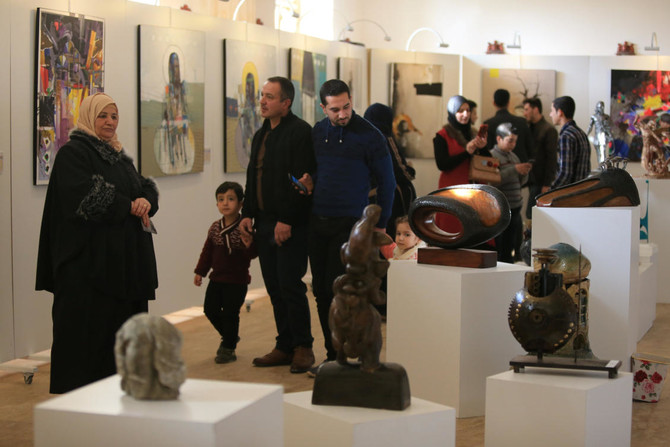
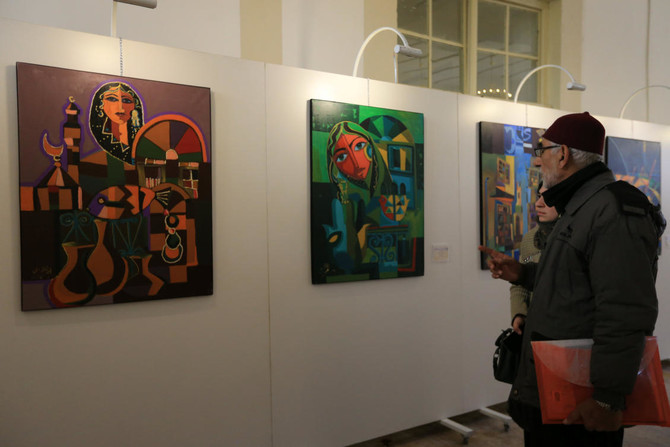
- Three years under the oppressive and violent rule of Daesh and the military campaign which drove it out in 2017 left much of the northern city in ruins
Secrecy, mines and Israeli strikes complicate removal of Assad-era chemical weapons, says Syrian envoy
- Nevertheless, new authorities made significant progress in their work with Organization for the Prohibition of Chemical Weapons, he tells UN Security Council
- Syrian authorities grant OPCW experts unrestricted access to 23 sites and since October have been hosting the organization’s longest continuous presence in the country
NEW YORK CITY: Syria’s envoy to the UN said on Thursday that secrecy surrounding the nation’s former chemical weapons program, security risks from land mines and other unexploded ordnance, and Israel’s targeting of suspected weapons sites continue to complicate his government’s efforts to eliminate Assad-era chemical weapons.
Speaking at a UN Security Council meeting about Syria’s chemical weapons, Ambassador Ibrahim Olabi said the nation’s new authorities had nevertheless made significant progress over the past year in their work with the Organization for the Prohibition of Chemical Weapons.
Despite what he described as “major challenges,” Syria had moved the issue “from a stage of suspicion and manipulation to one of partnership with the OPCW,” he said, adding: “Syria has achieved a qualitative leap in its cooperation with the OPCW.”
This shift is reflected in recent decisions by the watchdog’s executive council and changing positions among its member states, Olabi noted.
Syria’s chemical weapons program has been under international scrutiny since the early years of the country’s civil war, when repeated chemical attacks killed or injured large numbers of civilians. The deadliest incident occurred in 2013 in the Damascus suburb of Eastern Ghouta, when a sarin attack killed hundreds and triggered international efforts to dismantle the country’s chemical arsenal.
Olabi said the authorities that took over after President Bashar Assad and his regime were toppled in December 2024 were confronting what he called the “heavy legacy of the Assad era,” during which chemical weapons were widely used against civilians. He described the program as an inherited burden rather than a policy of the new government.
“The chemical file is a prime example of these inherited issues, issues of which we were victims,” he added.
Syrian authorities have granted OPCW experts unrestricted access during eight deployments that included visits to 23 sites, he said, and since October have been hosting what he described as the organization’s longest continuous presence in the country.
“This marks the beginning of a sustained presence of the OPCW in Syria,” Olabi added.
Adedeji Ebo, the UN’s deputy high representative for disarmament affairs, said OPCW teams visited 19 locations in Syria last year, four of them previously declared chemical weapons sites and 15 suspected locations, where they conducted interviews and collected samples in their attempts to determine the full scope of undeclared chemical weapons activity.
Some other sites are in dangerous areas, he added, which poses significant risks to both Syrian and international personnel.
“On-site destruction may be required where conditions prevent safe removal,” Ebo said, noting that a recent OPCW decision authorizing expedited on-site destruction of weapons marked a positive step forward.
He also highlighted the reestablishment of Syria’s National Authority for the OPCW and the watchdog’s current, continuous presence in Damascus.
Olabi said Syrian national teams had identified two sites containing empty cylinders previously used to store toxic chemicals and had immediately reported them to the OPCW. Syrian authorities also handed over about 6,000 documents relating to the former regime’s chemical weapons program, he added, and helped arrange interviews with 14 witnesses, including individuals who were involved with the program.
Syrian authorities were also cooperating with international investigators examining chemical attacks by Assad’s government, he said, and accountability and justice for the victims are priorities for the new authorities.
“Syria reiterates its determination to continue the efforts to close this chapter,” Olabi said, adding that there was “no place for chemical weapons in today’s world.”