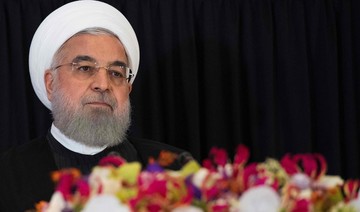
Iran facing the toughest economic situation in 40 years: Rouhani

Iranians shop in the capital Tehran's grand bazar. (File/AFP)
Updated 30 January 2019
Follow

Iran facing the toughest economic situation in 40 years: Rouhani

  • US President Donald Trump last year pulled out of an international nuclear deal with Iran and re-imposed sanctions
  • Iran’s rial currency has fluctuated in value in recent months, making it difficult for ordinary people to make ends meet

GENEVA: Iran’s president said on Wednesday the country was facing its toughest economic situation in 40 years, and the United States, not the government, was to blame.
US President Donald Trump last year pulled out of an international nuclear deal with Iran and re-imposed sanctions.
Workers, including truck drivers, farmers and merchants, have since launched sporadic protests against economic hardships, which have occasionally led to confrontations with security forces.
“Today the country is facing the biggest pressure and economic sanctions in the past 40 years,” Hassan Rouhani said, according to the presidential website.
“Today our problems are primarily because of pressure from America and its followers. And the dutiful government and Islamic system should not be blamed,” he added.
Rouhani spoke at a ceremony at the shrine of the founder of the Islamic Republic, Ayatollah Ruhollah Khomeini — part of a series of events leading up to the 40th anniversary of the February 11th revolution.
Iran’s rial currency has fluctuated in value in recent months, making it difficult for ordinary people to make ends meet.


Emerging markets should depend less on external funding, says Nigeria finance minister

Updated 10 February 2026
Follow

Emerging markets should depend less on external funding, says Nigeria finance minister

RIYADH: Developing economies must rely less on external financing as high global interest rates and geopolitical tensions continue to strain public finances, Nigeria’s finance minister told Al-Eqtisadiah.

Asked how Nigeria is responding to rising global interest rates and conflicts between major powers such as the US and China, Wale Edun said that current conditions require developing countries to rethink traditional financing models.

“I think what it means for countries like Nigeria, other African countries, and even other developing countries is that we have to rely less on others and more on our own resources, on our own devices,” he said on the sidelines of the AlUla Conference for Emerging Market Economies.

He added: “We have to trade more with each other, we have to cooperate and invest in each other.” 

Edun emphasized the importance of mobilizing domestic resources, particularly savings, to support investment and long-term economic development.

According to Edun, rising debt servicing costs are placing an increasing burden on developing economies, limiting their ability to fund growth and social programs.

“In an environment where developing countries as a whole — what we are paying in debt service, what we are paying in terms of interest costs and repayments of our debt — is more than we are receiving in what we call overseas development assistance, and it is more than even investments by wealthy countries in our economies,” he said.

Edun added that countries in the Global South are increasingly recognizing the need for deeper regional integration.

His comments reflect growing concern among developing nations that elevated borrowing costs and global instability are reshaping development finance, accelerating a shift toward domestic resource mobilization and stronger economic ties among emerging markets.