GAZA CITY, Gaza Strip: In a small studio packed with sculptures made of scrap metal, Palestinian artist Ahmed Humaid has found a new medium in origami, the Japanese art of paper folding.
It’s an unlikely pursuit for an artist living in the Gaza Strip, which has been largely cut off from the outside world since Israel and Egypt imposed a crippling blockade on the Hamas-ruled territory more than a decade ago.
But the 29-year-old Humaid, who has no regular job, says interest in origami is on the rise.
“With more people asking about it, this work has turned into a source of income for me,” said Humaid, who lives in Nusseirat refugee camp in central Gaza.
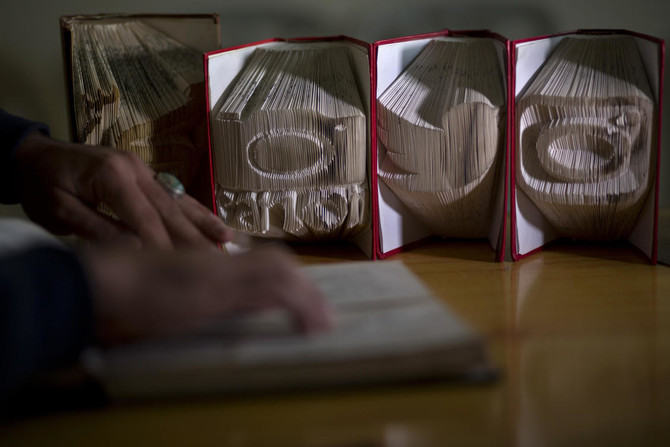
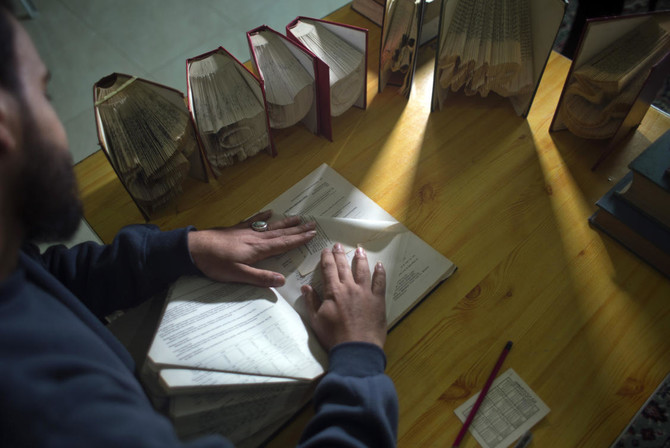
Humaid practices a form of origami in which he folds and forms the pages of an entire book into a readable inscription of calligraphic letters.
He has no formal training. He said he learned about origami when he saw some photos on Instagram. He began following Japanese artists and wrote to them. Some offered help and feedback.
When he made his first origami work in October, it took him 15 hours to finish. He shared the photo with some Japanese artists who acclaimed the work.
Since then, Humaid has sold 45 works locally, including books folded into names that lovers have given to each other as gifts, as well as logos for local businesses. Depending on the size and number of letters, he charges 50 to 100 shekels (about $15-30) per order.
Unemployment in Gaza, a coastal enclave sandwiched between Israel and Egypt, stands at more than 50 percent, according to UN and other international estimates. It is even higher among Gaza’s youth.
Humaid would like to expand his business beyond Gaza’s borders, but the blockade has cut off virtually all exports, and Israel and Egypt heavily restrict travel into and out of the territory.
“I wish to visit the homeland of this art — Japan — so I can be closer to the people who creatively mastered it,” he said.

Palestinian artist brings Japanese origami to Gaza
- Palestinian artist Ahmed Humaid says interest in origami is on the rise
- He charges 50 to 100 shekels (about $15-30) per order depending on the size and number of letters
Riyadh to install 25 new public artworks after conclusion of Tuwaiq Sculpture symposium
- Move will extend the impact of the annual art event beyond its conclusion, bringing large-scale contemporary artworks into the city’s streets and parks
- Artworks produced during the symposium will now become part of Riyadh Art’s permanent collection
RIYADH: Some 25 sculptures created during the seventh edition of the Tuwaiq Sculpture symposium and exhibition will soon be installed across public spaces in Riyadh.
The move will extend the impact of the annual art event beyond its conclusion, organizers said, bringing large-scale contemporary artworks into the city’s streets and parks.
Organized by the Royal Commission for Riyadh City through the Riyadh Art Program, the 2026 edition has ended after nearly two months of live sculpting, exhibitions and public programming.
The artworks produced during the symposium will now become part of Riyadh Art’s permanent collection and will appear across the capital as part of a broader effort to integrate art into everyday urban life.
This year’s symposium began in January and took place along Prince Mohammed bin Abdulaziz Road, widely known as Tahlia Street.
The site was transformed into an open-air studio in which visitors could observe artists carving, welding and assembling sculptures.
The live sculpting phase, which was held between Jan. 10 and Feb. 5, brought together leading Saudi and international artists to produce 25 large-scale works.
The sculptures were created using locally sourced granite and reclaimed metal, highlighting both the region’s natural materials and the creative reuse of industrial elements.
Visitors were able to follow the process of each artwork’s development, from raw materials to finished sculptures, while also interacting with the artists and learning about their techniques and concepts.
The event also featured a wide-ranging community engagement program designed to deepen public understanding of contemporary art.
The program included 10 panel discussions, 105 training workshops and 15 masterclasses exploring sculptural techniques, materials and the role of public art in cities.
Educational outreach formed another key component of the symposium. Organizers hosted 25 educational visits for more than 600 students, while daily guided tours enabled visitors to explore the artworks and gain insight into the creative processes behind them.
After the live sculpting phase, the completed sculptures remained on-site until March 8, giving visitors the opportunity to experience the works in their original setting before their distribution across Riyadh.
The symposium was curated by Lulwah Al-Homoud, Sarah Staton, and Rut Blees Luxemburg, who guided the artistic direction around the theme “Traces of What Will Be,” exploring how sculpture can reflect future possibilities while responding to the city’s evolving identity.


