

Daesh militants claim responsibility for twin bomb attack on Philippine church

1 / 6
Saudi Arabia expressed its strongest condemnation of Sunday’s twin bomb attack in the southern Philippines. (Getty Images)
2 / 6
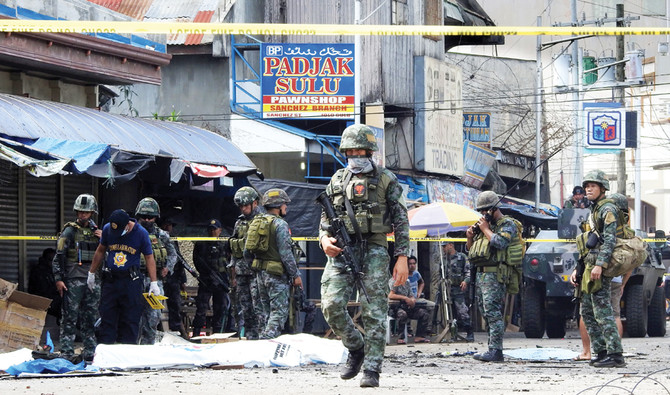
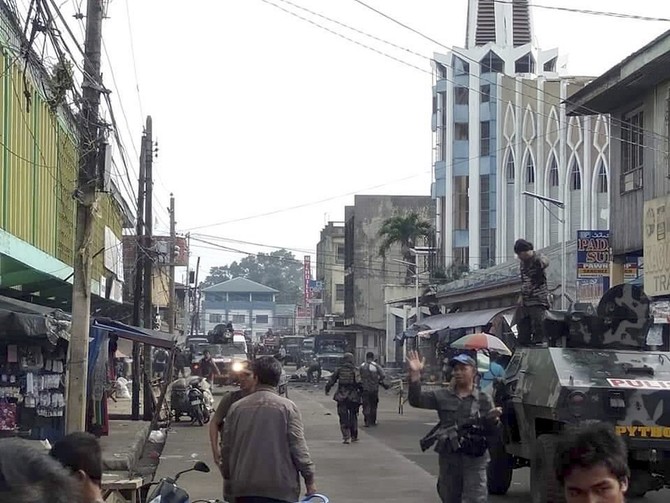
Soldiers and police cordon off the area after two bombs exploded outside a Catholic cathedral in Jolo, Sulu on Sunday, January 27, 2019. (WESMINCOM Armed Forces of the Philippines via AP)
3 / 6
Soldiers and police cordon off the area after two bombs exploded outside a Catholic cathedral in Jolo, Sulu on Sunday, January 27, 2019. (WESMINCOM Armed Forces of the Philippines via AP)
4 / 6
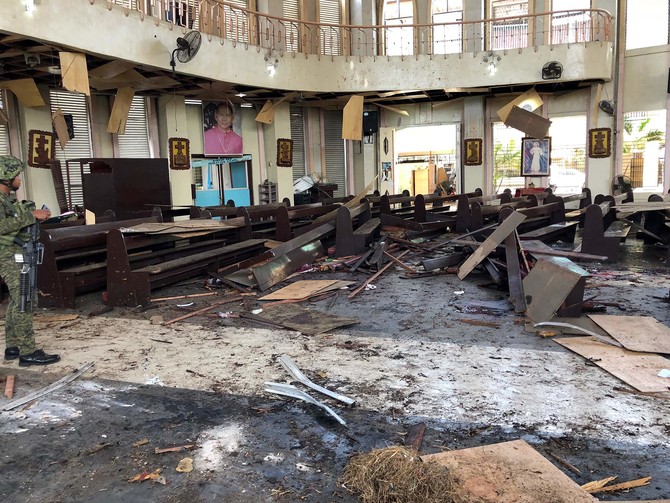
Inside the damaged Catholic cathedral, where two bombs exploded, in Jolo, Sulu on Sunday, January 27, 2019. (WESMINCOM Armed Forces of the Philippines via AP)
5 / 6
Victims receive treatment in a hospital after two bombs exploded outside a Roman Catholic cathedral in Jolo, Sulu. (WESMINCOM Armed Forces of the Philippines via AP)
6 / 6
Victims receive treatment in a hospital after two bombs exploded outside a Roman Catholic cathedral in Jolo, Sulu. (WESMINCOM Armed Forces of the Philippines via AP)
Updated 28 January 2019
Follow

Daesh militants claim responsibility for twin bomb attack on Philippine church

  • Jolo island has long been troubled by the presence of Abu Sayyaf militants, who are blacklisted by the United States and the Philippines as a terrorist organization
  • There have been speculations that the bombings may be a diversionary move by Muslim militants

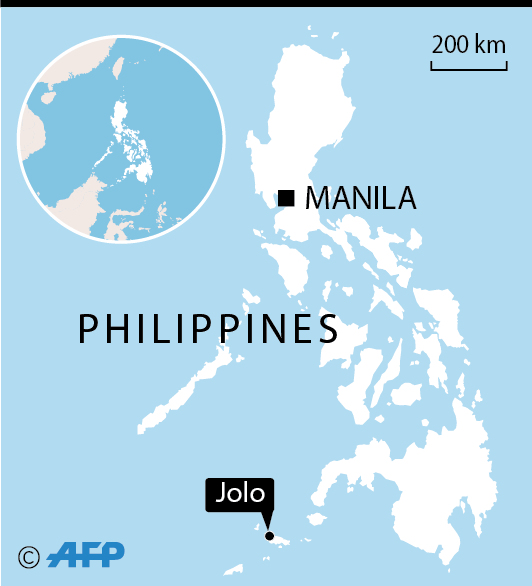
MANILA: Daesh militants claimed responsibility for a twin bomb attack that killed at least 20 people and injured 111 others in a Roman Catholic cathedral in the southern Philippines on Sunday.

The international terrorist group issued a formal communique saying two suicide bombers had detonated explosive belts, according to the SITE Intelligence Group which monitors jihadist activities.

But a Philippine military report said the second bomb was left in the utility box of a motorcycle in the parking area outside the church.

The first explosion went off inside the cathedral on Jolo island, in Sulu province, and was followed by a second blast outside, that was detonated as security forces raced to the scene, officials said.

Civilians bore the brunt of the attack, which also killed seven soldiers. Sixty-one civilians were among those wounded.


Condemnations

Saudi Arabia, the Organization of Islamic Cooperation (OIC), the Vatican and others condemned the attack and extended their sympathies to the families of the victims. 


Pope Francis, who is visiting Panama, expressed his “firm condemnation of this act of violence that causes more mourning in the Christian community. I pray for the dead and the injured.”

The first of the two bombs, placed inside the Cathedral of Our Lady of Carmel on the southern island of Jolo, detonated during Sunday Mass. 

The bloodshed came less than a week after voters’ decisive approval of giving Muslims in the south more control over their own affairs, which sparked hopes of quelling long-time separatist violence.

“Just because the referendum has passed does not mean that things are going to get better overnight,” said Gregory Wyatt, director for business intelligence at PSA Philippines Consultancy.

“There are still militant groups that will continue to be active and pose a security threat.”

National security adviser Hermogenes Esperon said that  “extremist criminals” plotted the bombings.

“We will not allow them to spoil the preference of the people for peace,” Esperon said. “Peace must prevail over war.”

Defense Secretary Delfin Lorenzana called the attack a “dastardly act” and urged the local population to cooperate and “deny terrorism any victory.”

Retribution

The attack was one of the deadliest in recent years in a region long plagued by instability. It came amid hope and excitement about the ratification of a devolution plan that aims to bring development, jobs and peace to one of Asia’s poorest and most volatile places.

Manila swiftly vowed to hunt down the attackers.

“The enemies of the state have boldly challenged the capability of the government to secure the safety of the citizenry in that region,” said Salvador Panelo, spokesman of Philippine President Rodrigo Duterte.

“We will pursue to the ends of the earth the ruthless perpetrators behind this dastardly crime. The law will give them no mercy,” he said.

National police chief Oscar Albayalde, speaking on DZMM radio, suggested the Abu Sayyaf group was the prime suspect.

“They want to show force and sow chaos,” he said. The Abu Sayyaf has pledged allegiance to Daesh and is notorious for its bombings and brutality.

Jolo is a stronghold of the Abu Sayyaf, which runs a lucrative piracy and kidnapping operation that successive governments have failed to break up. The group, which operates in the waters and islands of western Mindanao, has beheaded numerous foreign captives when ransom payments were not met.

Pictures distributed by the military of the inside of the Jolo church showed several rows of wooden pews destroyed, with debris strewn across a blackened floor. Humvees and army trucks were lined up on the road outside.

The attack followed Friday’s announcement that the region, a mainly Muslim part of the predominantly Catholic Philippines, had ratified the creation of an autonomous area called Bangsamoro, with 85 percent of voters behind it.

Although Sulu was among only a few areas that rejected autonomy, it will still be part of the new entity when it is fully formed in 2022.

The referendum came amid concerns about the presence of extremists in the Philippines and the possibility that foreign radicals will join those of Indonesia and Malaysia in gravitating to Mindanao to capitalize on porous borders, jungles and mountains, and an abundance of arms.

The Philippine military in mid-2017 encountered its biggest and longest battle since World War Two when an alliance of extremists loyal to Daesh, among them foreigners and children, overran Marawi City and tried to establish a caliphate.


Italian police fire tear gas as protesters clash near Winter Olympics hockey venue

Updated 08 February 2026
Follow

Italian police fire tear gas as protesters clash near Winter Olympics hockey venue

  • Police vans behind a temporary metal fence secured the road to the athletes’ village, but the protest veered away, continuing on a trajectory toward the Santagiulia venue

MILAN: Italian police fired tear gas and a water cannon at dozens of protesters who threw firecrackers and tried to access a highway near a Winter Olympics venue on Saturday.
The brief confrontation came at the end of a peaceful march by thousands against the environmental impact of the Games and the presence of US agents in Italy.
Police held off the violent demonstrators, who appeared to be trying to reach the Santagiulia Olympic ice hockey rink, after the skirmish. By then, the larger peaceful protest, including families with small children and students, had dispersed.
Earlier, a group of masked protesters had set off smoke bombs and firecrackers on a bridge overlooking a construction site about 800 meters (a half-mile) from the Olympic Village that’s housing around 1,500 athletes.
Police vans behind a temporary metal fence secured the road to the athletes’ village, but the protest veered away, continuing on a trajectory toward the Santagiulia venue. A heavy police presence guarded the entire route.
There was no indication that the protest and resulting road closure interfered with athletes’ transfers to their events, all on the outskirts of Milan.
The demonstration coincided with US Vice President JD Vance’s visit to Milan as head of the American delegation that attended the opening ceremony on Friday.
He and his family visited Leonardo da Vinci’s “The Last Supper” closer to the city center, far from the protest, which also was against the deployment of US Immigration and Customs Enforcement agents to provide security to the US delegation.
US Homeland Security Investigations, an ICE unit that focuses on cross-border crimes, frequently sends its officers to overseas events like the Olympics to assist with security. The ICE arm at the forefront of the immigration crackdown in the US is known as Enforcement and Removal Operations, and there is no indication its officers are being sent to Italy.
At the larger, peaceful demonstration, which police said numbered 10,000, people carried cardboard cutouts to represent trees felled to build the new bobsled run in Cortina. A group of dancers performed to beating drums. Music blasted from a truck leading the march, one a profanity-laced anti-ICE anthem.
“Let’s take back the cities and free the mountains,” read a banner by a group calling itself the Unsustainable Olympic Committee. Another group called the Association of Proletariat Excursionists organized the cutout trees.
“They bypassed the laws that usually are needed for major infrastructure project, citing urgency for the Games,” said protester Guido Maffioli, who expressed concern that the private entity organizing the Games would eventually pass on debt to Italian taxpayers.
Homemade signs read “Get out of the Games: Genocide States, Fascist Police and Polluting Sponsors,” the final one a reference to fossil fuel companies that are sponsors of the Games. One woman carried an artificial tree on her back decorated with the sign: “Infernal Olympics.”
The demonstration followed another last week when hundreds protested the deployment of ICE agents.
Like last week, demonstrators Saturday said they were opposed to ICE agents’ presence, despite official statements that a small number of agents from an investigative arm would be present in US diplomatic territory, and not operational on the streets.