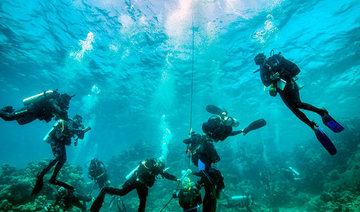
JEDDAH: For years, Jeddah, the bride of the Red Sea, has been a favorite destination for divers looking for a thrill underwater. Exploring the wonders beneath the surface, you are transported from reality to a different world with a positively ethereal feel. It’s a favored pastime for many, and a popular new shared family activity.
Eighteen-year-old pre-med student Joud Al Dabbagh told Arab News that the newfound love for scuba diving is shared by not only herself, but her siblings, too, the youngest being only 12.
“Listening to my cousin tell of his scuba diving excursions two years ago, I was enthralled and within two days my siblings and I signed up,” said Joud.
After completing the first phases of the training and just before experiencing firsthand diving off the coastline, they didn’t know what to expect.
To their surprise, they were immersed into a new world of wonder just a few feet away from the shores of the city.
“I’ve never felt like this before,” said Joud. “I wasn’t fearful but it was surreal as I didn’t realize how the Red Sea had so many gems. I was in awe and in constant amazement. My siblings and I all felt the same way and scuba diving has brought us closer together, we shared something in common that we all enjoyed and that we look forward to every time we head out together.”
To take diving lessons, you’d need to be at least 10 years of age for the most basic course for the “Open Water Diver” certification. Children under 15 will become Junior Open Water Divers and are allowed to dive down to 12 meters.
A large number of scuba diving centers can be found in the city, but divers are always advised to be vigilant and understand the rules by educating themselves before starting scuba diving courses. It is recommended that they understand the repercussions and penalties to avoid any problems.
Thirty-one year-old behavior analyst Shumaila Jaffrey has been diving for three years in Jeddah and her love for scuba diving is shared with her brother.
“Although I don’t dive with family members, I do have a friend who dives with his wife and another whose wife will be joining soon, as well. I find it really cool and I want my parents to come and try it out as well. They have a fear of the water but it would be a good experience for us as a family to bond together,” said Shumaila.
“Naturally, there are no means of communication underwater except through signs. There doesn’t need to be a verbal communication; it’s the silence and pure peacefulness that I’d want my parents to enjoy. It is very relaxing and it’s sharing the experience that builds the bond.”
Building trust is one point that has been reiterated by many, mothers and daughters, fathers and their children, and the disconnect from the distractions of daily life helps in building the bond. Simple, peaceful and a great family activity in the gem of the Red Sea.

Scuba diving in Red Sea: Family adventure finds new depths
- Building trust is one point that has been reiterated by many, mothers and daughters, fathers and their children, and the disconnect from the distractions of daily life helps in building the bond
Saudi tourism minister urges governments to ease travel barriers amid global tensions
- Tourism Minister Ahmed Al-Khateeb said visa restrictions and connectivity were major hurdles disrupting global movement, urging more frequent flights to smaller destinations
- Panel examined key challenges facing the $10 trillion global travel industry, including rising geopolitical tensions, climate volatility, artificial intelligence and growing cyber risks
DUBAI: Saudi Arabia’s tourism minister, Ahmed Al-Khateeb, has said travel should be made more accessible and flexible as it fosters dialogue and peace at a time when geopolitical tensions are prompting governments to impose stricter visa restrictions.
He was speaking during a panel discussion at the World Economic Forum’s annual meeting in Davos, which examined the key challenges facing the $10 trillion global travel industry. These include rising geopolitical tensions, climate volatility, artificial intelligence and growing cyber risks.
“Tourism brings peace at a time where everybody wants to hear about peace. It connects people, encourages dialogue, creates economies, and serves smaller economies like Africa, Latin America, the Pacific and the Caribbean countries,” said Al-Khateeb.
His remarks come as the US has tightened visa and immigration policies, affecting nationals from dozens of countries, and as anti-tourism protests have surfaced in parts of Europe amid mounting concerns over overtourism in major destinations.
He highlighted Saudi Arabia’s achievements in tourism, saying the sector has created 250,000 jobs in the last five years and boosted female participation to 47 percent, exceeding the global average of 45 percent. He highlighted the Kingdom’s focus on building new airports and expanding existing ones, as well as boosting the hotel sector to cater for 150 million travelers by 2030.
The sector’s contribution to the economy has grown from about 3 percent in 2020 to 5 percent today, with plans to raise that figure to between 8 and 10 percent by 2030.
With travel and tourism accounting for around 10 percent of global GDP, Al-Khateeb said that raising the sector’s contribution in Saudi Arabia would strengthen the Kingdom’s economy, make it more resilient and sustainable, and “allow us to share our beautiful culture with the world.”
He said visa restrictions and connectivity were major hurdles disrupting global movement, urging more frequent flights to smaller destinations to diversify traveler experiences and expand economies beyond major hubs.
With panelists citing last year’s anti-tourism protests in Spain and Mexico, Al-Khateeb said overtourism, already a challenge in some cities, will worsen as the UN projects an increase in the number of global travelers from 1.5 billion to 2 billion by 2050. He therefore urged governments to promote smaller cities and spread tourism beyond traditional hotspots to boost economic growth and create more jobs.
Expressing similar sentiments, Martin Eurnekian, CEO of Corporacion America International, linked economic growth to travel and said travel deregulation in the past had boosted European economies.
“Our history shows when growth was accelerated and these were the cases where the (travel) industry was set free,” said Eurnekian, adding geopolitical tensions and economic regulations were exacting a heavy cost on the industry.
“This is an industry based on freedom and globalization and if we lose sight of that we can really hurt the industry,” he added.
Cara Morton, CEO of global businesses and operations and a member of the executive committee at Zurich Insurance Group, said “disruption is now the norm,” citing an in-house assessment that found 80 percent of 4,000 business travelers experienced some form of disruption during their journeys.
She highlighted the role of artificial intelligence in steering people to new, less crowded destinations: “Obviously that will require governments to then make sure that those places have got the right infrastructure, but we will be able to see wealth distributed more equally. So the key is how we use AI in this area.”
Al-Khateeb said that while AI can enhance traveler experience, it should not replace human interaction.
“We will use tech when it isn’t necessary … such as using AI (for passengers to) move fast and finish their biometrics, but when you go to destination, you want to be served by humans not machines.”
He highlighted global travel trends, including the growing role of airports as destinations in their own right, driven by retail and food and beverage offerings, as well as the rapid rise of wellness tourism.
“Travel interacts with a wide range of sectors from aviation and airports to mobility, transportation, hotels, retail, and entertainment,” said Al-Khateeb.


