

Afghan President Ashraf Ghani calls on greater engagement with Pakistan

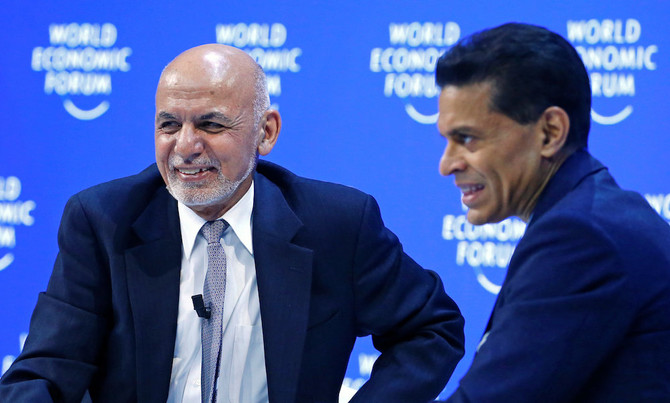
Afghan President Ashraf Ghani talks with Fareed Zakaria during the World Economic Forum (WEF) annual meeting in Davos. (Reuters)
Updated 24 January 2019
Follow

Afghan President Ashraf Ghani calls on greater engagement with Pakistan

  • Ghani said he had spoken to Pakistan’s Prime Minister Imran Khan but warned that Islamabad still needed to remove the “shadow of violence”
  • President played down talk of a breakthrough in talks between the Taliban and US officials in Doha

LONDON: Afghan President Ashraf Ghani said on Thursday he wants greater engagement with Pakistan as he claimed his country was “turning a corner.”

Ghani said he had spoken to Pakistan’s new Prime Minister Imran Khan but warned that Islamabad still needed to remove the “shadow of violence” in the country.

Pakistan has long been accused of aiding militant groups, including the Taliban, in Afghanistan. Many believe that improved relations between Kabul and Islamabad are crucial to peace in the country.

“Afghanistan wants an engagement with Pakistan,” Ghani said during a conversation with CNN’s Fareed Zakaria at the World Economic Forum in Davos. But he said that the countries needed to engage on the “issue of terrorism.” Ghani said improved relations could also make Afghanistan a stabilising force in Pakistan.

His comments came as a fourth day of talks between the Taliban and US officials were held in Qatar on Thursday. But Ghani played down speculation of a breakthrough amid frustration from Afghan leaders that they are being left out of the process.

Ghani played down talk of a breakthrough in talks between the Taliban and US officials in Doha at the World Economic Forum in Davos. “There’s discussion. But this discussion needs to be shared back (with the Afghan government),” he continued, adding that if not it “will not last.”

But he remained optimistic that the country was on the right track to bringing an end to the 17-year war with the Taliban, which still involves thousands of US troops.

“By 2024 Afghanistan will be self reliant,” Ghani said.

Afghanistan’s de facto prime minister Abdullah Abdullah also expressed his frustration at the talks in Doha, saying the Taliban are persisting in excluding his government from the negotiations

“The peace process cannot take place by proxy,” he said in Davos.

The Taliban have launched a series of attacks in recent weeks as they continue to strengthen their position in the country - now controlling about half the territory.

The insurgents killed dozens of Afghan forces this week in an attack on a military base in Wardak province.


Bangladesh’s Gen-Z party faces revolt over alliance with religious party, risking its future

Updated 7 sec ago
Follow

Bangladesh’s Gen-Z party faces revolt over alliance with religious party, risking its future

  • At least 30 senior leaders of the National Citizen Party have openly opposed its alliance with Jamaat-e-Islami
  • Before the deal, opinion polls predicted Jamaat finishing a close second behind Bangladesh Nationalist Party

DHAKA: A Bangladeshi youth-driven party born out of the country’s 2024 uprising is facing an open revolt from within after sealing an election alliance with a religious group, a ​move analysts say could jeopardize its future and reinforce established parties.

At least 30 senior leaders of the National Citizen Party (NCP) have openly opposed its alliance with Jamaat-e-Islami, announced on Sunday, with several resigning in protest.

The Muslim-majority South Asian nation goes to the polls on February 12.

Before the deal, opinion polls had predicted Jamaat finishing a close second behind the Bangladesh Nationalist Party (BNP) of former Prime Minister Khaleda Zia, while the NCP lagged far behind in third place.

“The NCP presented itself as a youth-driven alternative to traditional power structures. That identity is now under serious strain,” said H.M. Nazmul Alam, an academic.

“Youth-based movements do not collapse only because they lose elections. They collapse when they lose clarity and ‌internal unity.”

’ALLIANCE FOR ‌GREATER UNITY’

The NCP was formed earlier this year by leaders of the protests ‌that ⁠ousted ​long-time Prime ‌Minister Sheikh Hasina in August, 2024, forcing her to flee to India. Driven by Gen-Z activists born after the late 1990s, it says it aims to free the nation from decades of nepotism and the dominance of Hasina’s Awami League and the BNP.

With the Awami League banned, the vote will be effectively a direct contest between the BNP and Jamaat, which has trailed the other two in the past and had not been allowed to contest any elections since 2013 after a court said its registration as a political party conflicted with Bangladesh’s secular constitution.

An interim government led by Nobel laureate Muhammad Yunus revoked all the restrictions on ⁠Jamaat in August 2024.

The NCP’s struggle shows the challenges of turning street power into votes and holds lessons for neighboring Nepal, where similar youth-led protests ousted ‌the government this year and fresh elections are due in March, political ‍analysts have said.

NCP chief Nahid Islam told a ‍press conference late on Sunday that the recent killing of 32-year-old Sharif Osman Hadi, a key figure in the ‍uprising, forced his party to seek an alliance to keep at bay forces trying to derail the election through violence.

“The dictatorship we overthrew is attempting to sabotage the election. Therefore, for the sake of greater unity, we have reached an electoral understanding with Jamaat,” said Nahid, 27.

“This was a majority decision within the party, but some may be opposed to it and they are free to ​take their own decisions.”

Hadi was shot in the head by masked assailants in Dhaka earlier in December while launching his election campaign as an independent candidate. Police say they have identified ⁠the killers but have not apprehended them.

’YOUR CENTRIST IDEA AND IDEOLOGY WILL VANISH’

Nahid earlier told Reuters his organization was weak because it had not had enough time to build itself. It was also hampered by scarce funds and an unclear stance on key issues such as rights for women and minorities, Reuters reported in early December, citing party leaders who said alliance talks had been underway for some time.

One senior NCP leader to have resigned is Tasnim Jara, a doctor who left a career in Britain to join the party. She is now seeking the support of nearly 5,000 voters to be allowed to contest as an independent.

“I promised you and the people of this country that I would fight for you and for building a new political culture,” she said on Facebook. “Whatever the circumstances, I am determined to keep that promise.”

Political analyst Asif Shahan, a professor at the University of Dhaka, said the NCP was “doomed.”

“If you go with Jamaat, it will help Jamaat, not ‌you,” he said. “It will give them a liberal cover, and in return, you will become a force for the right. Your centrist idea and ideology — already poorly defined — will simply vanish.”