PARK CITY, UTAH: Hollywood is bundling up and descending on Park City, Utah to kick off the 2019 Sundance Film Festival Thursday.
Although the first films of the two-week long festival will not premiere until Thursday evening, the ski town is already bustling with activity as brands and sponsors rush to finish plastering Main Street with logos and installations before the thousands of film fans and filmmakers touch down. Although the temptations in town are many — from flashy virtual reality set-ups and performances from the likes of Arcade Fire, to cozy lounges and filmmaker panels — the films themselves remain the main event for Sundance attendees. The opening night selections are long sold out.
The festival officially starts Thursday evening with the premieres of “After The Wedding,” an adaptation of Susanne Bier’s Oscar-nominated Danish film starring Michelle Williams and Julianne Moore, and “The Inventor: Out For Blood in Silicon Valley,” Alex Gibney’s documentary about Theranos founder Elizabeth Holmes.
“I hope [audiences] get a deep dive into the psychology of fraud and the psychology of capitalism,” Gibney said. “That’s what’s really interesting to me about this, that journey of why we believe certain stories and why certain storytellers are effective.”
Also debuting Thursday night are “Native Son,” a contemporary re-ire-imaging the Richard Wright novel, “Memory: The Origins of Alien,” about the Ridley Scott film, and “Apollo 11,” which has never-before-seen or heard footage from the mission. Opening night films have tended to run the gamut from excellent (“Whiplash“) to forgettable (“The Bronze“).
The Robert Redford-founded film festival is the host this year to 117 feature films, 105 world premieres and even some retrospectives, including a 20th-anniversary screening of “The Blair Witch Project.”
Recent hits that debuted at Sundance include “The Big Sick,” “Get Out,” “Eighth Grade,” “Sorry to Bother You,” “RBG” and “Won’t You Be My Neighbor?” Even with competition from Netflix and Hulu, there are still some indies that break out. But lately, some of the pricier acquisition deals have not panned out, like last year’s “Assassination Nation,” which was purchased for $10 million and went on to gross only $2.5 million at the box office.
This year programmers have promised a return to the discovery aspect that Sundance made its name with. With a new director of programming in place in Kim Yutani, the festival also has a diverse lineup of filmmakers behind the camera too: 39% of the projects were directed by women and 35% by people of color.
“What attracted me to Sundance in the first place was my love of independent film and the types of stories that they’ve shown over the years: Stories about outsiders, people on the margins, things that exist outside of the mainstream,” Yutani said. “Part of [my goal] is keeping up that legacy and making sure our program is as diverse as possible.”
The festival runs through Feb. 3.


Hollywood heads to the mountains to kick off Sundance fest

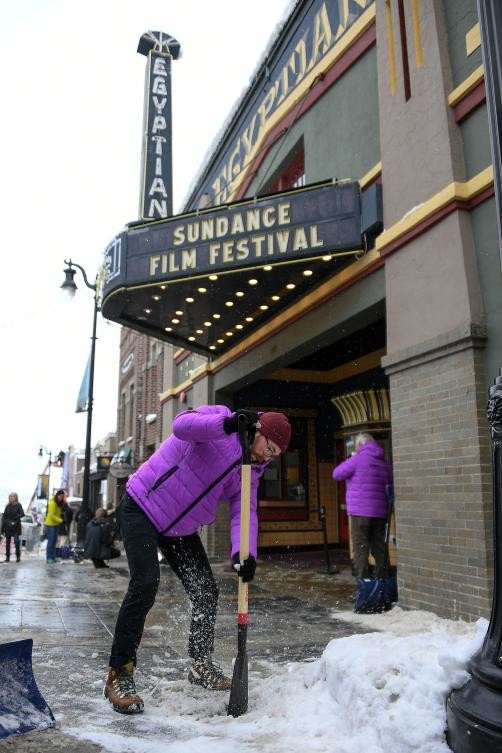
Hollywood heads to the mountains to kick off Sundance fest
- The ski town is already bustling with activity as brands and sponsors rush to finish plastering Main Street with logos and installations
- The opening night selections are long sold out


OPINION: Saudi Arabia’s cultural continuum: from heritage to contemporary AlUla
- The director of arts & creative industries at the Royal Commission for AlUla writes about the Kingdom’s cultural growth
AlUla: Saudi Arabia’s relationship with culture isa long and rich. It doesn’t begin with modern museums or contemporary installations, but in the woven textiles of nomadic encampments, traditional jewellery and ceramics, and of course palm‑frond weaving traditions. For centuries, Saudi artisans have worked with materials drawn directly from their environment creating objects that are functional, but also expressions of identity and artistry.
Many of these traditions have been recognised internationally, with crafts such as Al-Sadu weaving inscribed on UNESCO’s Intangible Cultural Heritage list.

This grounding in landscapes, resources, and collective history means Saudi Arabia’s current cultural momentum is not sudden, but the natural result of decades — even centuries — of groundwork. From the preservation of heritage sites and, areas, some of which have been transformed into world-renowned art districts, to, the creation of institutions devoted to craft, the stage has been set for a moment where contemporary creativity can move forward with confidence, because it is deeply rooted.
AlUla, with its 7,000 years of human history, offers one of the clearest views into this continuum. Millennia-old inscriptions at Dadan and Jabal Ikmah stand alongside restored mudbrick homes in Old Town and UNESCO-listed Hegra. In the present, initiatives like Madrasat Addeera carry forward AlUla’s craft traditions through design residencies and material research. And, each winter, the AlUla Arts Festival knots these threads together, creating a season in which heritage and contemporary practice meet.

This year, that dialogue began in the open desert with Desert X AlUla 2026. Now in its fourth edition, the exhibition feels like the pinnacle of the current moment where contemporary art, heritage, and forward-thinking meet without boundaries. The theme of Desert X AlUla 2026 was “Space Without Measure,” inspired by the work of Lebanese-American artist and writer Kahlil Gibran[HA1] [MJ2] . The theme invited artists to respond to the horizons of AlUla’s landscape and interpret its wonder through their perspective.
Works by Saudi and international figures converse directly with nature: Mohammed Al-Saleem’s modernist sculptures bring in celestial-inspired geometry; Maria Magdalena Campos-Pons translates the colour of AlUla’s sunsets; Agnes Denes “Living Pyramid” turns the oasis into a vertical landscape of indigenous plants, . The 11 artists of this year’s edition were able to capture AlUla’s essence while creating monumental works that speak directly to our relationship with the environment.

In AlJadidah Arts District, “Material Witness: Celebrating Design From Within,” features heritage craft and material research from Madrasat Addeera alongside work by regional and international designers, showing how they translate heritage materials into contemporary forms.[HA3] [MJ4]
Music adds another element of vitality, filling the streets of AlJadidah Arts District, with performances supported by AlUla Music Hub, featuring local musicians.
The opening of “Arduna,” the first exhibition presented byof the AlUla Contemporary Art Museum, co-curated with France’s Centre Pompidou, adds another layer to this conversation. Featuring Saudi, regional, and international artists, from Picasso and Kandinsky to Etel Adnan, Ayman Zedani and Manal AlDowayan, the [HA5] [MJ6] exhibition signals the emergence of a global institution rooted in the heritage and environment of AlUla, placing local voices in context with world masters.
Each activation in this year’s AlUla Arts Festival is part of the same Saudi cultural continuum, . This is why the Kingdom’s cultural rise feels different from rapid developments elsewhere. The scale of cultural infrastructure investment is extraordinary, but its deeper strength lies in how that investment connects to living traditions and landscapes.
The journey is only accelerating. Rooted in heritage yet open to the world, the Kingdom’s cultural future is being shaped not by sudden inspiration, but by our traditions and history meeting the imagination and creative voices of our present.


