

World’s 26 richest own same as poorest half of humanity: Oxfam

1 / 3
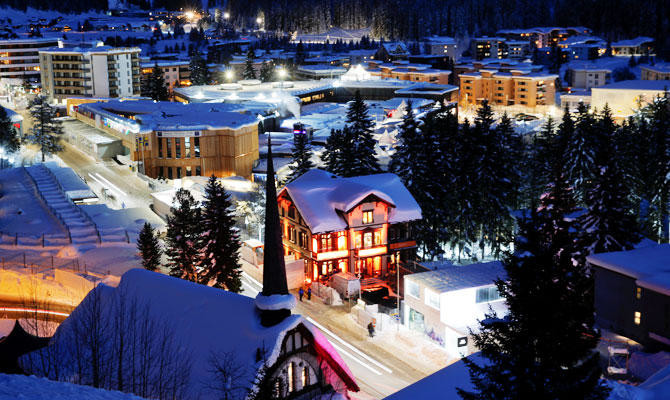
A night view shows a congress centre (L), the venue of the upcoming World Economic Forum (WEF) in the Swiss mountain resort of Davos, Switzerland, January 20, 2019. (REUTERS)
2 / 3
A person passes by a World Economic Forum logo in Davos, Switzerland, January 20, 2019. (REUTERS)
3 / 3
People are seen in a congress center ahead of the World Economic Forum in Davos, Switzerland, January 20, 2019. (REUTERS)
Updated 21 January 2019
Follow

World’s 26 richest own same as poorest half of humanity: Oxfam

  • Oxfam warned that governments were exacerbating inequality by increasingly underfunding public services like health care and education at the same time as they consistently under-tax the wealthy

DAVOS, Switzerland: The world’s 26 richest people own the same wealth as the poorest half of humanity, Oxfam said Monday, urging governments to hike taxes on the wealthy to fight soaring inequality.
A new report from the charity, published ahead of the World Economic Forum in Davos, also found that billionaires around the world saw their combined fortunes grow by $2.5 billion each day in 2018.
The world’s richest man, Amazon CEO Jeff Bezos, saw his fortune increase to $112 billion last year, Oxfam said, pointing out that just one percent of his wealth was the equivalent to the entire health budget of Ethiopia, a country of 105 million people.
The 3.8 billion people at the bottom of the scale meanwhile saw their wealth decline by 11 percent last year, Oxfam said, stressing that the growing gap between rich and poor was undermining the fight against poverty, damaging economies and fueling public anger.
“People across the globe are angry and frustrated,” warned Oxfam executive director Winnie Byanyima in a statement.
The numbers are stark: Between 1980 and 2016, the poorest half of humanity pocketed just 12 cents on each dollar of global income growth, compared with the 27 cents captured by the top one percent, the report found.
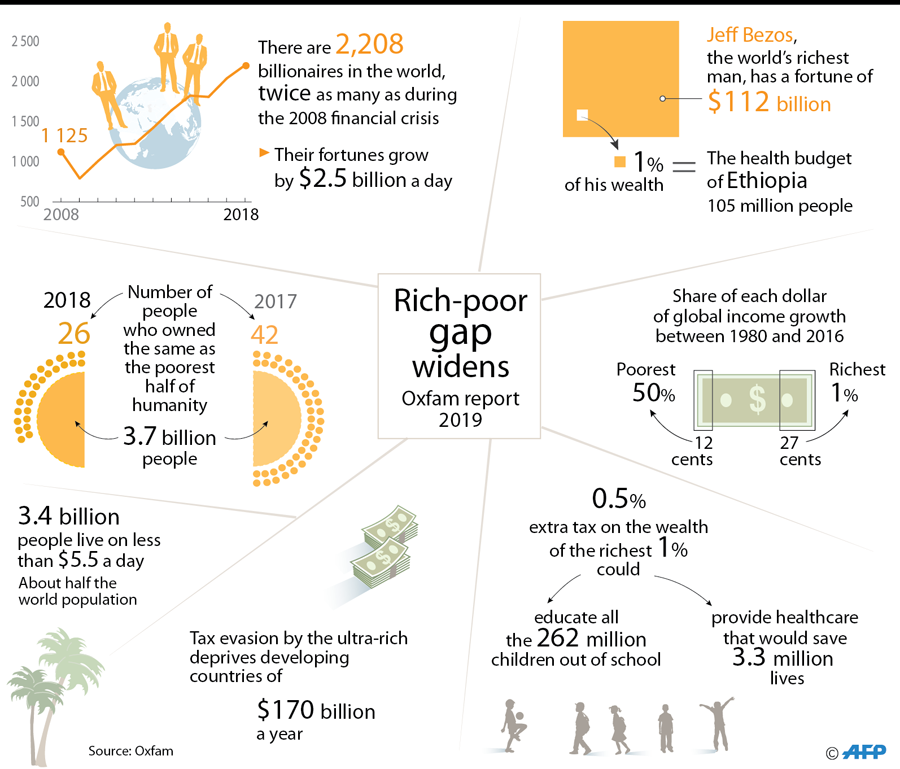

Oxfam warned that governments were exacerbating inequality by increasingly underfunding public services like health care and education at the same time as they consistently under-tax the wealthy.
Calls for hiking rates on the wealthy have multiplied amid growing popular outrage in a number of countries over swelling inequality.
In the United States, new congresswoman Alexandria Ocasio-Cortez made headlines earlier this month by proposing to tax the ultra-rich up to 70 percent.
The self-described Democratic Socialist’s proposal came after President Donald Trump’s sweeping tax reforms cut the top rate last year from 39.6 percent to 37 percent.
And in Europe, the “yellow vest” movement that has been rocking France with anti-government protests since November is demanding that President Emmanuel Macron repeal controversial cuts to wealth taxes on high earners.
“The super-rich and corporations are paying lower rates of tax than they have in decades,” the Oxfam report said, pointing out that “the human costs — children without teachers, clinics without medicines — are huge.”
“Piecemeal private services punish poor people and privilege elites,” it said, stressing that every day, some 10,000 people die due to lacking access to affordable health care.
The report, released as the world’s rich, famous and influential began arriving for the plush annual gathering at the luxury Swiss ski resort town, urged governments to “stop the race to the bottom” in taxing rich individuals and big corporations.
Oxfam found that asking the richest to pay just 0.5 percent extra tax on their wealth “could raise more money than it would cost to educate all 262 million children out of school and provide health care that would save the lives of 3.3 million people.”


US intercepts fifth sanctioned tanker as it exerts control over Venezuelan oil distribution

Updated 4 sec ago
Follow

US intercepts fifth sanctioned tanker as it exerts control over Venezuelan oil distribution

WASHINGTON: US forces boarded another oil tanker in the Caribbean Sea on Friday, the US military said, as the Trump administration targets sanctioned tankers traveling to and from Venezuela as part of a broader effort to take control of the South American country’s oil.
The predawn raid was carried out by Marines and Navy sailors launched from the aircraft carrier USS Gerald R. Ford, part of the extensive force the US has built up in the Caribbean in recent months, according to US Southern Command, which declared “there is no safe haven for criminals” as it announced the seizure of the tanker called the Olina. The Coast Guard then took control of the vessel, officials said.
Southern Command and Homeland Security Secretary Kristi Noem both posted unclassified footage on social media Friday morning of a US helicopter landing on the vessel and US personnel conducting a search of the deck and tossing what appeared to be an explosive device in front of a door leading to inside the ship.
In her post, Noem said the ship was “another ‘ghost fleet’ tanker ship suspected of carrying embargoed oil” and it had departed Venezuela “attempting to evade US forces.”
The Olina is the fifth tanker that has been seized by US forces as part of the effort by President Donald Trump’s administration to control the production, refining and global distribution of Venezuela’s oil products, and the third since the US ouster of Venezuela President Nicolás Maduro in a surprise nighttime raid.
In a post on his social media network later in the day, Trump said the seizure was conducted “in coordination with the Interim Authorities of Venezuela” but offered no elaboration.
The White House did not immediately respond to requests for more details.
Venezuela’s government acknowledged in a statement that it was working with US authorities to return the tanker, “which set sail without payment or authorization from the Venezuelan authorities,” to the South American nation.
“Thanks to this first successful joint operation, the ship is sailing back to Venezuelan waters for its protection and relevant actions,” according to the statement.
Samir Madani, co-founder of TankerTrackers.com, said his organization used satellite imagery and surface-level photos to document that at least 16 tankers left the Venezuelan coast in contravention of the quarantine US forces have set up to block sanctioned ships from conducting trade. The Olina was among that flotilla.
US government records show that the Olina was sanctioned for moving Russian oil under its prior name, Minerva M, and flagged in Panama.
While records show the Olina is now flying the flag of Timor-Leste, it is listed in the international shipping registry as having a false flag, meaning the registration it is claiming is not valid. In July, the owner and manager of the ship on its registration was changed to a company in Hong Kong.
According to ship tracking databases, the Olina last transmitted its location in November in the Caribbean, north of the Venezuelan coast. Since then, however, the ship has been running dark with its location beacon turned off.
While Noem and the military framed the seizure as part of an effort to enforce the law, other officials in the Trump administration have made clear they see it as a way to generate cash as they seek to rebuild Venezuela’s battered oil industry and restore its economy.
In an early morning social media post, Trump said the US and Venezuela “are working well together, especially as it pertains to rebuilding, in a much bigger, better, and more modern form, their oil and gas infrastructure.”
The administration said it expects to sell 30 million to 50 million barrels of sanctioned Venezuelan oil, with the proceeds to go to both the US and Venezuelan people. But the president expects the arrangement to continue indefinitely. He met Friday with executives from oil companies to discuss his goal of investing $100 billion in Venezuela to repair and upgrade its oil production and distribution.
Vice President JD Vance told Fox News this week that the US can “control” Venezuela’s “purse strings” by dictating where its oil can be sold.
Madani estimated that the Olina is loaded with 707,000 barrels of oil, which at the current market price of about $60 a barrel would be worth more than $42 million.