Kingdom’s biggest falconry festival ready to spread its wings

1 / 2
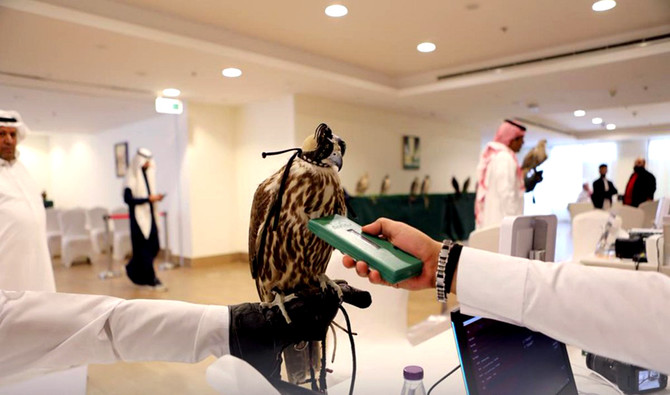
The Saudi Falcons Club is all to organize the first edition of the King AbdulAziz Falconry Festival next week. (Photo Courtesy: Saudi Falcons Club)
2 / 2
To support the pioneering role of the Arab falconers and the Kingdom’s interest in upholding the country’s heritage, a royal decree was stipulated to establish the Falcon Club in the Kingdom in 2017. (Photo Courtesy: Saudi Falcons Club)
Updated 19 January 2019
Follow

Kingdom’s biggest falconry festival ready to spread its wings

  • Saudi Arabia has more than 20,000 enthusiasts interested in the sport
  • First edition of the event will be held in Riyadh from January 25 to February 3

ISLAMABAD: Hunting with falcons is an ancient Arab cultural heritage, one which the Saudi Falcon Club hopes to promote by organizing the first edition of the King Abdulaziz Falconry Festival next week.

The event, which is set to be held in Riyadh from January 25 to February 3, is the biggest of its kind where thousands of enthusiasts will be in attendance, not only from Saudi Arabia and the region but from the rest of the world, too.

“There are more than 20,000 falconers in the Kingdom. To support the pioneering role of the Arab falconers and the Kingdom’s interest in this heritage, a royal decree was stipulated to establish the Falcon Club in the Kingdom in 2017 to create an association of falconers,” a statement posted on the Saudi Falcons Club’s website reads.

Saudi Arabia is one among several countries listed by UNESCO in the falcon-breeding category, especially since it is home to various types of local falcons and serves as a pathway for others that migrate across the country.

According to the club, falcons are divided into dozens of groups, which vary in size, weight, feather colors, speed, and their ability to fly. There is a miscellany of falcons living in various geographical and climatic regions, from extreme deserts to colder regions.

“Researchers have scientifically divided falcons’ origins into four main types: Falco Cherrug/Saker Falcon (Hurr), Gyrfalcon Falco Rusticolus (Jeer), Falco Peregrinus (Shaheen) and Lanner Falcon/Falco Biarmicus (Wakri),” the website says.

The club had hosted the first Saudi Falcons and Hunting Exhibition in Riyadh last year, where more than 250 exhibitors had participated from around the Kingdom, the GCC and the world.

Next week’s festival in Riyadh will feature other heritage-related activities focusing on families, young children and Saudi nationals.


ADB, Pakistan sign over $300 million agreements to undertake climate resilience initiatives

Updated 30 December 2025
Follow

ADB, Pakistan sign over $300 million agreements to undertake climate resilience initiatives

  • Pakistan ranks among nations most vulnerable to climate change and has seen erratic changes in weather patterns
  • The projects in Sindh and Punjab will restore nature-based coastal defenses and enhance agricultural productivity

ISLAMABAD: The Pakistani government and the Asian Development Bank (ADB) have signed more than $300 million agreements to undertake two major climate resilience initiatives, Pakistan’s Press Information Department (PID) said on Tuesday.

The projects include the Sindh Coastal Resilience Sector Project (SCRP), valued at Rs50.5 billion ($180.5 million), and the Punjab Climate-Resilient and Low-Carbon Agriculture Mechanization Project (PCRLCAMP), totaling Rs34.7 billion ($124 million).

Pakistan ranks among nations most vulnerable to climate change and has seen erratic changes in its weather patterns. In 2022, monsoon floods killed over 1,700 people, displaced another 33 million and caused over $30 billion losses, while another 1,037 people were killed in floods this year.

The South Asian country is ramping up climate resilience efforts, with support from the ADB and World Bank, and investing in climate-resilient infrastructure, particularly in vulnerable areas.

“Both sides expressed their commitment to effectively utilize the financing for successful and timely completion of the two initiatives,” the PID said in a statement.

The Sindh Coastal Resilience Project (SCRP) will promote integrated water resources and flood risk management, restore nature-based coastal defenses, and strengthen institutional and community capacity for strategic action planning, directly benefiting over 3.8 million people in Thatta, Sujawal, and Badin districts, according to ADB.

The Punjab project will enhance agricultural productivity and climate resilience across 30 districts, improving small farmers’ access to climate-smart machinery, introducing circular agriculture practices to reduce residue burning, establishing testing and training facilities, and empowering 15,000 women through skills development and livelihood diversification.

Earlier this month, the ADB also approved $381 million in financing for Pakistan’s Punjab province to modernize agriculture and strengthen education and health services, including concessional loans and grants for farm mechanization, Science, Technology, Engineering and Mathematics (STEM) education, and nursing sector reforms.