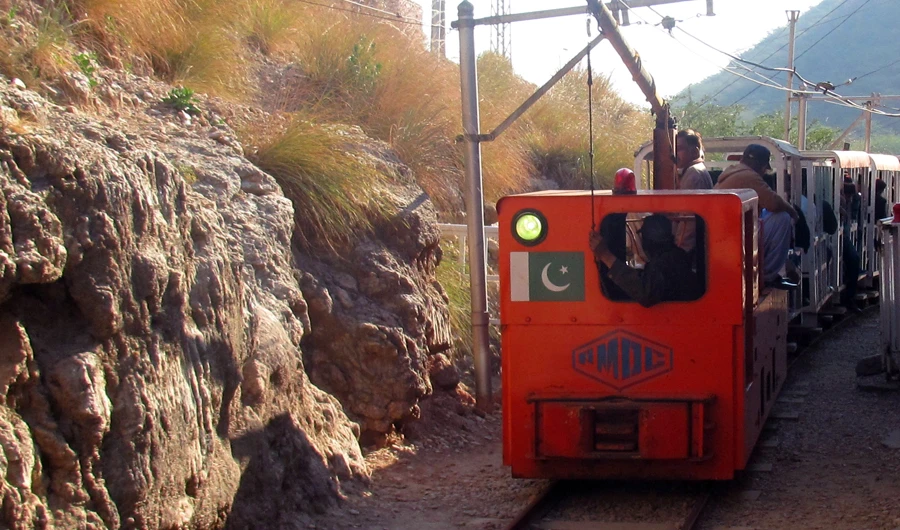
Inside Pakistan's Khewra, the second largest salt mine in the world

1 / 11
A view of a special train for visitors outside Khewra Salt Mine. (AN photo)
2 / 11
A labour crushes rock salt to make a souvenir at the Khwera Salt Mines.
3 / 11
The main entrance of the Khewra Salt Mines. (AN photo)
4 / 11
A special dispensary for asthma patients inside the Khewra Salt Mines. (AN photo)
5 / 11
A view of a cannon at the Khewra Salt Mines. (AN photo)
6 / 11
Salt is visible in rocks and the sand in the area around the Khewra Salt Mines. (AN photo)
7 / 11
Tourists buy souvenirs inside the Khewra Salt Mine. (AN photo)
8 / 11
Tourists seen buying items made from rock salt at the Khewra Salt Mines. (AN photo)
9 / 11
Melting salt particles seen inside a mine at the Khewra Salt Mines. (AN photo)
10 / 11
A tunnel view inside the salt mines of Khewra, Pakistan. The Khewra Salt Mines, located 100 miles south of Islamabad, are said to be the second largest salt mine in the world. (AN photo)
11 / 11
Workers load a truck with rock salt at the Khewra Salt Mines. (AN photo)
Updated 19 January 2019
Follow

Inside Pakistan's Khewra, the second largest salt mine in the world

  • The mines located about 160 kilometres south of the Pakistani capital of Islamabad
  • Nearly one million tourists visit the mine annually

KHEWRA: The Khewra Salt Mines, located about 160 kilometres south of the Pakistani capital of Islamabad, are said to be the second largest salt mine in the world and the largest in Pakistan. 

“Nearly one million tourists visit the mine annually,” senior guide Abid Hussain, who has worked at the mines since 1985, told Arab News. The entry fee is just 200 rupees. 

“Salt was previously extracted from the mine in three shifts, 24 hours a day, but now due to a shortage of workers it’s been limited to two morning and evening sessions,” Hussain said. The salt, normally used for human and animal consumption, is also exported to foreign countries including Korea, Japan and Malaysia.

The history of the mines dates back to 320 BC when Alexander the Great is said to have discovered them. The colonial British government improved mining practices in 1872. 

Shanzay Syed Bokhari, a seventh grade student from Kahuta, had come to Khewra just to see the salt mines. “It was interesting to read about it in our social studies book but seeing it is far better,” Bokhari said, saying she now planned to convince her classmates to pay a visit to the mines also.

“I must say it’s a beautiful gift from God to us,” said Syed Munir Hussain Shah, a school teacher who had brought his students to the mines on a field trip. “We explained the Khewra salt mines chapter to the students and today we brought them to show them. It will clear their minds and they will be able to explore it [the mines] by themselves,” Hussain said. 

The mines also have a souvenir store where you can buy models of the Minar-e-Pakistan, canons, and mosque made from salt bricks. There is also a restaurant and a unique dispensary where people with asthma spend 8-10 hours a day undergoing salt therapy.

Pakistan, global crypto exchange discuss modernizing digital payments, creating job prospects 

Updated 05 December 2025
Follow

Pakistan, global crypto exchange discuss modernizing digital payments, creating job prospects 

  • Pakistani officials, Binance team discuss coordination between Islamabad, local banks and global exchanges
  • Pakistan has attempted to tap into growing crypto market to curb illicit transactions, improve oversight

ISLAMABAD: Pakistan’s finance officials and the team of a global cryptocurrency exchange on Friday held discussions aimed at modernizing the country’s digital payments system and building local talent pipelines to meet rising demand for blockchain and Web3 skills, the finance ministry said.

The development took place during a high-level meeting between Finance Minister Muhammad Aurangzeb, Pakistan Virtual Assets Regulatory Authority (PVARA) Chairman Bilal bin Saqib, domestic bank presidents and a Binance team led by Global CEO Richard Teng. The meeting was held to advance work on Pakistan’s National Digital Asset Framework, a regulatory setup to govern Pakistan’s digital assets.

Pakistan has been moving to regulate its fast-growing crypto and digital assets market by bringing virtual asset service providers (VASPs) under a formal licensing regime. Officials say the push is aimed at curbing illicit transactions, improving oversight, and encouraging innovation in blockchain-based financial services.

“Participants reviewed opportunities to modernize Pakistan’s digital payments landscape, noting that blockchain-based systems could significantly reduce costs from the country’s $38 billion annual remittance flows,” the finance ministry said in a statement. 

“Discussions also emphasized building local talent pipelines to meet rising global demand for blockchain and Web3 skills, creating high-value employment prospects for Pakistani youth.”

Blockchain is a type of digital database that is shared, transparent and tamper-resistant. Instead of being stored on one computer, the data is kept on a distributed network of computers, making it very hard to alter or hack.

Web3 refers to the next generation of the Internet built using blockchain, focusing on giving users more control over their data, identity and digital assets rather than big tech companies controlling it.

Participants of the meeting also discussed sovereign debt tokenization, which is the process of converting a country’s debt such as government bonds, into digital tokens on a blockchain, the ministry said. 

Aurangzeb called for close coordination between the government, domestic banks and global exchanges to modernize Pakistan’s payment landscape.

Participants of the meeting also discussed considering a “time-bound amnesty” to encourage users to move assets onto regulated platforms, stressing the need for stronger verifications and a risk-mitigation system.

Pakistan has attempted in recent months to tap into the country’s growing crypto market, crack down on money laundering and terror financing, and promote responsible innovation — a move analysts say could bring an estimated $25 billion in virtual assets into the tax net.

In September, Islamabad invited international crypto exchanges and other VASPs to apply for licenses to operate in the country, a step aimed at formalizing and regulating its fast-growing digital market.