Syrian-born woman among 4 slain Americans in Manbij

1 / 2
The attack came a month after US President Donald Trump announced his decision to withdraw all 2,000 US troops from Syria. (AFP)
2 / 2
American Army Chief Warrant Officer Jonathan Farmer, 37, was killed in the northern Syrian town of Manbij. (Fort Bragg via AP)
Updated 20 January 2019
Follow

Syrian-born woman among 4 slain Americans in Manbij

  • US government sources say the Pentagon and other national agencies are investigating the bombing
  • This is one of the deadliest attacks on US forces in Syria since their deployment in 2015

WASHINGTON: One of the four Americans killed in a suicide bomb attack in Syria this week was a Navy sailor and married mother of two whose father is a high-ranking officer in the New York State Police, officials said on Friday.
The Pentagon identified three of the four Americans killed in Wednesday’s attack in the northern Syrian town of Manbij.
They are Army Chief Warrant Officer 2 Jonathan R. Farmer, 37, of Boynton Beach, Florida, who was based at Fort Campbell, Kentucky; Navy Chief Cryptologic Technician (Interpretive) Shannon M. Kent, 35, of Pine Plains, New York, and based at Fort Meade, Maryland; and a civilian, Scott A. Wirtz, from St. Louis.
The Pentagon has not identified the fourth casualty, a civilian contractor.
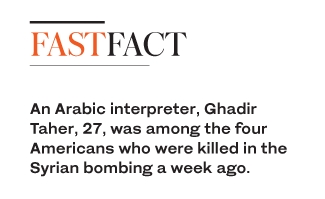
But according to The Atlanta Journal-Constitution, an Arabic interpreter who had emigrated from Syria to the US was among at least 20 people killed in the bombing.
Ali Taher told the newspaper on Friday that his older sister, Ghadir Taher, 27, of East Point, Georgia, was killed by the blast.
Ali Taher, who immigrated with his family to the US, said his sister’s smile would light up the room. He said she graduated from Tri-Cities High School and was kind and very easy to talk to.
The family learned of her death from her employer, Valiant Integrated Services, a defense contractor, he said.
In an email to the newspaper, Valiant spokesman Tom Becker confirmed the death, adding they were “extremely saddened by the tragic and senseless passing” of Ghadir Taher.
The attack, claimed by Daesh, also wounded three US troops and was the deadliest assault on US troops in Syria since American forces went into the country in 2015.
The Pentagon’s statement said Kent was from upstate New York but did not give a hometown. New York Gov. Andrew Cuomo said in a statement that she was from Pine Plains and was the daughter of state police field commander Col. Stephen Smith, the agency’s third-highest position.
“We owe her our eternal gratitude for her selfless dedication and sacrifice,” Cuomo said while ordering flags on state government buildings to be flown at half-staff in Kent’s honor.
Tara Grieb, principal of Stissing Mountain Junior-Senior High School in Pine Plains, said Kent grew up in the small, picturesque Hudson Valley town 145 km north of New York City and graduated from the local high school in 2001.
Grieb said Kent moved away after enlisting in the Navy in 2003.
“She was an honor student and a fabulous person,” Grieb said. “We are proud of her and her service and we support her family 100 percent in their time of sorrow.”
Kent’s mother, Mary Smith, taught sixth grade in the district until retiring last year, Grieb said.
Kent, who lived in Maryland with her husband and two children, was assigned to the Cryptologic Warfare Activity 66 based at Fort George Meade.
Cryptologic technicians are part of the Navy’s intelligence-gathering apparatus, analyzing encrypted electronic communications and using computers and other technology to compile information on the nation’s enemies.
Cmdr. Joseph Harrison, the unit’s commanding officer, said in a statement that Kent “was a rockstar, an outstanding Chief Petty Officer, and leader to many in the Navy Information Warfare Community.”
Florida’s Palm Beach Post reported that Farmer’s parents loaded suitcases into a friend’s SUV on Friday morning before heading to Dover, Delaware, for the return of their son’s remains.
Duncan Farmer characterized his son as “a good man. Good son. Good father. Good husband.” Then he added, “A good friend.”
Duncan Farmer said they knew Jonathan, a Green Beret, was in Syria, but “we didn’t know exactly where.”
Jonathan Farmer was born in Boynton Beach, Florida, south of West Palm Beach. He grew up in Palm Beach Gardens, attending the Benjamin School before going to Bowdoin College in Maine.
His father said Jonathan Famer was in the military for 13 years and had been in dangerous places “many times,” including Syria, Afghanistan and Iraq.
He said services will be at St. Patrick Catholic Church in Palm Beach Gardens, but a date has not been set. He said internment will be at Arlington National Cemetery.
In Missouri, Gov. Mike Parson asked Missourians to pray for the family of Wirtz, a former Navy SEAL who was working for the US Defense Intelligence Agency as an operations support specialist.
Wirtz “died bravely serving our nation in a dangerous part of the world, and for that we are grateful,” Parson said.


UK foreign minister urges UN Security Council to confront ‘bitter truth’ of ‘catastrophically failing Sudan’

Updated 5 sec ago
Follow

UK foreign minister urges UN Security Council to confront ‘bitter truth’ of ‘catastrophically failing Sudan’

  • Yvette Cooper recounts harrowing stories of atrocities during the country’s civil war, including ‘point-blank executions of civilians’ and sexual violence against women and girls
  • The diplomatic momentum that secured the Gaza ceasefire must now be harnessed to secure peace in Sudan and ensure those guilty of atrocities are held to account, she says

NEW YORK CITY: Britain’s foreign secretary, Yvette Cooper, on Thursday called on the UN Security Council to confront “the bitter truth” that the world has been “catastrophically failing the people of Sudan.”
The UK is chairing the Security Council this month, and Cooper is serving as its president. Setting out the scale of the crisis in Sudan, which has been locked in civil war since April 2023, she cited a report by a fact-finding mission on atrocities in El-Fasher, commissioned by the UK, that was published on Thursday.
She highlighted its accounts of “indiscriminate shootings, point-blank executions of civilians in homes, streets, open areas or while attempting to flee the city.”
In one incident, Cooper said: “A pregnant woman was asked how far she was in her pregnancy. When she responded ‘seven months,’ he fired seven bullets into her abdomen, killing her.”
Hospitals, medical personnel and the wounded “were not spared,” she added, and survivors reported being raped in front of relatives, including children.
The report concluded that the atrocities “bear the hallmarks of genocide,” Cooper said. “El-Fasher should have been a turning point. Instead, the violence now is continuing.”
More than three months after the fall of the city, she said, reports of violations of international humanitarian law and human rights abuses persist. Aid agencies face barriers to access, while schools, hospitals, markets and humanitarian convoys, including those belonging to the World Food Programme, have come under attack.
Since the start of the month alone, she said, there have been reports of strikes on aid operations by both of the warring military factions, the Sudanese Armed Forces and the Rapid Support Forces.
Cooper described what she had witnessed firsthand during a recent visit to the border between Chad and Sudan, and warned that behind the statistics lie shattered lives.
“At the Chad-Sudan border, in a camp of over 140,000 people who have fled Sudan’s conflict, 85 percent of them are women and children,” she said.
A Sudanese community worker told her she believed “half, more than half, the women in the camp had been subjected to sexual violence,” Cooper revealed.
She recounted the case of “three sisters arriving at one of the Sudanese emergency response rooms, who had all been raped. The oldest sister was 13. The youngest was eight.
“There is a war being waged on the bodies of women and girls. The world must hear the voices of the women of Sudan and not the military men who are perpetuating this conflict; voices that ensure that this council confronts the bitter truth, because the world has been catastrophically failing the people of Sudan.”
She described the conflict as “the worst humanitarian crisis of the 21st Century,” with 33 million people in need of assistance, 14 million forced from their homes, and famine “stalking millions of malnourished children.”
It is also a regional security crisis and a migration crisis, Cooper added, as she warned of destabilization across the Horn of Africa and the Sahel, opportunities for extremist groups to exploit the instability, and the risk of increased migration affecting Europe.
Cooper commended US-led efforts to convene regional powers, including Egypt, the UAE and Saudi Arabia, to discuss peace plans, as well as support from the African Union and the EU.
“We will need pressure from every UN member state,” she said. “I urge all of those with influence on both the RSF and the SAF not to fuel further conflict, but instead to exert maximum pressure on them to halt the bloodshed.”
She warned that “the reason that the military men still convince themselves there is a military solution is because they can still obtain ever-more lethal weapons.”
Arms restrictions “need to be enforced and extended,” Cooper said, adding: “Now is the time to choke off the arms flows and exert tangible pressure for peace.”
She also called for greater accountability, saying it was time for more sanctions against the perpetrators. The UK has already sanctioned senior RSF commanders linked to atrocities in El-Fasher, she said, and joined the US and France in proposing that they be designated by the Security Council.
Recalling the diplomatic momentum behind efforts to secure a ceasefire in Gaza last year, Cooper said: “We need that same energy and determination to bring peace for Sudan so we can
secure an immediate ceasefire, humanitarian truce, and so that those responsible for atrocities are held to account.
“Let this be the time that the world comes together to end the cycle of bloodshed and to pursue a path to peace.”