Iraq-Iran football match prompts awkward silence from Tehran-backed politicians in Baghdad

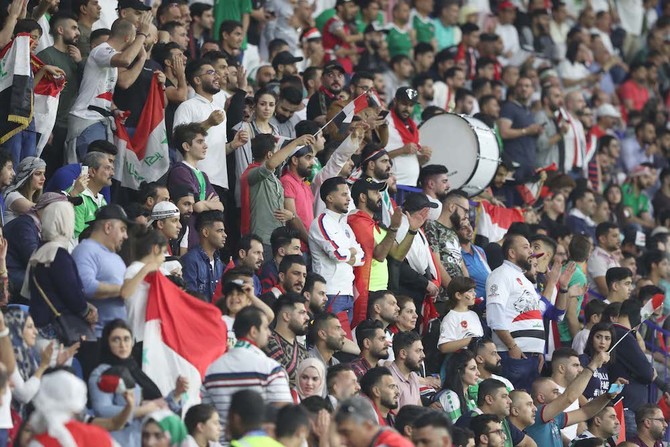
Iraqi fans cheer on their team inside the Al-Maktoum Stadium in Dubai. (AN photo)
Updated 16 January 2019
Follow

Iraq-Iran football match prompts awkward silence from Tehran-backed politicians in Baghdad

  • Iraqi official says failure of some politicians to get behind Iraqi team “embarrassing”
  • Many criticized Iran-backed political leaders in the build-up to the match for remaining silent

BAGHDAD: A much-anticipated football match between Iran and Iraq on Wednesday ended in an anticlimactic 0-0 draw. But in Baghdad, the Asian Cup clash proved fertile ground for Iraqi fans to poke fun at the crisis-ridden new government and express their rejection of Iranian influence in their country.

Many criticized Iran-backed political leaders in the build-up to the match for remaining silent and not encouraging the Iraqi national team against Iran.

Some even accused forces sponsored by Tehran of supporting the Iranian team instead of their own national players.

The game in Dubai was played against the backdrop of a tense political stand off in Iraq between pro and anti-Iran parties.

Iran has sought to deepen its influence in Iraq since the fall of Saddam Hussein in 2003. It supports armed factions and political parties, and increased its military involvement during the Daesh occupation of large parts of the country.

Iran-backed parliamentary blocs have been at loggerheads with rival groups for control of key government positions since an election in May.

Government figures and many MPs remained silent about the match, despite racing to encourage and congratulate the national team during previous games.

One senior Iraqi official told Arab News that the failure of some politicians to get behind the Iraqi team was “embarrassing”.

“Most of our political leaders have been silent as they are all busy praying that the Iraqi team will not win,” the official said. “How can they congratulate Iraqis on a victory against Iran?” he added sarcastically.

Fans were similarly bemused, posting scathing comments on social media.

“Today is the match between our team and the team of our lords,” Jaafar Al-Kinani, wrote on his Facebook page. “We ask God to help us determine which team we have to support.”

“I will support the referee. I cannot encourage any of the teams for fear of angering the other team,” Mustafa Nassir, wrote on his page.

Other fans posted more sincere calls for Iraqis to get behind their team despite the politics.

“All Iraqis will encourage the Iraqi team, even those close to Iran,” Ziyad Al-Dulaimaim, an activist from the Sunni-dominated western province of Anbar, wrote. “In 2007, our regions were under Al-Qaeda militants’ control and when the Iraqi team won the championship, everyone took to the street to celebrate, including the gunmen.”

Both Iraq and Iran had already qualified for the next round when they played on Wednesday. But a win against a strong team like Iran would have revived Iraqi hopes that they could reach the final.

In the build up to the match, many of the giant screens in Baghdad replayed previous Iraqi victories over Iran.

The last was in 2015 in the semifinal of the same tournament, when Iraq won in a penalty shootout. 

Cafes and clubs prepared for the match by offering free entry for families and decorating their facades with Iraqi flags. Thousands of Iraqis watched the match outside on the streets.

Both Iraq and Iran have won the Asian Cup in recent years. Iraq famously won in 2007 just four years after the fall of Saddam Hussein in a victory that came as the country was wracked by violence.



Foreign women linked to Daesh group in Syrian camp hope for amnesty after government offensive

Updated 30 January 2026
Follow

Foreign women linked to Daesh group in Syrian camp hope for amnesty after government offensive

  • Many of the women are either wives or widows of Daesh fighters who were defeated in Syria
  • “There were changes in the behavior of children and women. They became more hostile,” the camp’s director said

ROJ CAMP, Syria: Foreign women linked to the Daesh group and living in a Syrian camp housing more than 2,000 people near the border with Iraq are hoping that an amnesty may be on the horizon after a government offensive weakened the Kurdish-led force that guards the camp.
The women spoke to The Associated Press on Thursday in northeast Syria’s Roj camp, where hundreds of mostly women and children linked to Daesh have been held for nearly a decade.
The camp remains under control of the Kurdish-led Syrian Democratic Forces, which until recently controlled much of northeastern Syria. A government offensive this month captured most of the territory the group previously held, including the much larger Al-Hol camp, which is holding nearly 24,000 mostly women and children linked to Daesh.
Many of the women are either wives or widows of Daesh fighters who were defeated in Syria in March 2019, marking the end of what was once a self-declared caliphate in large parts of Iraq and Syria.
The most well-known resident of the Roj camp, Shamima Begum, was 15 when she and two other girls fled from London in 2015 to marry Daesh fighters in Syria. Begum married a Dutch man fighting for Daesh and had three children, who all died.
Last month, Begum lost her appeal against the British government’s decision to revoke her UK citizenship. Begum refused to speak to AP journalists at the camp.
The director of the Roj camp, Hakmiyeh Ibrahim, said that the government’s offensive on northeast Syria has emboldened the camp residents, who now tell guards that soon they will be free and Kurdish guards will be jailed in the camp instead.
“There were changes in the behavior of children and women. They became more hostile,” the camp’s director said. “It gave them hope that the Daesh group is coming back strongly.”
Since former Syrian President Bashar Assad was toppled in a lightning rebel offensive in December 2024, the country’s new army is made up of a patchwork of former insurgent groups, many of them with Islamist ideologies.
The group led by now-interim President Ahmad Al-Sharaa was once linked to Al-Qaeda although Al-Sharaa’s group and Daesh were rivals and fought for years. Since becoming president, Al-Sharaa — formerly known by the nom de guerre Abu Mohammed Al-Golani — has joined the global coalition against Daesh.
Camp residents hope for amnesty
One woman from Tunisia who identified herself only as Buthaina, pointed out that Al-Sharaa was removed from the UN and US lists of terrorists.
“People used to say that Al-Golani was the biggest terrorist. What happened to him later? He became the president of Syria. He is not a terrorist any more,” she said. “The international community gave Al-Golani amnesty. I should be given amnesty too.”
She added, “I did not kill anyone or do anything.”
The camp director said more than 2,300 people are housed in the Roj camp. They include a small number of Syrians and Iraqis, but the vast majority of them — 742 families — come from nearly 50 other countries, the bulk of them from states in the former Soviet Union.
That is in contrast to Al-Hol camp, where most residents are Syrians and Iraqis who can be more easily repatriated. Other countries have largely been unwilling to take back their citizens. Human rights groups have for years cited poor living conditions and pervasive violence in the camps.
The US military has begun moving male Daesh detainees from Syrian prisons to detention centers in Iraq, but there is no clear plan for the repatriation of women and children at the Roj Camp.
“What is happening now is exactly what we have been warning about for years. It is the foreseeable result of international inaction,” said Beatrice Eriksson, the cofounder of the children rights organization Repatriate the Children in Sweden. “The continued existence of these camps is not an unfortunate by-product of conflict, it is a political decision.”
Some women don’t want to go home
Some of the women interviewed by the AP said they want to go back home, while others want to stay in Syria.
“I did not come for tourism. Syria is a Muslim country. Germany is all infidels,” said a German woman who identified herself only as Aysha, saying that she plans to stay.
Another woman, a Belgian who identified herself as Cassandra, said she wants to get out of the camp but would like to stay in the Kurdish-controlled area of Syria.
She said that her French husband was an Daesh fighter killed in the northern city of Raqqa, once considered the de facto capital by Daesh. She said Belgium has only repatriated women who had children, unlike her. She was 18 when she came to Syria, she said.
Cassandra added that when fighting broke out between government forces and Kurdish fighters, she started receiving threats from other camp residents because she had good relations with the Kurdish guards.
Future of the camps in limbo
The government push into northeast Syria led to chaos in some of the more than a dozen detention centers where nearly 9,000 members of Daesh have been held for years.
Syrian government forces are now in control of Al-Aqtan prison near Raqqa as well as the Shaddadeh prison near the border with Iraq, where more than 120 detainees managed to flee amid the chaos before most of them were captured again.
Part of an initial ceasefire agreement between Damascus and the SDF included the Kurdish-led group handing over management of the camps and detention centers to the Syrian government.
Buthaina, the Tunisian citizen, said her husband and her son are held in a prison. She said her husband worked in cleaning and did not fight, while her son fought with the extremists.
She has been in Roj for nine years and saw her other children grow up without proper education or a childhood like other children.
“All we want is freedom. Find a solution for us,” Buthaina said.
She said the Tunisian government never checked on them, but now she hopes that “if Al-Golani takes us there will be a solution.”
She said those accused of crimes should stand trial and others should be set free.
“I am not a terrorist. The mistake I made is that I left my country and came here,” she said. “We were punished for nine years that were more like 90 years.”