

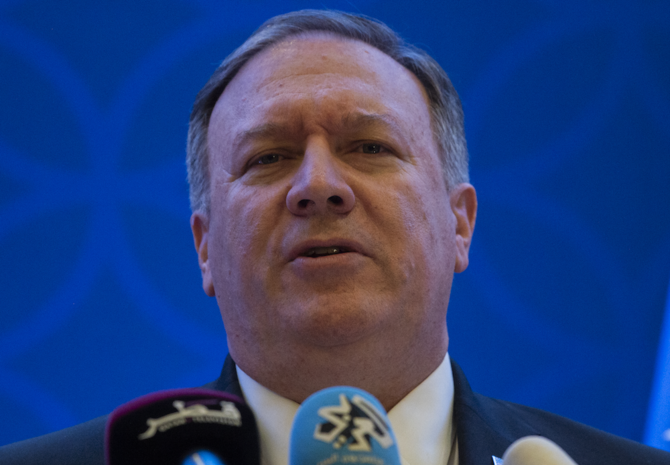
Pompeo slams Houthis for breaking Yemen cease-fire

US Secretary of State Mike Pompeo on Monday accused Iran-backed Houthi militias in Yemen of failing to comply with a cease-fire agreement for the Red Sea port city of Hodeidah. (AFP)
Updated 15 January 2019
Follow

Pompeo slams Houthis for breaking Yemen cease-fire

  • Comments came after he cut short his Middle East tour and headed home early to attend a family funeral
  • Pompeo and Prince Mohammed “agreed on the need for continued de-escalation” in Yemen

DUBAI: US Secretary of State Mike Pompeo on Monday accused Iran-backed Houthi militias in Yemen of failing to comply with a cease-fire agreement for the Red Sea port city of Hodeidah reached at UN-sponsored talks in Sweden.

His comments came after he cut short his Middle East tour and headed home early to attend a family funeral on Monday.

“The work that was done in Sweden on Yemen was good, but both sides need to honor those commitments,” Pompeo said in Riyadh after talks with Saudi King Salman and Crown Prince Mohammed bin Salman. “To date, the Houthis have chosen not to do that.”

The US Embassy in Riyadh said Pompeo and Prince Mohammed “agreed on the need for continued de-escalation and adherence to the Sweden agreements,” especially the cease-fire in Hodeidah.

“A comprehensive political solution is the only way to end the conflict,” the embassy said.

Hodeidah was for months the main front line in Yemen after government forces backed by a Saudi-led military coalition launched an offensive to capture it in June. More than 80 percent of Yemen’s imports pass through the port, but it is also a key route for Iranian arms and ammunition supplied to the Houthis, including parts for missiles used to attack Saudi Arabia.

The UN has said the Hodeidah truce has largely held since it came into force on Dec. 18, but there have been delays in the agreed pullback of Houthi and government forces. In 80 minutes of talks with the king and the crown prince, Pompeo restated US concern about the 19-month dispute between Qatar and other Gulf states over Doha’s support for terrorism, which he said was threatening regional unity needed to counter Iran.

“We did talk about how we might put the Gulf rift back in a better place,” he said. “I think they’d like to see that too.”

Pompeo said the king and the crown prince had also assured him everyone responsible for the murder of the Saudi journalist Jamal Khashoggi would be held accountable. Khashoggi, 59, was killed in the Saudi consulate in Istanbul last October. Eleven Saudis have been charged and prosecutors seek the death penalty for five of them.

The Saudi leaders “acknowledged that accountability needed to take place. They talked about the process inside their country, both the investigative process and the judicial process,” Pompeo said.

“They reiterated their commitment to achieve the objective, the expectations we set for them.”

Pompeo left Saudi Arabia for Oman on Monday but canceled plans to visit Kuwait because of a death in his family.

The ongoing dispute between Qatar and four of America’s other close Arab partners also featured in Pompeo’s talks, as the rift continues to hamper a US-led effort to unite the Gulf Arab states, Egypt and Jordan in a military alliance to counter Iran.

Bahrain, Egypt, Saudi Arabia and the UAE began a boycott of Qatar in June 2017, accusing Qatar of funding extremist groups and cozying up to Iran.


Saad Hariri pledges to contest May election

Updated 14 February 2026
Follow

Saad Hariri pledges to contest May election

  • Beirut rally draws large crowds on anniversary of his father’s assassination

BEIRUT: Lebanon’s former Prime Minister Saad Hariri announced on Saturday that his movement, which represents the majority of Lebanon’s Sunni community, would take part in upcoming parliamentary elections scheduled for May.

The Future Movement had suspended its political activities in 2022.

Hariri was addressing a large gathering of Future Movement supporters as Lebanon marked the 21st anniversary of the assassination of his father and former Prime Minister Rafik Hariri, at Martyrs’ Square in front of his tomb.

He said his movement remained committed to the approach of “moderation.”

A minute’s silence was observed by the crowd in Martyrs’ Square at the exact time when, in 2005, a suicide truck carrying about 1,000 kg of explosives detonated along Beirut’s seaside road as Rafik Hariri’s motorcade passed, killing him along with 21 others, including members of his security guards and civilians, and injuring 200 people.

Four members of Hezbollah were accused of carrying out the assassination and were tried in absentia by the Special Tribunal for Lebanon.

The crowd waved Lebanese flags and banners of the Future Movement as they awaited Saad Hariri, who had returned to Beirut from the UAE, where he resides, specifically to commemorate the anniversary, as has been an annual tradition.

Hariri said that “after 21 years, the supporters of Hariri’s approach are still many,” denouncing the “rumors and intimidation” directed at him.

He added: “Moderation is not hesitation … and patience is not weakness. Rafik Hariri’s project is not a dream that will fade. He was the model of a statesman who believed, until martyrdom, that ‘no one is greater than their country.’ The proof is his enduring place in the minds, hearts and consciences of the Lebanese people.”

Hariri said he chose to withdraw from political life after “it became required that we cover up failure and compromise the state, so we said no and chose to step aside — because politics at the expense of the country’s dignity and the project of the state has no meaning.”

He said: “The Lebanese are weary, and after years of wars, divisions, alignments and armed bastions, they deserve a normal country with one constitution, one army, and one legitimate authority over weapons — because Lebanon is one and will remain one. Notions of division have collapsed in the face of reality, history and geography, and the illusions of annexation and hegemony have fallen with those who pursued them, who ultimately fled.”

Hariri said the Future Movement’s project is “One Lebanon, Lebanon first — a Lebanon that will neither slide back into sectarian strife or internal fighting, nor be allowed to do so.”

He added that the Taif Agreement is “the solution and must be implemented in full,” arguing that “political factions have treated it selectively by demanding only what suits them — leaving the agreement unfulfilled and the country’s crises unresolved.”

He said: “When we call for the full implementation of the Taif Agreement, we mean: weapons exclusively in the hands of the state, administrative decentralization, the abolition of political sectarianism, the establishment of a senate and full implementation of the truce agreement. All of this must be implemented — fully and immediately — so we can overcome our chronic problems and crises together.

“Harirism will continue to support any Arab rapprochement, and reject any Arab discord. Those who seek to sow discord between the Gulf and Arab countries will harm only themselves and their reputation.

“We want to maintain the best possible relations with all Arab countries, starting with our closest neighbor, Syria — the new Syria, the free Syria that has rid itself of the criminal and tyrannical regime that devastated it and Lebanon, and spread its poison in the Arab world.”

Hariri said he saluted “the efforts of unification, stabilization and reconstruction led by Syrian President Ahmad Al-Sharaa.”

When asked about the Future Movement’s participation in parliamentary elections following his withdrawal from politics, he said: “Tell me when parliamentary elections will be held, and I will tell you what the Future Movement will do. I promise you that, when the elections take place, they will hear our voices, and they will count our votes.”

The US Embassy in Lebanon shared a post announcing that Ambassador Michel Issa laid a wreath at the grave of Rafik Hariri.

Hariri’s legacy “to forge peace and prosperity continues to resonate years later with renewed significance,” the embassy said.