

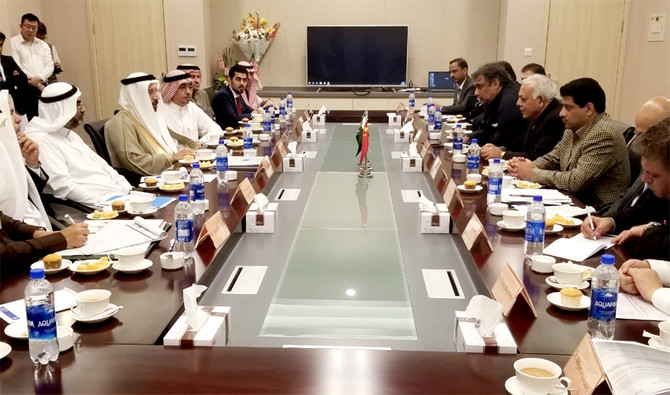


KARACHI: Saudi Arabia’s energy minister Khalid Al-Falih said on Saturday Saudi Arabia was planning to set up a $10 billion oil refinery in Pakistan’s deepwater port of Gwadar.
Al-Falih arrived in Gwadar on Saturday and visited the site of the proposed oil city.
“Pakistan and Saudi Arabia are the two strong foundations of peace and stability through investment ”, Khalid A Al-Falih said while speaking to media in Gwadar. “Saudi Arabia wants to make Pakistan’s economic development stable through establishing an oil refinery and partnership with Pakistan in the China Pakistan Economic Corridor (CPEC)," he added, referring to Beijing's $60 billion investment in power stations, major highways, new and upgraded railways and higher capacity ports in Pakistan.
Pakistan and Saudi Arabia are in talks over an agreement to install the Saudi Aramco Oil Refinery in Balochistan’s Gwadar district, which is the jugular vein of CPEC. Last year, Saudi Arabia offered Pakistan a $6 billion package that included help to finance crude imports.
Al-Falih, who is also chairman of the Board of Saudi Aramco, said bilateral relations between Pakistan and Saudi Arabia were very strong and Saudi Arabia would play its role for the development and prosperity of Pakistan through investment."
The Saudi delegation was received by Pakistan petroleum minister Ghulam Sarwar Khan, port and shippings minister Syed Ali Haider Zaidi and Baluchistan information minister Zahoor Buledi.
The visiting Saudi delegation and their hosts reviewed arrangements for signing the Memorandum of Understanding, likely next month.
Pakistan’s petroleum minister hoped that a MoU would be signed between the two governments during the expected visit of Saudi Crown Prince Muhammad Bin Salman: “This would be the biggest investment of Saudi Arabia in Pakistan."
Both countries are also expected to sign a number of investment agreements including petrochemical, refining, renewable energy, and mining during next month.
During the discussion with Pakistani counterparts, the Saudi delegation also discussed means to increase bilateral trade through exports and investment.
“The Saudi delegation led by Al Falih has come to see the area allocated for the oil refinery in Gwadar. Soon a state of the art oil refinery would be set up in Gwadar”, Ghulam Sarwar said, according to a statement issued by the ministry of petroleum.
The visiting Saudi delegation was briefed by the chairman of Gwadar Development Authority, Dostain Jamaldini, about the development of the country’s deep sea port being constructed with the help of China.
Earlier, Haroon Sharif, Chairman of Pakistan Board of Investment, had said that “Overall directions of agreement (MoU) have been agreed upon and the agreement will be signed at the appropriate time”.
“I am expecting around $15 billion investment from Saudi Arabia in the next three years. The inflow of investments for the oil refinery and petrochemical complex in Pakistan is estimated to be between $6 billion to $10 billion,” Sharif said.
Pakistan is hoping to attract more than $40 billion foreign direct investment in the next five years.
“We estimate that roughly around $40 billion investment will be made by these three countries (Saudi Arabia, the UAE, and China) during the next three to five years,” Sharif added.


