

Two terrorists killed in operation in Balochistan, ISPR says

IEDs (Improvised Explosive Devices), grenades and mines were recovered from suspected terrorist hideouts. (Photo courtesy: ISPR)
Updated 11 January 2019
Follow

Two terrorists killed in operation in Balochistan, ISPR says

  • Frontier Corps also recovered a cache of arms and ammunition during the crackdown
  • Move was part of an intelligence-based initiative against suspected militant hideouts

ISLAMABAD: Frontier Corps Balochistan killed two militants during an intelligence-based operation, as part of measures to weed out their alleged hideouts from Pakistan’s southern province, the military’s media wing, the Inter-Services Public Relations (ISPR), said on Friday.
The operation was conducted in Kalat, Kharan, and the Maiwand areas of Balochistan.
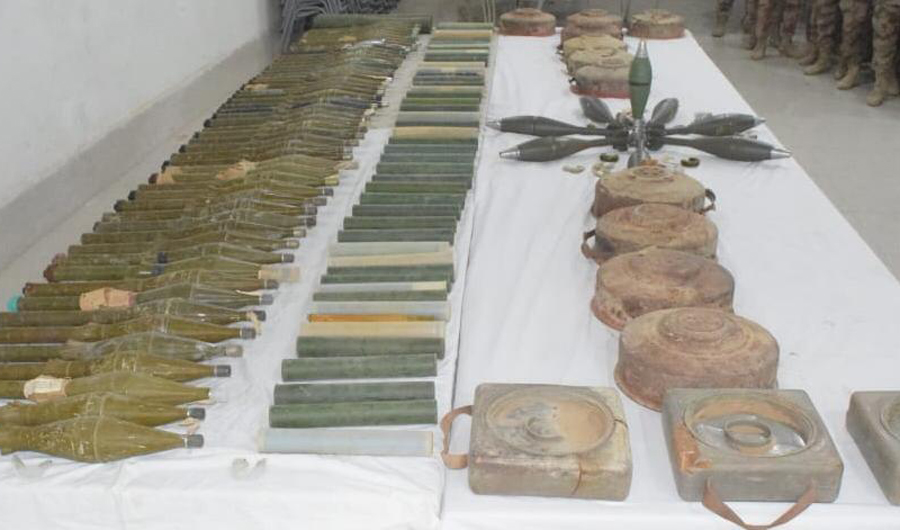


Frontier Corps also recovered a cache of arms and ammunition during the crackdown. (Photo courtesy: ISPR)


“Weapons and ammunition, including sub-machine guns, IEDs (Improvised Explosive Devices), grenades, mines, RPG-7 rockets, and communication equipment were also recovered,” the ISPR said in a statement.
The operation is part of the Pakistan army’s ongoing “Radd-ul-Fasaad” (elimination of strife) initiative which is being carried out across the country, the ISPR’s statement added.
In February 2017, the army — with the support of local enforcement agencies --launched the “Radd-ul-Fasaad” operation. 
At the time, the army had said that the aim of the nationwide operation was to eliminate militancy and gain a foothold in the counter-terrorism operations being conducted for the past several years in Pakistan. 
On Wednesday, Pakistan’s Army Chief General Qamar Javed Bajwa — while addressing soldiers in Bahawalpur city, in southern Punjab — said that Pakistan is a “peace-loving country and looks forward to peace within” and outside of it’s borders, keeping “in line with the vision of father of the nation.”


Pakistan expresses condolences as Bangladesh’s first female PM passes away

Updated 9 sec ago
Follow

Pakistan expresses condolences as Bangladesh’s first female PM passes away

  • Khaleda Zia passed away in Dhaka after prolonged illness at the age of 80, says her party
  • PM Shehbaz Sharif describes Zia as a “committed friend of Pakistan” in condolence message

ISLAMABAD: Prime Minister Shehbaz Sharif on Tuesday expressed condolences over the passing of Bangladesh’s first female prime minister, Khaleda Zia, describing her as a committed friend of Islamabad. 

In a statement on Tuesday, the Bangladesh Nationalist Party (BNP) announced its leader Zia had passed away at the age of 80 after prolonged illness. She died at the Evercare Hospital in Dhaka, where the former prime minister was admitted on Nov. 23 with symptoms of a lung infection, according to The Daily Star, a Bangladesh news website.

“Deeply saddened by the passing of Begum Khaleda Zia, Chairperson of the BNP and former Prime Minister of Bangladesh,” Sharif wrote on social media platform X. 

“Her lifelong service to Bangladesh and its growth and development leaves a lasting legacy.”

Sharif said his government and people stand with the people of Bangladesh during this difficult time. 

“Begum Zia was a committed friend of Pakistan,” he added. 

Pakistan and Bangladesh used to be part of the same country before the latter seceded into the separate nation of Bangladesh after a bloody civil war in 1971. 

Ties between the two countries have remained mostly strained since then. However, Islamabad enjoyed better relations with Dhaka under Zia’s government compared to when Bangladesh was led by her arch-rival, Sheikh Hasina. 

Hasina was ousted after a violent uprising last year, leading to improved relations between Islamabad and Dhaka. 

Despite years of ill health and imprisonment, Zia vowed in November to campaign in elections set for February 2026.

The BNP is widely seen as a frontrunner, and Zia’s son Tarique Rahman, who returned only on Thursday after 17 years in exile, is seen as a potential prime minister if they win a majority.

-With additional input from AFP