

Film Review: Girls of the Sun — A female Kurdish battalion gives Daesh a drubbing

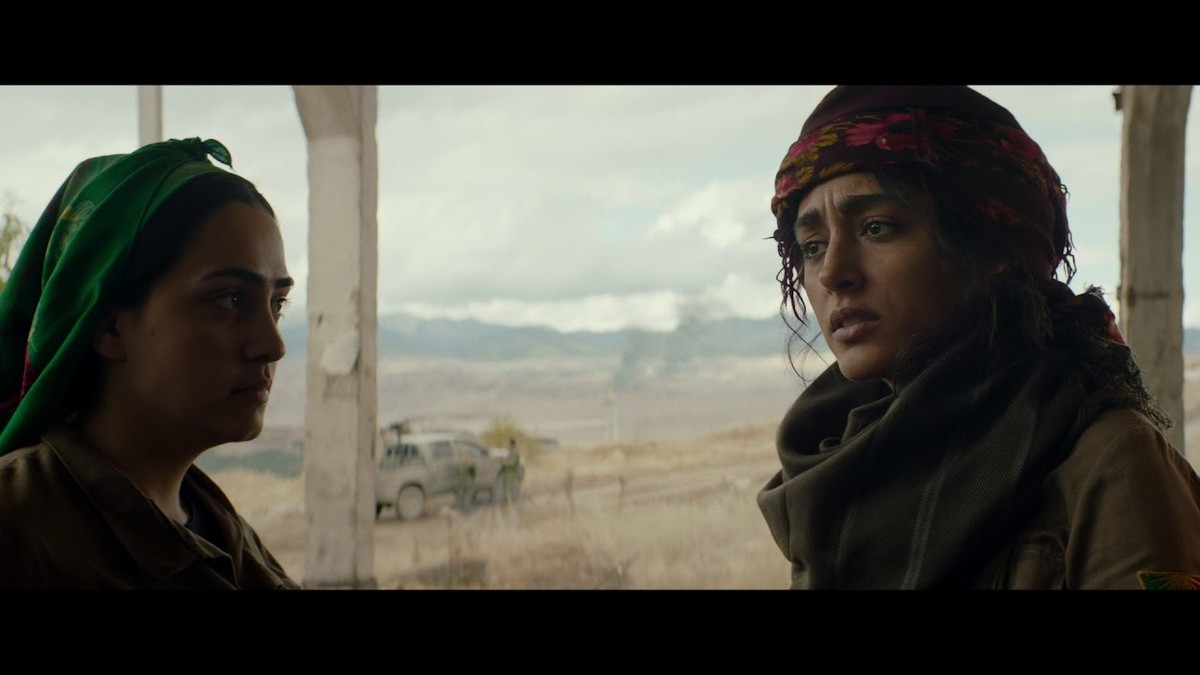
A still from the film 'Girls of the Sun'. (Supplied)
Updated 09 January 2019
Follow

Film Review: Girls of the Sun — A female Kurdish battalion gives Daesh a drubbing

  • 'Girls of the Sun' is a war drama
  • The film is a fictional story based on a true story

CHENNAI: Eva Husson’s war drama “Girls of the Sun” is hitting movie theaters just as the world’s attention is once again focused on northern Iraq, where this fictional story, based on a true story, is set. It also comes as Hollywood, under attack for underrepresentation of women in the industry, is trying to stamp out gender inequality.

With the exiled Iranian actress Golshifteh Farahani in the role of Bahar, commander of a Kurdish unit battling Daesh, “Girls of the Sun” is a paean to the courage and never-say-die attitude of a band of female combatants. From a bored but extremely patient wife in “The Patience Stone” to a Rajasthani woman in “The Song of Scorpions,” Farahani has a brilliant range.

In “Girls of the Sun” Bahar and her comrades take advantage of a male jihadi superstition that death at the hands of a woman will push them straight into hell. A university graduate from Iraq and once a lawyer by profession, Bahar was sold into virtual slavery, her husband murdered and her young son sent away to be trained as a rebel soldier.

Another strong female character is Mathilde (Emmanuelle Bercot), a French war reporter who lost an eye in a conflict zone and has landed in Iraq – a character obviously modelled on American journalist Marie Colvin who died covering the siege of Homs in Syria in early 2012. A film based on Colvin’s life, “A Private War,” has since been made.
French director Husson, the granddaughter of Spanish Republican soldiers, is believed to have written “Girls of the Sun” to explore the theme of resistance against fascist oppression. The message is decidedly feminist, the script is powerful and the action sequences are true to life.

According to one study, women accounted for just 8 percent of directors of the 250 highest-grossing Hollywood films made in 2018. The overall percentage of women in behind-the-scenes movie roles rose to a paltry 20 percent from 18 percent in 2017. “Girls of the Sun,” which competed for the Palme d’Or at the 2018 Cannes Film Festival, marks a step by Hollywood in the right direction.


Art Cairo part of a ‘long-term cultural project,’ founder says

Updated 25 January 2026
Follow

Art Cairo part of a ‘long-term cultural project,’ founder says

CAIRO: As Art Cairo 2026 draws to a close, its founder Mohammed Younis is keen to set the fair apart from its regional counterparts — and also asserts that the annual event is part of a “long-term cultural project.”

The fair, which took place at the Grand Egyptian Museum and wrapped up on Jan. 26, boasted a distinctly Arab flavor, in terms of galleries, artists and the themes of the artworks on show.

Younis says that is all part of a conscious curatorial effort.

“Art Cairo stands apart from other art fairs in the region as the only platform dedicated exclusively and intentionally to Arab art … While many regional fairs present a broad, globalized perspective, Art Cairo emerges from a different vision — one rooted in presenting Arab art from within,” Younis told Arab News.

Across the fair, depictions of golden age icons such as 1950s superstar Mohamed Mohamed Fawzy by painter Adel El-Siwi jostled for attention alongside ancient iconography and pop culture references from the Arab world.

Abu Dhabi’s Salwa Zeidan Gallery, for example, exhibited work by up-and-coming Egyptian artist Passant Kirdy.

“My work focuses on Egyptian heritage in general, including pharaonic and Islamic art. These influences are always present in what I create. This symbol you’re looking at is a pharaonic scarab …  I’m very attached to this symbol,” she told Arab News.

The Arab focus of the curation is part of an effort to bill Art Cairo as a “long-term cultural project,” Younis noted.

“Ultimately, Art Cairo is not simply an art fair; it is a long-term cultural project. It exists to support Arab artists, contribute to building a sustainable art market, and articulate an authentic Arab narrative within the regional and international art landscape.”