


NEW DELHI: India’s parliamentary lower house on Tuesday passed a controversial bill that gives non-Muslim communities from neighboring Afghanistan, Pakistan and Bangladesh citizenship rights despite strong dissent from opposition parties.
The opposition called the bill “an attack on the core of the Indian constitution.”
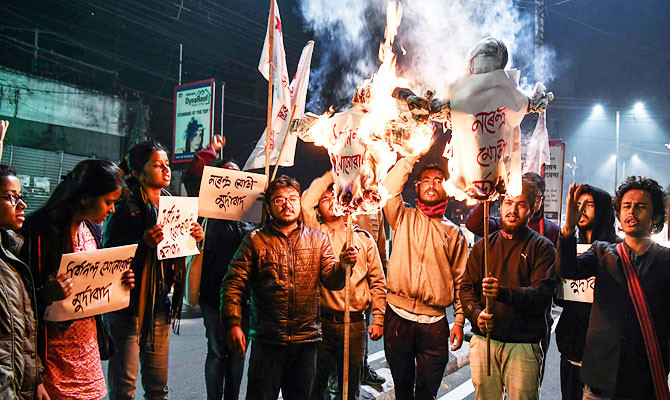
The bill was passed on a day when all seven northeastern states were brought to a standstill by protests over the proposed legislation.
“The Citizenship (Amendment) Bill is not for Assam alone or for the betterment of migrants coming from a particular country,” the Home Minister Rajnath Singh told Parliament.
“This bill is also for migrants who have come from the western borders and have settled down in Rajasthan, Punjab, New Delhi and Rajasthan,” he said.
“Minorities are persecuted in Pakistan and other neighboring countries. They have faced violence. The bill offers security to persecuted minorities.”
The bill will grant citizenship to Hindus, Sikhs, Buddhists, Jains, Parsis and Christians who fled religious persecution in Bangladesh, Pakistan and Afghanistan and entered India before Dec. 31, 2014.
However, the opposition Congress Party walked out of Parliament, saying the bill was discriminatory and against the spirit of the constitution.
“The bill will lead to unrest not only in Assam but also in several parts of India,” Mallikarjun Kharge, the party’s parliamentary leader, said.
Saugata Roy, a senior opposition leader with the Trinamool Congress based in West Bengal, condemned what he described “as the most diabolical and divisive bill of the past 70 years.”
“Muslims are not included among the six religions mentioned in the bill. Make it secular. Anyone who comes out of religious persecution should be included if they seek asylum in India,” he said.
While Parliament debated the contentious bill, protests brought states in India’s northeast to a near standstill after student organizations and civil rights groups demanded an 11-hour shutdown.
Assam was worst affected by the strike with some street protests descending into violence. The call for the shutdown was made by the All Assam Student Union (AASU) and several civil rights groups.
“The overwhelming response to the call for the strike shows how agitated the people of Assam are over the Citizenship Bill,” said Sammujal Bhattacharya, an adviser to the AASU.
“The bill is sectarian and communal in nature. In India, citizenship cannot be decided on the basis of religion. We will fight with all that we have,” he said.
Bhattacharya said the Assam accord of 1985 fixed the cut-off date for granting citizenship to people who entered India from Bangladesh as March 1971, and any attempt to tamper with the deadline would be met with resistance.
The BJP government, under the leadership of Prime Minister Narendra Modi, introduced the bill in 2016.
Critics say that by amending the Citizenship Act, the BJP wants to protect Bengali Hindus who have come from Bangladesh while ignoring Muslims.
Rezaul Karim Sarkar, of the AASU, claimed the bill “will disturb communal harmony in Assam. It will incite violence between Hindu and Muslim. The BJP is aiming at the 2019 elections and wants to win on the basis of religious violence.”
However, the Bengali United Forum of Assam said the bill will help Hindu Bengalis “live a respectable life.”
Mahananda Sarkar Dutta, the forum’s chief coordinator, said: “We are not part of the BJP or any political party. The people of Assam should not blame us for the bill. Other communities will also benefit,” he said.


