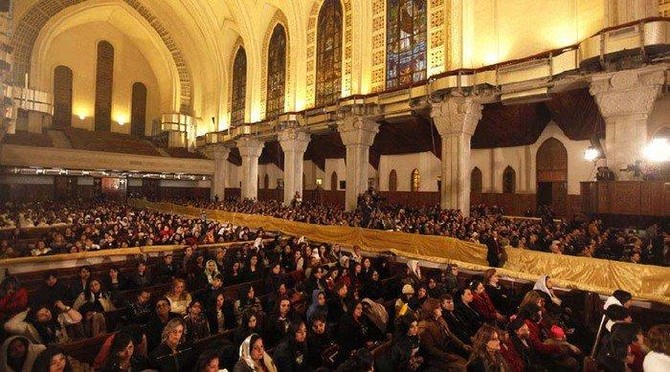
While the rest of the Christian world has recently celebrated Christmas, Jan. 7 is the day Coptic Christians mark the birth of Jesus Christ, according to the Orthodox calendar.
It’s marked in Egypt
Over 10 million Christians reside in Egypt, which makes up 10 percent of the country’s entire population. Most of them are Orthodox Copts, the largest Christian population in the Middle East.
Jan. 7 is the day
Unlike Dec. 25, Coptic Christians celebrate the birth of Jesus Christ on Jan. 7, following the Coptic calendar. This is the same for other Orthodox Christians in places like Russia and Serbia.
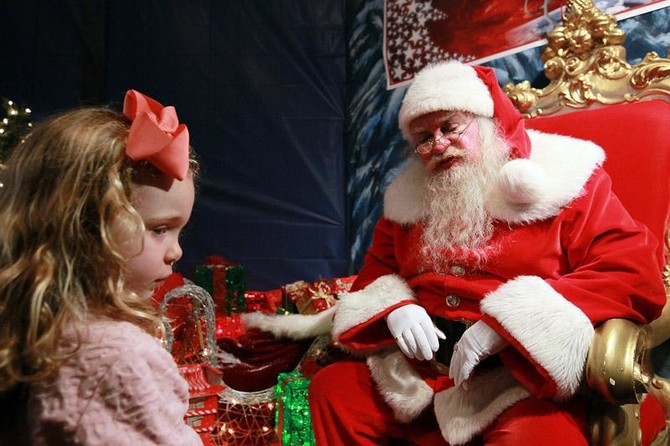
Baba Noel is Santa
Children patiently wait for Baba Noel (Father Christmas), the Copts’ own version of Santa Claus. Stories have it that Baba Noel finds his way through windows and leaves some gifts, often in exchange of an Egyptian treat called “Kahk.”
There is fasting…
In the run-up to Christmas day, Coptic Christians fast for 43 days, avoiding food products that come from animals. The fasting period starts Nov. 25 and lasts until the day before Christmas.
… and singing
The month before Christmas is called Kiahk, the fourth month in the Coptic calendar where Copts sing special songs of praise or “Kiahk tunes” on Saturday evenings. The month plays a significant role in Copts’ preparation for Christmas.
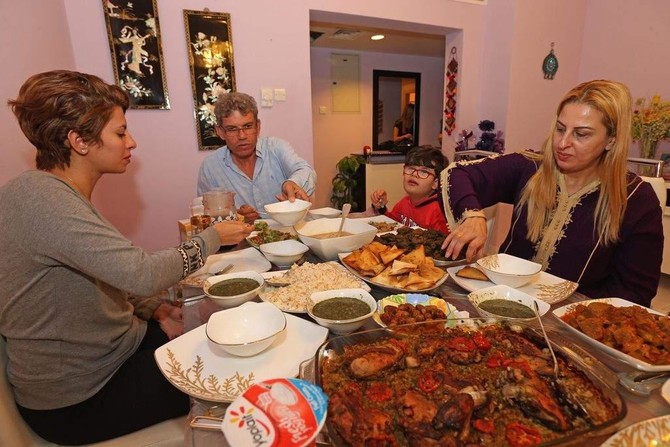
… and feasting
After the Christmas service on the eve of Jan. 7, Copts break their fast with a feast of meat. A favorite Coptic dish during Christmas is called “fatta,” which consists of rice, bread, and boiled lamb or beef.

Everything you need to know about Coptic Christmas
Sotheby’s to bring coveted Rembrandt lion drawing to Diriyah
DUBAI: Later this month, Sotheby’s will bring to Saudi Arabia what it describes as the most important Rembrandt drawing to appear at auction in 50 years. Estimated at $15–20 million, “Young Lion Resting” comes to market from The Leiden Collection, one of the world’s most important private collections of 17th-century Dutch and Flemish art.
The drawing will be on public view at Diriyah’s Bujairi Terrace from Jan. 24 to 25, alongside the full contents of “Origins II” — Sotheby’s forthcoming second auction in Saudi Arabia — ahead of its offering at Sotheby’s New York on Feb. 4, 2026. The entire proceeds from the sale will benefit Panthera, the world’s leading organization dedicated to the conservation of wild cats. The work is being sold by The Leiden Collection in partnership with its co-owner, philanthropist Jon Ayers, the chairman of the board of Panthera.
Established in 2006, Panthera was founded by the late wildlife biologist Dr. Alan Rabinowitz and Dr. Thomas S. Kaplan. The organization is actively engaged in the Middle East, where it is spearheading the reintroduction of the critically endangered Arabian leopard to AlUla, in partnership with the Royal Commission for AlUla.
“Young Lion Resting” is one of only six known Rembrandt drawings of lions and the only example remaining in private hands. Executed when Rembrandt was in his early to mid-thirties, the work captures the animal’s power and restless energy with striking immediacy, suggesting it was drawn from life. Long before Rembrandt sketched a lion in 17th-century Europe, lions roamed northwest Arabia, their presence still echoed in AlUla’s ancient rock carvings and the Lion Tombs of Dadan.
For Dr. Kaplan, the drawing holds personal significance as his first Rembrandt acquisition. From 2017 to 2024, he served as chairman of the International Alliance for the Protection of Heritage, of which Saudi Arabia is a founding member.
The Diriyah exhibition will also present, for the first time, the full range of works offered in “Origins II,” a 64-lot sale of modern and contemporary art, culminating in an open-air auction on Jan. 31 at 7.30 pm.