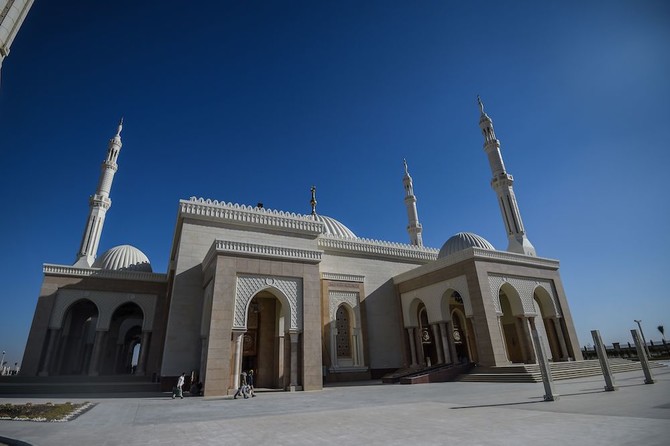
CAIRO: President Abdel Fattah El-Sisi inaugurated Egypt's largest church and mosque in the New Administrative Capital on Sunday, the eve of Coptic Christmas, in a symbolic message of tolerance in the predominantly Muslim nation.
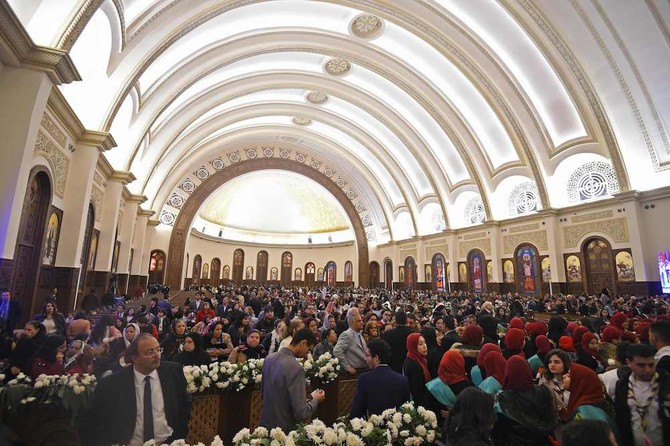
Copts, the largest Christian minority in the Middle East, were due hold a midnight mass in the Cathedral of the Nativity, billed by the government as the Middle East's largest church, a few hours after the inauguration.
Coptic Christians make up an estimated 10 percent of Egypt's nearly 100 million people and have long complained of discrimination under laws that favour Muslims.
They have also increasingly been targeted in recent years by militants including Daesh, which is waging an insurgency in the north of the remote Sinai Peninsula.
Foreign dignitaries and officials including Palestinian President Mahmoud Abbas and Arab League Chief Ahmed Aboul Gheit flanked Sisi at the opening, state television showed.
Angham, a prominent local singer, sang for Muslim-Christian coexistence as a display of fireworks lit the skies over the two houses of worship.
"On this day we see you have fulfilled this promise and here we are witnessing a great opening on this grand occasion," the head of the Coptic church Pope Tawadros II said. He will preside over midnight mass later in the evening with Sisi in attendance.
US President Donald Trump also praised the opening of the church and the mosque.
"Excited to see our friends in Egypt opening the biggest Cathedral in the Middle East. President El-Sisi is moving his country to a more inclusive future," Trump tweeted on Sunday.
The Cathedral of the Nativity, adorned with Coptic icons, can accommodate more than 8,000 worshippers while the Al-Fattah Al-Aleem Mosque can hold nearly double the number. Both are located in the new administrative capital, a major development located some 45 km (28 miles) east of Cairo.
Contractors have been clearing debris from the perimeter of the cathedral in the last two weeks in preparation for its grand opening, a Reuters witness said.
The new Egyptian capital, announced in March 2015, is intended partly to reduce crowding in Cairo but will also be home to government ministries and an airport. The government is expecting to begin moving to the new premises later this year.


Egypt’s Sisi opens mega-mosque and Middle East’s largest cathedral in New Capital



Egypt’s Sisi opens mega-mosque and Middle East’s largest cathedral in New Capital

- Saturday’s explosion on the eastern edge of Cairo that killed a policeman who was trying to defuse the device
- Coptic Christians have been hit by a string of attacks


Syrian and Lebanese presidents discuss border security after Hezbollah strikes hit west Damascus
- Ahmad Al-Sharaa expresses Syria’s absolute support for Lebanese government’s efforts to disarm the Iran-backed militant group
LONDON: The Syrian president, Ahmad Al-Sharaa, and his Lebanese counterpart, Joseph Aoun, discussed border security on Tuesday.
It came as Syria accused the Iran-backed militant group Hezbollah of massing reinforcements close to the border, targeting army positions in Syria, and launching artillery shells from Lebanese territory that landed near the town of Serghaya, west of the capital Damascus.
During his conversation with Aoun, Al-Sharaa expressed his absolute support for the Lebanese government’s efforts to disarm Hezbollah, the Syrian Arab News Agency reported. Depriving the group of its weapons was a crucial step in efforts to strengthen the sovereignty of Lebanon and protect the region from the consequences of ongoing armed conflicts, he added.
The two leaders also emphasized the need for joint action to ensure the safety of the Syrian people.
Thousands of Syrians who fled to Lebanon to escape the 13-year civil war in their country have returned home since the US and Israel launched strikes against Iran on Feb. 28, and the spread of the conflict to other parts of the Middle East.
Israel has launched strikes against Israel and several Arab countries in the region, while Hezbollah, an ally of Tehran which the UK and other nations consider a terrorist organization, has also fired into Israel.
Israeli forces have hit back against Hezbollah with strikes on southern Lebanon and southern Beirut, and its forces have occupied key areas south of the Litani River.


