KARACHI: With an eye on further strengthening the bilateral and trade ties between Riyadh and Islamabad, the Kingdom will soon be undertaking renewable energy projects in Pakistan, officials said on Sunday.
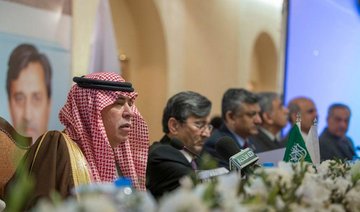
A. Q. Khalil, former president of Karachi Chamber of Commerce and Industry (KCCI), quoted the Saudi Advisor for Energy & Mineral Resources, Ahmad Al Ghamdi, when he discussed the matter with Arab News.
Khalil was part of the KCCI team which met with the Saudi delegation. He added that Saudi company, ACWA Power, would soon be visiting Pakistan to introduce its renewable energy technologies.
“We have also discussed the investment opportunities in Pakistan’s mining sector and in this regard, a Memorandum of Understanding is at final stage which will soon be signed between the countries, signifying the commencement of new relations between Pakistan and Saudi Arabia,” Al Ghamdi told the Pakistani businessmen.
He suggested that businessmen from both countries could meet more frequently and participate in trade promotional events in Saudi Arabia and Pakistan.
Al Ghamdi said that the businessmen from Saudi’s private sector were unaware of the opportunities in Pakistan and hesitant to invest in the country due to security concerns. “If we keep saying Pakistan is safe and secure, they will not believe us. However, if someone from Pakistani government comes and guarantees about the safety and security, besides extending full support of the Pakistani government, Saudi investors will certainly get a strong signal for making an investment,” a statement released by the KCCI quotes Al Ghamdi as saying.
Referring to a recent meeting which took place during Prime Minister Imran Khan’s visit to Saudi Arabia, Al Ghamdi said that Khan was particularly focused on visa issues – something which had also been raised by other top leaders from Pakistan.
“Saudi Arabia is now going through a transformation as many new things and rules have been introduced which will hopefully be beneficial for Pakistan and Saudi Arabia. The ease in issuance of visas is also being discussed, particularly the tourism visa so that people could be encouraged to explore tourism in Saudi Arabia,” he said, adding that “we would like to get some of the very good Pakistani products in Saudi Arabia and would also like to improve Saudi exports to Pakistan as we want to create a win-win situation for both countries.”
President KCCI, Junaid Esmail Makda said that a KCCI delegation will be leaving for Saudi Arabia on January 12 to explore trade opportunities.
Makda said that Pakistan and Saudi Arabia share healthy bilateral relations based on cooperation in different economic spheres, particularly trade and investment. “In recent years, both countries have developed plans to expand bilateral cooperation in trade, education, real estate, tourism, information technology, communications, and agriculture.
He also appreciated the Kingdom for providing $3 billion as financial support to Pakistan in order to address the country’s balance of payments crisis, in addition to a one-year deferred payment facility for the import of oil worth $3 billion. He mentioned that during 2017, goods worth $400.8 million were exported to Saudi Arabia while the imports stood at $2.73 billion, indicating a trade balance which was in favor of Saudi Arabia by $2.32 billion.
While highlighting the huge potential to enhance trade and investment ties, Makda told the Saudi delegates that Pakistan's investment policy provides a comprehensive framework and a conducive business environment. It entails reducing the cost of doing business, eases the processes of doing business, and emphasizes the creation of industrial clusters and Special Economic Zones.
Saudi companies can choose between setting up a liaison office, branch office or incorporate a Pakistani company as either it’s a wholly-owned subsidiary or joint venture with a Pakistani/overseas partner, he said. “It is the right time to invest in Pakistan and capitalize on the widespread opportunities available,” he stressed.
While appreciating the investment gestures from Saudi Arabia, Khalil told Arab News that Pakistan has huge resources which needs to be explored and countries from the Islamic bloc, especially Saudi Arabia, should take the initiative in this regard.
Experts say the future of Pakistan lies in the renewable energy sector and that the Kingdom’s interest in alternative energy projects is a step in the right direction. “It is a timely offer from a brotherly country, which is a friend in need for Pakistan,” Sajiz Aziz, an energy expert, told Arab News.
He added: “Pakistan is the signatory of the Kyoto protocol, which requires the countries to phase out all the conventional sources of energy, like furnace oil and coal, and move towards using green energy, including solar power, wind power, biogas and kinetic and all other sources with no omission.”