



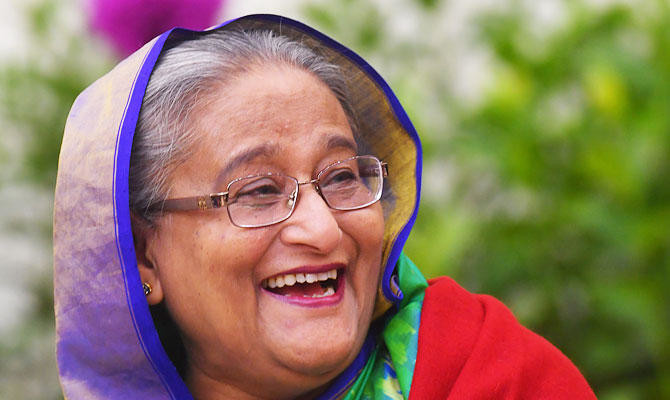


DHAKA: A crushing victory for Prime Minister Sheikh Hasina in an election overshadowed by allegations it was fixed raises fears about the future of democracy in Bangladesh, analysts say.
Hasina’s Awami League party extended its decade-long grip on power by winning an unprecedented 98 percent of seats while key opposition parties are now floundering in the wilderness with next to no representation in parliament.
The Muslim-majority nation is now an entrenched “one-party system,” political analyst Ataur Rahman told AFP, likening it to Southeast Asian ruling parties of the 1970s and 80s.
“There will be less space for freedom of press, civil society... (and) political parties” after the election, said Rahman, who heads the Dhaka-based Center for Governance Studies.
Hasina, Bangladesh’s longest-serving leader, has been accused of locking up dissenters and presiding over enforced disappearances as well as muzzling freedom of speech through a draconian anti-press law toughened this year.
She denies any authoritarianism.
The main opposition Bangladesh Nationalist Party (BNP) endured its worst ever electoral performance Sunday while the country’s largest Islamist party has been crushed in government crackdowns.
The Jamaat-e-Islami’s leaders and many of its activists have gone underground to avoid arrest since the party was banned from putting up candidates under its own banner in 2012.
Five of its top leaders have been hanged over war crimes charges dating back to Bangladesh’s 1971 independence war.
The BNP has claimed the detention of thousands of its activists ahead of the poll prevented it from running anything close to an effective campaign.
It rejected the results, saying the vote was “90 percent rigged” due to ballot box stuffing and a climate of fear which deterred voters from going to polling booths.
The BNP picked up only six seats compared with 288 for the Awami League and its allies in a 300-seat parliament, raising questions about where it goes from here.
“The country has turned into a totalitarian one-party system. It is not BNP’s problem but the whole nation is facing the biggest crisis,” BNP secretary general Fakhrul Islam Alamgir told AFP.
And one Western diplomat, who asked to remain anonymous, said: “The health of Bangladesh’s democracy is now seriously in question.”
“Bangladesh has decided to follow the Cambodian precedent and not Malaysia’s.”
Political experts say the BNP, a right-of-center party which has ruled Bangladesh for 15 of its 47 years as an independent country, must accept some blame for its own demise.
The root of its present troubles, they say, lies in its decision to boycott the 2014 election over fears it wouldn’t be free and fair, gifting victory to Hasina.
“It was a suicidal decision,” said Rahman.
The BNP was founded by military dictator Ziaur Rahman in the late 1970s. His widow Khaleda Zia revived it in the 1980s after Rahman was killed in a coup.
The party joined forces with the Awami League to oust military dictator Hussain Muhammad Ershad in 1990.
But then Zia and Hasina fell out and were nicknamed the “Battling Begums.”
Zia won two elections, in 1991 and 2001, as she and Hasina alternated in power.
The BNP leader was this year sentenced to 17 years in jail for what her supporters say are trumped-up graft charges, ruling her out of the election, Bangladesh’s 11th since independence.
Zia’s party is facing “an existential crisis,” according to political scientist Shahab Enam Khan of Jahangirnagar University.
He said the huge election defeat was a “wake-up call” for the party to “reform itself” so it can “respond to the new form of politics that has emerged in the country.”
Khan believes Sunday’s controversial election has delivered a “fractured mandate... which neither the public nor the politicians can unconditionally accept or invalidate.”
“This is an uncertain situation for democracy in Bangladesh, more precisely for BNP,” he told AFP.
The BNP is unlikely to organize mass protests over doubts it can mobilize enough support but Rahman, the analyst, thinks the it can slowly build support again.
“Their movement for an election to be overseen by (a) neutral government will gain momentum,” he said.


