

Sudan’s Bashir tells police not to use excessive force against demonstrators

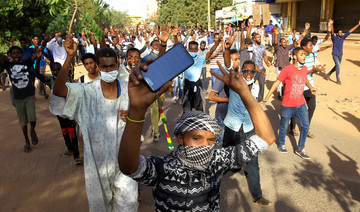
Bashir met top police officers in Khartoum and instructed them to refrain from using excessive force against demonstrators. (AFP)
Updated 30 December 2018
Follow

Sudan’s Bashir tells police not to use excessive force against demonstrators

  • Protesters have rallied after the government raised the price of a loaf of bread from one Sudanese pound to three

KHARTOUM: Sudan’s President Omar Bashir on Sunday told police to abstain from using excessive force against anti-government demonstrators as the UN called for a probe into deaths during the violent protests.

At least 19 people have been killed since Dec. 19 during protests sparked by Khartoum’s decision to hike the price of bread, according to the government.

Rights group Amnesty International says 37 people have died.

On Sunday, Bashir met top police officers in Khartoum and instructed them to refrain from using excessive force against demonstrators.

“We want to maintain security and we want the police to do that by using less force,” Bashir, dressed in a blue police uniform, said.

Protesters have rallied after the government raised the price of a loaf of bread from one Sudanese pound to three (from about 2 to 6 US cents).

Sudan is facing an acute foreign exchange crisis and soaring inflation despite Washington lifting an economic embargo in October 2017.

Inflation is running at 70 percent and the Sudanese pound has plunged in value, while shortages of bread and fuel have regularly hit several cities.

“We admit that we have economic problems... but they can’t be solved by destructions, lootings, and thefts,” Bashir said, referring to buildings and ruling offices torched by protesters in several cities during the demonstrations.

“We don’t want our country to go the way other countries in the region have gone,” he said.

“We will not allow our people to be refugees. If this happens where can we go in this region?”

UN Secretary-General Antonio Guterres appealed “for calm and restraint” and called on “the authorities to conduct a thorough investigation into the deaths and violence,” a UN spokesman said in a statement on Friday.

The UN chief is “following with concern” developments in Sudan and “emphasizes the need to safeguard freedom of expression and peaceful assembly,” the spokesman added.

Libya’s security authorities free more than 200 migrants from ‘secret prison’, two security sources say

Updated 6 sec ago
Follow

Libya’s security authorities free more than 200 migrants from ‘secret prison’, two security sources say

BENGHAZI: Libya’s security authorities have freed more than 200 migrants from what they described as a secret prison in the town of Kufra in the southeast of the country after they ​were held captive in inhuman conditions, two security sources from the city told Reuters on Sunday.
The security sources, speaking on condition of anonymity, said that the security authorities had found an underground prison, nearly three meters deep, which the sources said was run by a Libyan human trafficker.
One of the sources said this person had not yet been detained.
“Some of the freed migrants were ‌held captive up ‌to two years in the underground cells,” ‌this ⁠source ​said.
The ‌other source said what the operation had found was “one of the most serious crimes against humanity that has been uncovered in the region.”
“The operation resulted in a raid on a secret prison within the city, where several inhumane underground detention cells were uncovered,” one of the sources added.
The freed migrants are from sub-Saharan Africa, mainly from Somalia ⁠and Eritrea, including women and children, the sources said. Kufra lies in eastern Libya, ‌about 1,700 kilometers (1,000 miles) from the capital ‍Tripoli.
Libya has become a transit ‍route for migrants fleeing conflict and poverty to Europe via dangerous ‍routes across the desert and over the Mediterranean since the toppling of Muammar Qaddafi in a NATO-backed uprising in 2011.
The oil-based Libyan economy is also a draw for impoverished migrants seeking work, but security throughout the ​sprawling country is poor, leaving migrants vulnerable to abuses.
At least 21 bodies of migrants were found in a ⁠mass grave in eastern Libya last week, with up to 10 survivors in the group bearing signs of having been tortured before they were freed from captivity, two security sources told Reuters.
Libya’s attorney general said in a statement on Friday the authorities in the east of the country had referred a defendant to the court for trial in connection with the mass grave on charges of “committing serious violations against migrants.”
In February last year, 39 bodies of migrants were recovered from about 55 mass graves in Kufra. The town houses ‌tens of thousands of Sudanese refugees who fled the conflict that erupted in Sudan in 2023.