DHAKA: Bangladesh is set to hold general elections on Sunday amid heightened security throughout the country. More than 104 million people will vote to elect leaders in the country’s almost 300 constituencies. A total of 1,860 candidates from almost 40 political parties are competing in the election.
According to local media reports, more than 1,000 supporters of the Bangladesh Nationalist Party (BNP) and Jatiya Oikya Front (JOF) have been injured in dozens of clashes over the past three weeks.
“Security measures have been beefed up through Bangladesh’s Armed Forces, Border Guards Bangladesh and the country’s Rapid Action Battalion,” said Asdauzzaman Miah, Dahaka police commissioner.
More than 50,000 soldiers from Bangladesh’s army have been deployed throughout the country.
“We will collaborate with several law enforcement agencies to ensure voter safety and accuracy,” said Aziz Ahmed, chief of army staff.
“I have learned from past experience that minority communities often fall victim to violence after election results have been announced, especially among voters whose leaders did not win the elections. At the end of the day, we hope for an inclusive voting process.”
Several international human rights bodies have expressed concern over the transparency of the upcoming elections, questioning “the integrity and credibility of the upcoming election” considering “the prevalent conditions in the country.”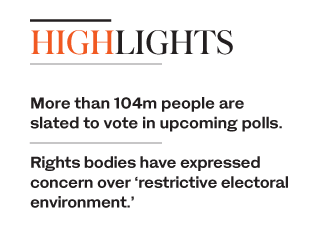
In a statement issued Saturday, human rights officials from 16 organizations expressed concern over the “restrictive electoral environment.”
“Ever since the election was announced, the government has embarked on a crackdown on civil society, the opposition and the media, undermining any semblance of a democratic process,” read the statement.
“This places a severe strain on the waning health of democratic engagement in Bangladesh and compromises the integrity of the upcoming election. The credibility of an election is not defined solely on competitiveness and orderliness of the process, but most importantly, on the quality of the electoral environment. As the election draws near, independent civil society organizations and media have experienced restrictions on their operations.”
Chief Election Commissioner K. M. Nurul Huda urged law enforcement agencies to remain impartial and vigilant.
“We hope those on duty will take an iron fist approach with anyone trying to wreak havoc at the polling states,” he said. “Officers found to have influenced polling through abuse of power will be held to book.”
Kamal Hossain, JOF chief, also urged election officials to remain impartial on polling day. “Where the public should be celebrating, residents are in a state of fear and apprehension,” said Hossain. “Vote tomorrow. Don’t let them intimidate you. Evil forces will flee before you. They can’t fight people’s strength.”
The Ruling Awami League (AL) claims they will accept whatever election result prevails.
“AL came to power through the people’s vote,” said Abdul Rahman, AL general secretary, adding that more than 400 AL supporters recently came under attack by BNP and JOF supporters. To curtail provocative fake content circulating on social media, all five of Bangladesh’s mobile phone operators, including state-owned Teletalk, suspended their 3G and 4G services on Saturday. “The Bangladesh Telecommunication Regulatory Commission (BTRC) has asked mobile operators to keep services suspended until Sunday at midnight,” Mohammad Zakir Hossain Khan, senior assistant media director at BTRC, told Arab News.
According to the BTRC, the country has more than 90 million mobile data users.


![]()

Security heightened as Bangladesh votes today

Security heightened as Bangladesh votes today
- Clashes have gripped the Muslim majority country of 165 million in the run-up to the polls
- “We have ensured the highest level of security in Bangladesh as per the capacity of the country,” Rafiqul Islam of the election commission said


Latest updates


Recommended


© 2026 SAUDI RESEARCH & PUBLISHING COMPANY, All Rights Reserved And subject to Terms of Use Agreement.