BEIRUT: Syrian troops deployed in support of Kurdish forces in a strategic northern city on Friday, in a shift of alliances hastened by last week’s announcement of a US military withdrawal.
Nearly eight years into Syria’s deadly conflict, the move marked another key step in President Bashar al-Assad’s Russian-backed drive to reassert control over the country.
Buoyed by its military victories, the regime is also making progress in efforts to break its diplomatic isolation, with Thursday’s reopening of the Emirati embassy in Damascus.
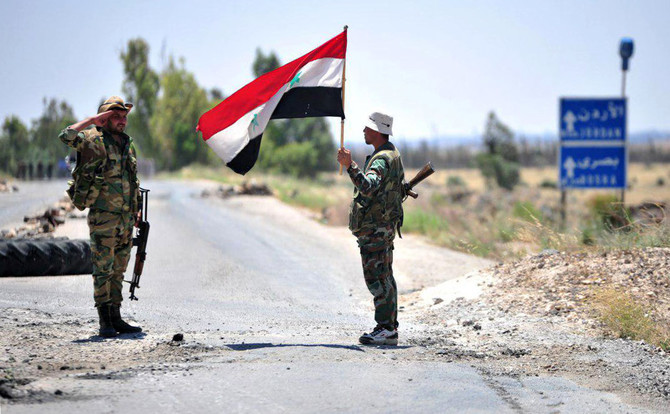
The Syrian army announced that it had raised the flag in Manbij, a strategic city close to the Turkish border where US-led coalition forces are stationed.
A military spokesman said in a televised announcement that the army would be bent on "crushing terrorism and defeating all invaders and occupiers".
More than 300 government forces deployed in the Manbij area, according to the Syrian Observatory for Human Rights.
The Britain-based war monitor stressed however that regime troops had mostly moved into areas around the city, inside which US and French forces are still believed to be stationed.
Their deployment creates a regime buffer arching across northern Syria that fully separates the Turkish army and its proxies from the Kurds.
US President Donald Trump’s shock announcement last week that he was ordering all US forces back home left the Kurds in the cold.
The People’s Protection Units (YPG) have been the backbone of an alliance that has spearheaded the US-backed fight against Daesh in Syria.
They are currently battling the last remnants of the extremists’ once sprawling "caliphate" in the country’s far east, near the border with Iraq.
A US withdrawal will leave them exposed to an assault by Turkey, which has thousands of proxy fighters in northern Syria and wants to crush Kurdish forces it considers terrorists.
The Kurds issued a statement welcoming the regime advance, a pragmatic shift in alliances that will dash their aspirations for autonomy but could help cut their losses after a US pullout they resent as a betrayal.
"We invite the Syrian government forces... to assert control over the areas our forces have withdrawn from, particularly in Manbij, and to protect these areas against a Turkish invasion," the YPG said in a statement.
After Manbij, the focus is likely to move to Raqqa, a mostly Arab city that the Kurds liberated from IS last year and that the regime has vowed to retake.
Turkey said Syrian Kurds "don’t have the right" to seek regime help but Russia, the main foreign player in Syria since it intervened to rescue Assad in 2015, hailed the latest development.
"Of course, this will help in stabilizing the situation. The enlargement of the zone under the control of government forces... is without doubt a positive trend," said Kremlin spokesman Dmitry Peskov.
Peskov said the situation would be discussed on Saturday during a visit to Moscow by the Turkish foreign and defense ministers, to "clarify" the situation and "synchronize actions" between the two countries.
The year 2018 saw the regime, which three years earlier was clinging for dear life and controlled less than a third of the country, reclaim large swathes of territory.
The government ousted rebels from their bastions in and around the capital Damascus and flushed out other pockets to reopen key transport and trade routes.
With internal opposition in tatters and UN-backed political negotiations stillborn, Assad is now trying to shed his pariah status and looking for funds to rebuild the country.
The US pullout from Syria risks opening a highway for other regional players such as Turkey and Iran, a prospect that some of Assad’s erstwhile foes are keen to counter.
On Thursday, the United Arab Emirates -- a Turkish rival in the region -- reopened its embassy in Damascus, six years after severing ties and recognizing a now defunct opposition umbrella.
The move was the latest in a series of developments building up to the return of Assad’s Syria into the Arab fold.
Bahrain also announced it would reopen its mission in the Syrian capital while observers expect regional heavyweight Saudi Arabia to confirm that trend in the coming weeks.
The Arab League has admitted that the reintegration of Syria, which was suspended from the regional body when it intensified its repression of anti-government protests seven years ago, is on the table.


Syria army enters Manbij in new alliance with Kurds
Syria army enters Manbij in new alliance with Kurds

- The announcement came moments after the Kurds, left exposed by a US pledge to pull out its own troops, asked for the regime's help to face a threatened Turkish offensive
- The Syrian army spokesman said the national flag was raised in Manbij, a key city which lies about 30 kilometres (19 miles) south of the Turkish border


The UN says Al-Hol camp population has dropped sharply as Syria moves to relocate remaining families

The UN says Al-Hol camp population has dropped sharply as Syria moves to relocate remaining families
- Forces of Syria’s central government captured the Al-Hol camp on Jan. 21 during a weekslong offensive against the SDF, which had been running the camp near the border with Iraq for a decade
DAMASCUS: The UN refugee agency said Sunday that a large number of residents of a camp housing family members of suspected Daesh group militants have left and the Syrian government plans to relocate those who remain.
Gonzalo Vargas Llosa, UNHCR’s representative in Syria, said in a statement that the agency “has observed a significant decrease in the number of residents in Al-Hol camp in recent weeks.”
“Syrian authorities have informed UNHCR of their plan to relocate the remaining families to Akhtarin camp in Aleppo Governorate (province) and have requested UNHCR’s support to assist the population in the new camp, which we stand ready to provide,” he said.
He added that UNHCR “will continue to support the return and reintegration of Syrians who have departed Al-Hol, as well as those who remain.”
The statement did not say how residents had left the camp or how many remain. Many families are believed to have escaped either during the chaos when government forces captured the camp from the Kurdish-led Syrian Democratic Forces last month or afterward.
There was no immediate statement from the Syrian government and a government spokesperson did not respond to a request for comment.
At its peak after the defeat of IS in Syria in 2019, around 73,000 people were living at Al-Hol. Since then, the number has declined with some countries repatriating their citizens. The camp’s residents are mostly children and women, including many wives or widows of IS members.
The camp’s residents are not technically prisoners and most have not been accused of crimes, but they have been held in de facto detention at the heavily guarded facility.
Forces of Syria’s central government captured the Al-Hol camp on Jan. 21 during a weekslong offensive against the SDF, which had been running the camp near the border with Iraq for a decade. A ceasefire deal has since ended the fighting.
Separately, thousands of accused IS militants who were held in detention centers in northeastern Syria have been transferred to Iraq to stand trial under an agreement with the US
The US military said Friday that it had completed the transfer of more than 5,700 adult male IS suspects from detention facilities in Syria to Iraqi custody.
Iraq’s National Center for International Judicial Cooperation said a total of 5,704 suspects from 61 countries who were affiliated with IS — most of them Syrian and Iraqi — were transferred from prisons in Syria. They are now being interrogated in Iraq.