

Abidi’s murder a result of possible infighting within MQM — Police

1 / 4
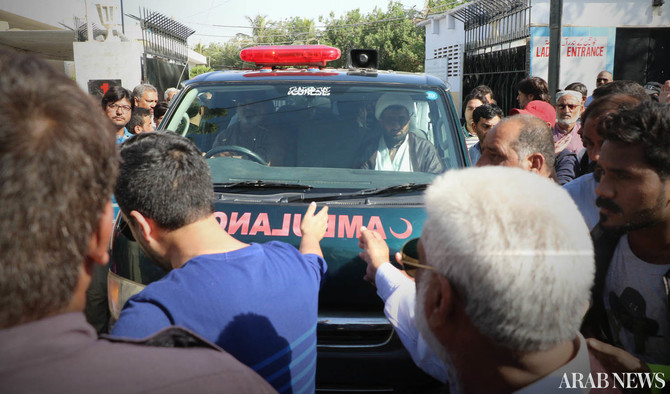
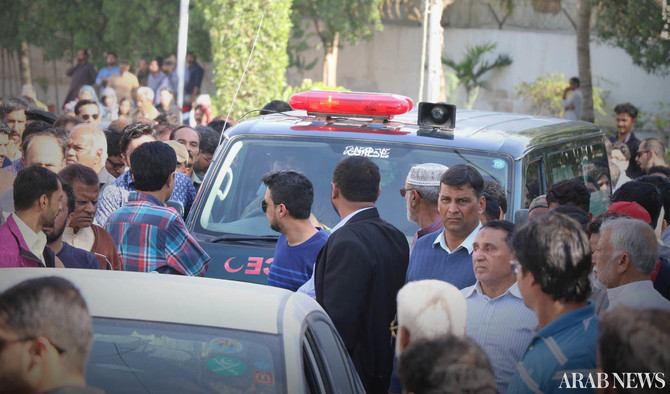
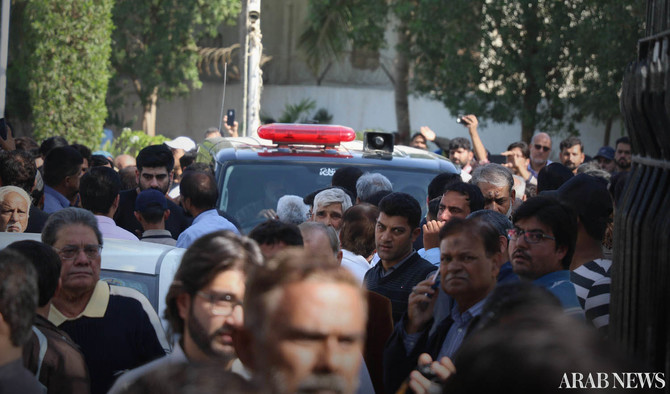
Former MNA of MQM, Ali Raza Abidi, was laid to rest in DHS graveyard after his funeral was offered at Imambarhagh Yasab in Karachi on Wednesday, Dec. 26, 2018. (AN photo by M.F. Sabir)
2 / 4
Former MNA of MQM, Ali Raza Abidi, was laid to rest in DHS graveyard after his funeral was offered at Imambarhagh Yasab in Karachi on Wednesday, Dec. 26, 2018. (AN photo by M.F. Sabir)
3 / 4
Former MNA of MQM, Ali Raza Abidi, was laid to rest in DHS graveyard after his funeral was offered at Imambarhagh Yasab in Karachi on Wednesday, Dec. 26, 2018. (AN photo by M.F. Sabir)
4 / 4
Former MNA of MQM, Ali Raza Abidi, was laid to rest in DHS graveyard after his funeral was offered at Imambarhagh Yasab in Karachi on Wednesday, Dec. 26, 2018. (AN photo by M.F. Sabir)
Updated 26 December 2018
Follow

Abidi’s murder a result of possible infighting within MQM — Police

  • Ex-lawmaker who was killed last night laid to rest in DHA’s graveyard
  • Video surfaces showing group’s self-exiled founder asking followers to kill leaders associated with different factions

KARACHI: The murder of Ali Raza Abidi is most likely the result of infighting within the various factions of the Muttahida Qaumi Movement (MQM), a senior counter-terrorism official said on Wednesday.
Fearing a return of violence to Karachi, where peace has been restored after years of bloodshed from 2009 till 2014, senior counter terrorism officer, Raja Umar Khattab said that 2013 — when targeted operations began to rid the city of violence — was the deadliest year with 3,251 killings.



Abidi was shot multiple times outside his residence in the Khayaban-e-Ghazi neighborhood of DHA on Tuesday night by unidentified assailants. (Screengrab from a video provided by Sindh Police)

Abidi was shot multiple times outside his residence in the Khayaban-e-Ghazi neighborhood of DHA on Tuesday night by unidentified assailants. His funeral prayers were offered on Wednesday afternoon. Allama Hassan Zafar Naqvi led the prayers at the Imambargah Yasrab, which was attended by senior leaders of the MQM-Pakistan, relatives, friends, and political and social figures of the city.
“The murder of Abidi is most likely the outcome of internal differences,” Khattab said, adding that the “incidents which occurred over the last couple of days is indication of the more violence. Law enforcement agencies are, however, ready to curb violence.”
“Two trained killers carried out the shooting within 10 seconds and escaped,” Khattab said.
Citing details of the forensic report, the official said that the weapon used to murder Abidi matched the pistol used in the killing of Ehtisham , who was killed by Irfan . Irfan is believed to be associated with the MQM.
Senior Superintendent of Police (SSP) South Karachi, Pir Muhammad Shah said that the investigation is being conducted from three angles. “We are investigating the murder from three angles; personal enmity, political, and sectarian,” Shah told Arab News.
“We have the technology, which will help us identify the killers. The footage we have got will definitely take us to the killers,” Shah said.
The official said that Abidi’s guard, identified as Qadeer, has been taken into custody as he fled instead of retaliating. SP Investigation Tariq Dharejo told Arab News that the statements of seven persons, including the guards, have been recorded.
A high-level security meeting at the CM House also cited political reasons as the motive for the murder.
“They [The intelligence agencies[ also pointed out making and breaking in some parties was also leading to violence,” a statement issued by the CM House said, adding that “police and Rangers have made some important arrests and they are sure that some solid clues would be unearthed to arrest the killers.”
It was also highlighted at the meeting that due to hate speeches being broadcasted from London, certain party workers were being instigated to murder their opponents.
“At this the chief minister directed Chief Secretary Mumtaz Shah to talk to the Foreign office in Islamabad to raise the issue with the British embassy,” the statement added.


Pakistan, global crypto exchange discuss modernizing digital payments, creating job prospects 

Updated 05 December 2025
Follow

Pakistan, global crypto exchange discuss modernizing digital payments, creating job prospects 

  • Pakistani officials, Binance team discuss coordination between Islamabad, local banks and global exchanges
  • Pakistan has attempted to tap into growing crypto market to curb illicit transactions, improve oversight

ISLAMABAD: Pakistan’s finance officials and the team of a global cryptocurrency exchange on Friday held discussions aimed at modernizing the country’s digital payments system and building local talent pipelines to meet rising demand for blockchain and Web3 skills, the finance ministry said.

The development took place during a high-level meeting between Finance Minister Muhammad Aurangzeb, Pakistan Virtual Assets Regulatory Authority (PVARA) Chairman Bilal bin Saqib, domestic bank presidents and a Binance team led by Global CEO Richard Teng. The meeting was held to advance work on Pakistan’s National Digital Asset Framework, a regulatory setup to govern Pakistan’s digital assets.

Pakistan has been moving to regulate its fast-growing crypto and digital assets market by bringing virtual asset service providers (VASPs) under a formal licensing regime. Officials say the push is aimed at curbing illicit transactions, improving oversight, and encouraging innovation in blockchain-based financial services.

“Participants reviewed opportunities to modernize Pakistan’s digital payments landscape, noting that blockchain-based systems could significantly reduce costs from the country’s $38 billion annual remittance flows,” the finance ministry said in a statement. 

“Discussions also emphasized building local talent pipelines to meet rising global demand for blockchain and Web3 skills, creating high-value employment prospects for Pakistani youth.”

Blockchain is a type of digital database that is shared, transparent and tamper-resistant. Instead of being stored on one computer, the data is kept on a distributed network of computers, making it very hard to alter or hack.

Web3 refers to the next generation of the Internet built using blockchain, focusing on giving users more control over their data, identity and digital assets rather than big tech companies controlling it.

Participants of the meeting also discussed sovereign debt tokenization, which is the process of converting a country’s debt such as government bonds, into digital tokens on a blockchain, the ministry said. 

Aurangzeb called for close coordination between the government, domestic banks and global exchanges to modernize Pakistan’s payment landscape.

Participants of the meeting also discussed considering a “time-bound amnesty” to encourage users to move assets onto regulated platforms, stressing the need for stronger verifications and a risk-mitigation system.

Pakistan has attempted in recent months to tap into the country’s growing crypto market, crack down on money laundering and terror financing, and promote responsible innovation — a move analysts say could bring an estimated $25 billion in virtual assets into the tax net.

In September, Islamabad invited international crypto exchanges and other VASPs to apply for licenses to operate in the country, a step aimed at formalizing and regulating its fast-growing digital market.