Iraqi Christians celebrate Christmas one year after Daesh defeat

1 / 4
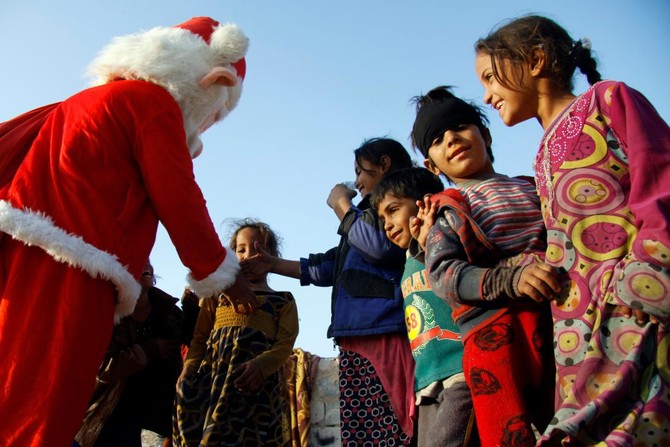
A man dressed in a Santa Claus outfit touring a popular neighborhood on the outskirts of the Iraqi central city of Najaf, takes children on a ride in a tuktuk on December 25, 2018. (AFP)
2 / 4
Iraqis attend Christmas Mass in Mar Youssif Chaldean Church, in Baghdad, Iraq, Tuesday, Dec. 25, 2018. (AP)
3 / 4
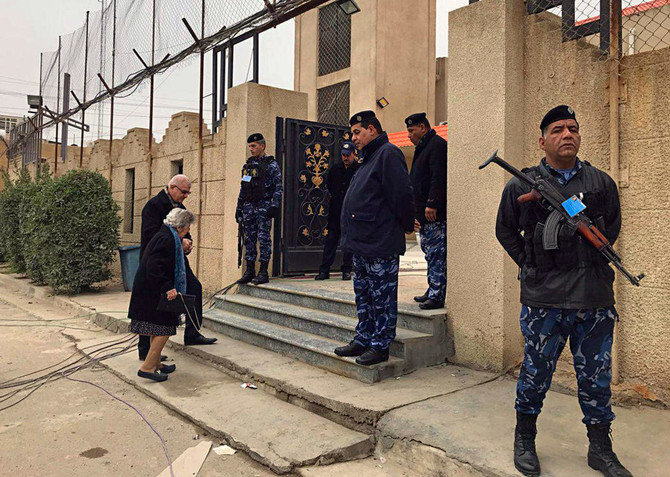
Security forces stand guard before Christmas Mass outside Mar Youssif Chaldean Church in Baghdad, Iraq, Tuesday, Dec. 25, 2018. (AP)
4 / 4
A man dressed in a Santa Claus outfit touring a popular neighbourhood on the outskirts of the Iraqi central city of Najaf, distributes small gifts to children on December 25, 2018. (AFP)
Updated 26 December 2018
Follow

Iraqi Christians celebrate Christmas one year after Daesh defeat

  • War and sectarian conflict shrank Iraq’s Christian population from 1.5 million to about 400,000 after the US-led invasion in 2003
  • Iraq is home to many different eastern rite churches, both Catholic and Orthodox

BAGHDAD: Iraqi Christians quietly celebrated Christmas on Tuesday amid improved security, more than a year after the country declared victory over Daesh militants who threatened to end their 2,000-year history in Iraq.
Christianity in Iraq dates back to the first century of the Christian era, when the apostles Thomas and Thaddeus are believed to have preached the Gospel on the fertile flood plains of the rivers Tigris and Euphrates.
Iraq is home to many different eastern rite churches, both Catholic and Orthodox, traditionally a sign of the country’s ethnic and religious diversity.
But war and sectarian conflict shrank Iraq’s Christian population from 1.5 million to about 400,000 after the US-led invasion in 2003. Following the onslaught of Daesh in 2014 and the brutal three-year war that followed their numbers have fallen further, though it is not known exactly by how much.
In Baghdad, Christians celebrated mass on Tuesday morning — declared a national holiday by government — in churches decorated for Christmas. Once fearful, they said they were now hopeful, since conditions had improved.
“Of course we can say the security situation is better than in previous years,” said Father Basilius, leader of the St. George Chaldean Church in Baghdad where more than a hundred congregants attended Christmas mass.
“We enjoy security and stability mainly in Baghdad. In addition, Daesh was beaten.”
Iraq declared victory over the militants more than a year ago, but the damage done to Christian enclaves on the Nineveh Plains has been extensive.
In Qaraqosh, a town also known as Hamdaniya which lies 15 km (10 miles) west of Mosul, the damage is still visible.
At the city’s Immaculate Church, which belongs to the Syrian Catholic denomination and has not yet been rebuilt since the militants set it on fire in 2014, Christians gathered for midnight mass on Monday, surrounded by blackened walls still tagged with Daesh graffiti.
Dozens of worshippers prayed and received communion, and then gathered around the traditional bonfire in the church’s courtyard.
Before the militant onslaught, Qaraqosh was the largest Christian settlement in Iraq, with a population of more than 50,000. But today only a few hundred families have returned.
Faced with a choice to convert, pay a tax or die, many Christians in the Nineveh Plains fled to nearby towns and cities and some eventually moved abroad.
Some have since returned, Father Butros said, adding: “We hope that all displaced families will return.”


Fledgling radio station aims to be ‘voice of the people’ in Gaza

Updated 15 February 2026
Follow

Fledgling radio station aims to be ‘voice of the people’ in Gaza

  • The electricity crisis is one of the most serious and difficult problems in the Gaza Strip, says Shereen Khalifa Broadcaster

DEIR EL-BALAH: From a small studio in the central city of Deir El-Balah, Sylvia Hassan’s voice echoes across the Gaza Strip, broadcast on one of the Palestinian territory’s first radio stations to hit the airwaves after two years of war.

Hassan, a radio host on fledgling station “Here Gaza,” delivers her broadcast from a well-lit room, as members of the technical team check levels and mix backing tracks on a sound deck. “This radio station was a dream we worked to achieve for many long months and sometimes without sleep,” Hassan said.

“It was a challenge for us, and a story of resilience.”

Hassan said the station would focus on social issues and the humanitarian situation in Gaza, which remains grave in the territory despite a US-brokered ceasefire between Israel and Hamas since October.

“The radio station’s goal is to be the voice of the people in the Gaza Strip and to express their problems and suffering, especially after the war,” said Shereen Khalifa, part of the broadcasting team.

“There are many issues that people need to voice.” Most of Gaza’s population of more than 2 million people were displaced at least once during the gruelling war.

Many still live in tents with little or no sanitation.

The war also decimated Gaza’s telecommunications and electricity infrastructure, compounding the challenges in reviving the territory’s local media landscape. “The electricity problem is one of the most serious and difficult problems in the Gaza Strip,” said Khalifa.

“We have solar power, but sometimes it doesn’t work well, so we have to rely on an external generator,” she added.

The station’s launch is funded by the EU and overseen by Filastiniyat, an organization that supports Palestinian women journalists, and the media center at the An-Najah National University in Nablus, in the occupied West Bank.

The station plans to broadcast for two hours per day from Gaza and for longer from Nablus. It is available on FM and online.

Khalifa said that stable internet access had been one of the biggest obstacles in setting up the station, but that it was now broadcasting uninterrupted audio.

The Gaza Strip, a tiny territory surrounded by Israel, Egypt, and the Mediterranean Sea, has been under Israeli blockade even before the attack on Oct. 7, 2023, which sparked the war. Despite the ceasefire, Israel continues to strictly control the entry of all goods and people to the territory.

“Under the siege, it is natural that modern equipment necessary for radio broadcasting cannot enter, so we have made the most of what is available,” she said.