


LONDON: The sight of drivers in fast cars revving their engines and speeding around the historical Ad Diriyah district of Riyadh offered proof, if any were needed, that when it comes to sport, the Kingdom has moved up a gear or two in the past 12 months.
The Formula E race earlier this month was the first motorsport event of global significance to take place in Saudi Arabia. The format’s Middle East debut offered a glimpse not only of the country’s sporting future as a host of world-class races and matches but also the likely direction of motorsport itself.
There are many pundits who claim Formula E’s electric cars could soon rival the gas guzzlers of Formula One in the popularity stakes.
Felipe Massa, a former F1 star who made the leap to Formula E, told Arab News during the Riyadh race weekend that the sport is on track to overtake its older rival.
“Formula E and electric cars will definitely be the future, even possibly the short-term future,” the Brazilian, who finished in 14th on his debut, said.
“We are even racing in a country known as an oil country, so I think this shows how much the championship is growing.”
If Massa is correct, the decision to host Formula E, rather than F1, could prove to be a remarkable bit of foresight by the General Sport Authority (GSA).
 The environmentally conscious show of speed certainly proved popular as thousands of Middle East “petrolheads” descended on the street circuit in the Saudi capital to witness Antonio Felix da Costa win the inaugural Saudi E-Prix.
The weekend also brought a party atmosphere unlike anything the Kingdom had witnessed before, with a mixed crowd dancing to the tunes of DJ David Guetta and other international line-ups.
On top of that there was a feeling that the Formula E race would become a annual sporting highlight not only in the Kingdom but also in the region and beyond.
But Saudi Arabia is no stranger to the global sporting stage. Take this year’s football World Cup, when the Green Falcons took on hosts Russia in the much-anticipated opening match.
An estimated 3.4 billion people watched the tournament, and a significant number of those would have been glued to the TV to watch the opener. While the result — a 5-0 defeat to an inspired Russia side — did not go according to plan, the Saudi team showed grit in their next two games, losing 1-0 to Uruguay in the second clash before winning their first match at a World Cup since 1994.
That came in a well-deserved 2-1 victory over Arab rivals Egypt. The Green Falcons’ performances were better than the results suggested and offered hope that Juan Antonio Pizzi’s men can use the World Cup as a springboard to success in next month’s Asian Cup in the UAE.
Since the win over Mohamed Salah and Co., the Green Falcons have been beaten just once, by the might of Brazil, and will head to the tournament full of confidence.
If Pizzi’s players are seeking inspiration, they need look no further than their younger counterparts. The Young Falcons soared to glory, beating South Korea 2-1 in the final to claim the Asian U-19 Championships in November. Turki Al-Ammar, who won the MVP award, personified the spirit in the side, and provided hope for next year’s U-20s World Cup and beyond as the senior national team look to take more strides in the future.
It was not only in motorsport and football that Saudi Arabia packed a global punch. On Sept. 28, Jeddah’s King Abdullah Sports City played host to a boxing world title fight — the first such event to take place in the Kingdom.
Britain’s Callum Smith beat compatriot George Groves to win the WBA super-middleweight title and the World Boxing Super Series crown. On the same night Saudi boxer Abdulfatah Julaidan made history as the first man to win a professional bout in the Kingdom.
American Anthony Duncan saw the transformative effect of boxing first-hand at King Abdullah Sports City.
“Of course, we hope that the impact of this night will be felt for many years to come,” Duncan told Arab News. “Many people weren’t sure what they were going to get, but after watching it up close and personal, I know they will be aspiring to become champions.”
While that fight night was solely for men, women’s boxing has also been jabbing its way into the public consciousness in Saudi Arabia.
Halah Al-Hamrani is proving herself to be a trailblazer, training women fighters in the Kingdom. She hopes to stage the first boxing competitions for women in the Kingdom next year, and has lofty ambitions of propelling one of her charges to Olympic glory.
“My ultimate dream for women’s boxing in Saudi Arabia is for one of them to go to the Olympics,” Al-Hamrani told Arab News in October.
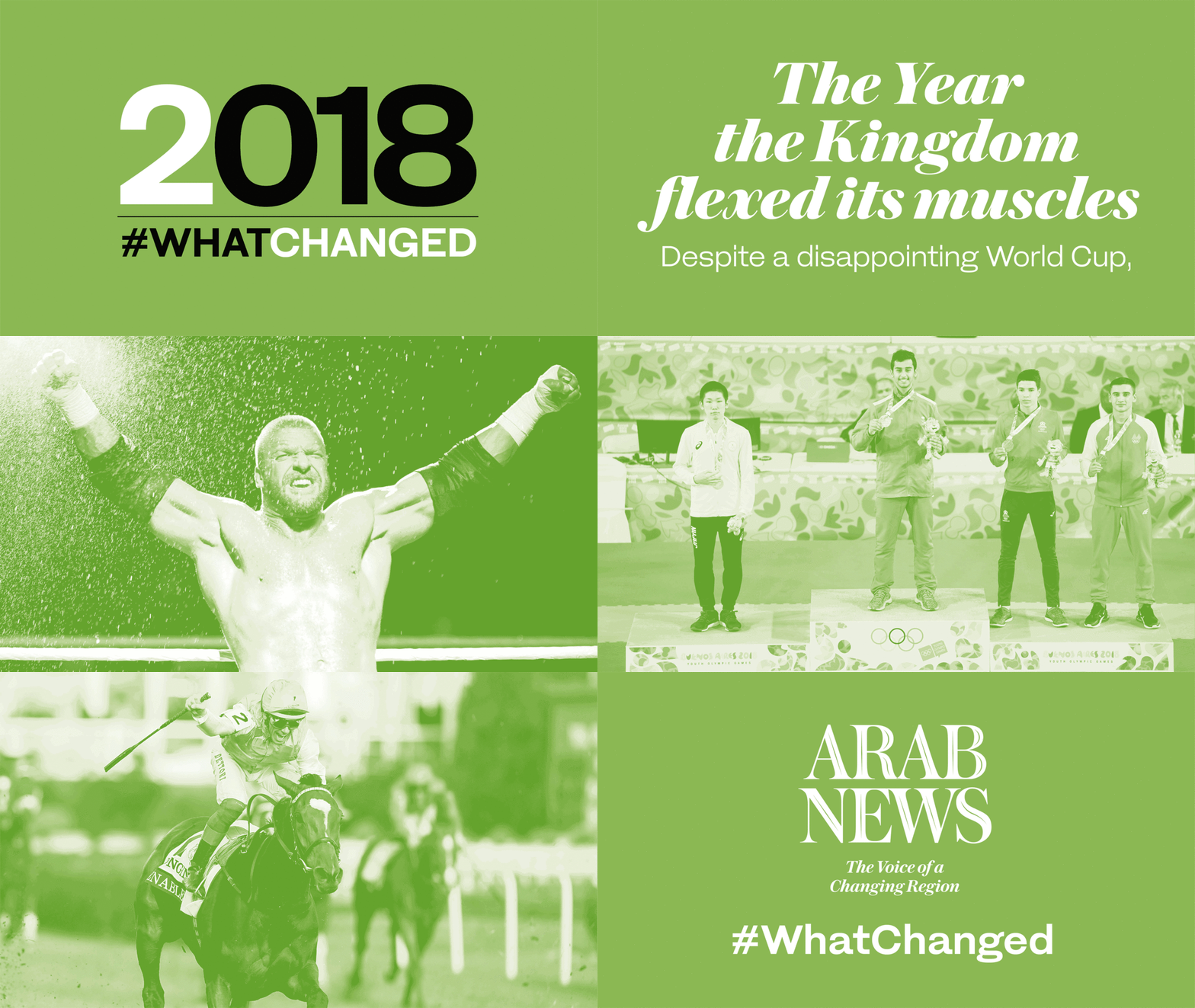
In October, the Kingdom took nine athletes to the Youth Olympics in Buenos Aires. The young guns returned with three medals. Two bronze came in weightlifting and the 400m hurdles, while Mohammed Al-Assiri’s karate triumph in the final of the men’s Kumite -61kg was the Kingdom’s first Olympic gold at any level. It also ensured that Buenos Aires will be remembered as Saudi Arabia’s greatest medal haul, eclipsing the one bronze and one silver at the 2000 Olympics in Sydney.
It is easy to dismiss success at youth level since the difficulties of translating youthful talent into success as an adult are well known. But it is hard to dismiss the hopes and inspiration the young heroes take back from events such as the Youth Olympics, to say nothing of the galvanizing effect such an experience can generate.
Ali Yousef Al-Othman, who won a weightlifting bronze, told Arab News after collecting his prize that the Tokyo Olympics in two years’ time is his top priority.
“My dream was to win a medal at the Youth Olympics,” he said. “Now that dream has changed and I will work harder than ever to make Tokyo 2020 a reality.” Such Olympic hopes require focus and dedication and a reserved, often understated, ambition.
The Saudi Arabian Federation for Electronic and Intellectual Sports was initiated in 2017, a step toward positioning the Kigndom as a main eSports hub in the Middle East and the world.
Given Saudi Arabia’s large youth population, Princess Reema said, “we truly believe that this is a sector that we can develop and grow, and is ripe for investment.”
Last August, Saudi teenager Mosaad Aldossary picked up a $250,000 prize winning the global FIFA eWorld Cup Grand Final. Last November, the Saudi eSports team won first prize in the Tekken 7 competition at the 10th edition of the IESF eSports World Championship in Taiwan, the first participation for the team.
One event that is anything but understated is WWE, and in April this year the “sport” that is pure Americana — at once brash and back-breaking — had its debut in Saudi Arabia.
“The Greatest Royal Rumble” and its big names — John Cena, Triple H and Brock Lesner — provided a prelude to the Crown Jewel event, held at the end of October.
More than 60,000 people, including women, attended both events. Immediately afterwards, wrestling clubs were flooded with inquiries from children wanting to be the next Triple H or Undertaker, proving once again that from watching sport comes a desire to take part.
But for all the history-making events and achievements that are marking the passage to a new era, the real change in Saudi sport has been out of the spotlight.
In the past year the number of sports being playing in the Kingdom has risen dramatically. From having 30 federations, the GSA now has 64, increasing the number of sporting options open to all Saudis, regardless of gender.
In the future, the work of heroes such as Al-Hamrani could prove to be as significant as the big-name events and stars heading to Saudi Arabia.


