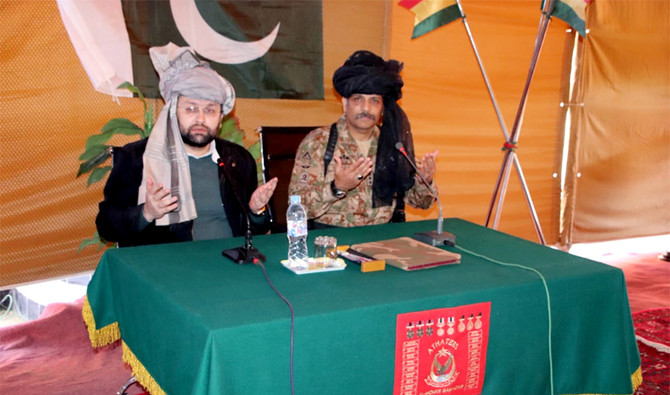
PESHAWAR: Provincial health and education ministers on Saturday paid their first visit to North and South Waziristan districts since they were merged with Khyber Pakhtunkhwa province earlier this year, and announced various social development projects.
In May, Pakistan's parliament passed legislation to merge the country’s tribal belt along the Afghan border with the Khyber Pakhtunkhwa province, a key step to ending the region’s colonial era governance system.
The KP health and education ministers announced multiple development projects during the visit to “compensate the tribal people for their matchless sacrifices during the years long military operation against militant."
The semi-autonomous region consists of seven big districts and six towns known as the Federally Administered Tribal Areas (FATA) and has been governed for over 150 years by colonial era laws. Over the past decade, Pakistan’s army has carried out many operations in FATA against militant groups that have used these areas as launching pads for attacks in Pakistan and across the border in Afghanistan.
After arriving in Miran Shah, the headquarters of North Waziristan, KP Health Minister Hisham Inamullah visited the District Headquarters Hospital and announced the appointment of lady doctors and a gynecologist and the creation of new vacancies for female staff in the female ward of the hospital.
Abdullah Shah, a tribal elder told Arab News by phone, that the minister also pledged to provide the hospital with state-of-the-art equipment and announced the upgrade of a hospital in Razmak.
“The minister announced Insaf Health Cards for the people of North Waziristan and announced the setting up of a trauma center, CT scan, dialysis and thalassemia centers at the main hospital,” another tribal elder Ali Jan said, referring to a public health insurance card.
Earlier, in his briefing to the visiting guests, Agency Surgeon Dr. Muhammad Younas said that 77 percent of health centers in the area were functional while 29 were non-functional.
Inamullah said the Pakistan Tehreek-e-Insaf government was committed to making all health centers functional without further delay.
Separately, the KP Education Minister Ziaullah Bangash visited the adjacent South Waziristan tribal district where he announced the upgrade of the decades-old Government High School Wana.
Responding to widespread complaints about the existence of over 300 ghost schools in the tribal areas, the minister pledged that all resources would be employed to make these educational institutions functional.
“Past governments have ignored the development of the tribal region, but we are committed to bolstering the education sector here in line with the vision of Prime Minister Imran Khan,” Bangash told tribal elders.


![]()
![]()
![]()

Ministers pay first visit to tribal belt since their merger with rest of country

Ministers pay first visit to tribal belt since their merger with rest of country
- In May, Pakistan passed law to align tribal regions with Khyber Pakhtunkhwa
- Health and education ministers announce various uplift projects


Latest updates





© 2026 SAUDI RESEARCH & PUBLISHING COMPANY, All Rights Reserved And subject to Terms of Use Agreement.