CAIRO: Nadia Mohammad Salem started saving up for her wedding long before she got engaged. But getting married proved far more stressful than she’d imagined when her husband proposed a year ago.
The number of marriages across Egypt fell by nearly 3 percent in 2017, according to official data, and a lot of that appears to be down to rising costs.
“Things were very expensive,” said Nadia, 30. “I was feeling nervous and concerned.”
Tough economic reforms including a devaluation of the country’s pound in late 2016 have led to a dramatic increase in prices, notably for the imported goods bought by many newly-weds to equip their homes.
“All of the necessities that come with getting married are going to be more expensive,” said Rania Salem, assistant professor at the University of Toronto’s sociology department. “Therefore I would expect people to stay in the single state or engagement period longer and longer.”
In 2012, the average cost of a wedding was 61,000 Egyptian pounds, Salem said. Back then the currency traded at around 6.15 to the dollar, compared with nearly 18 now.
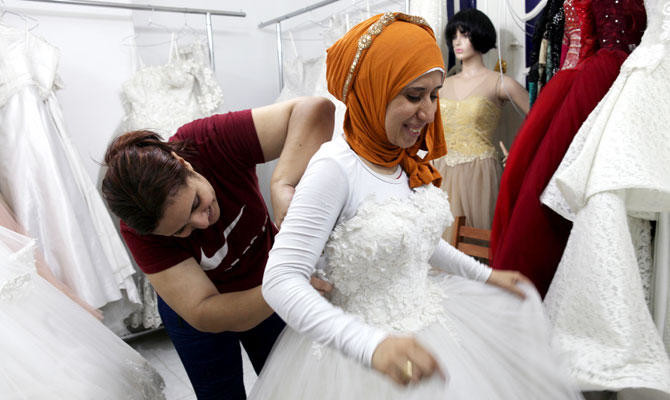
This year, Nadia spent around 80,000 pounds ($4,500) on just her “gehaz” — the kitchen equipment and other items a bride purchases ahead of her marriage. Despite help from her family, she had to save up for years.
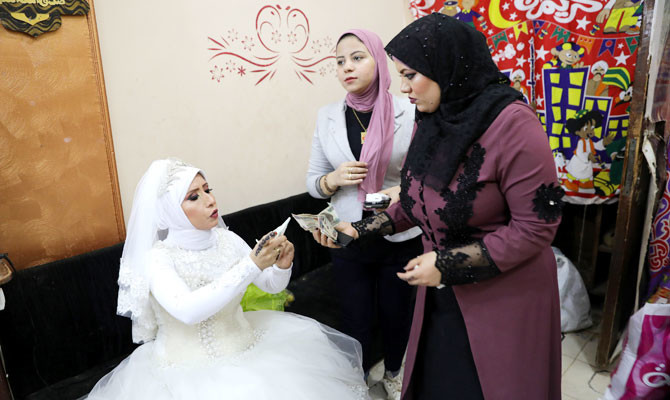
On their wedding day in November, she and her husband had a small celebration on the street rather than a formal party.
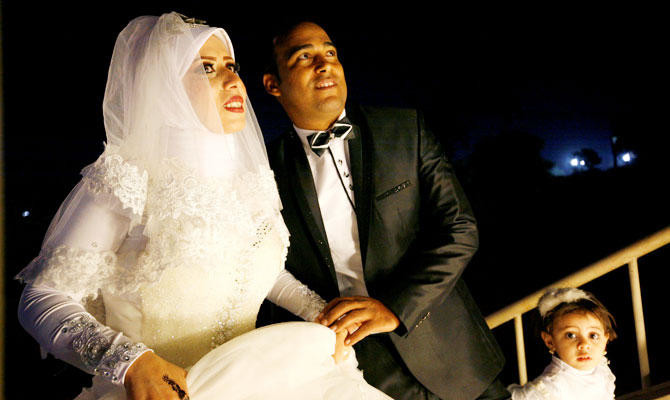
A week later, she put on a cheap, second-hand dress and gathered with her husband and a few relatives in a garden, where they posed for pictures.
Nadia said she hoped her children would find getting married less of a financial burden.
“If I have a daughter, I hope things will be much easier for her,” she said. “I want her to have everything she wants.”
($1 = 17.8600 Egyptian pounds)


In Egypt, weddings get costlier as economic hardships deepen



In Egypt, weddings get costlier as economic hardships deepen

- This year, Nadia spent around 80,000 pounds ($4,500) on just her “gehaz” — the kitchen equipment and other items a bride purchases ahead of her marriage


Viral phenomenon in Argentina has young people identifying themselves as animals
- As the movement gains traction, psychologists are stepping in to analyze the phenomenon and its place in public discourse
BUENOS AIRES: On a recent Sunday, a Buenos Aires plaza transformed into a makeshift wilderness for an unusual group of teenagers.
Sofía, wearing a lifelike beagle mask, ran across the grass on all fours. Nearby, 15-year-old Aguara leapt through the air, clearing an obstacle course while imitating the precise movements of a Belgian breed dog. Others dressed as cats and foxes perched in the branches of trees, keeping their distance from curious onlookers.
It was the latest gathering of “therians,” individuals who say they identify mentally, spiritually or psychologically with non-human animals. The trend has taken over Argentine social media over the past few months, gaining traction on platforms like TikTok, where the hashtag #therian has surpassed 2 million posts, with Argentina leading all other Latin American countries in engagement. The surge has drawn the attention of influencers and media outlets alike, sparking reactions that range from laughter and bewilderment to outright anger.
And as the movement gains traction, psychologists are stepping in to analyze the phenomenon and its place in public discourse.
Aguara, who claims to identify as a Belgian Malinois and counts her age as the equivalent of two years and two months in dog years, says she’s a lot like any other teenager.
“I wake up like a normal person and live my life like a normal person,” she said. “I simply have moments when I like being a dog.”
As the leader of what she calls her “pack,” Aguara — the name she identifies with — boasts more than 125,000 followers on TikTok and coordinates regular meetups around the Argentine capital.
Aru, a 16-year-old who wore a seal mask to the park meetup, said she considers herself part of the “otherpaw” branch of therians: individuals who wear masks and tails or move on all fours just for fun. “It’s not necessarily about identifying as an animal,” she said.
She reckons the therian trend took off in Argentina because of the country’s “fairly free” environment. For other young Argentines, the movement has provided a vital community where they can feel truly accepted.
Should parents be worried?
Débora Pedace, a psychologist and director of the Integral Therapeutic Center in Buenos Aires, acknowledged that the phenomenon generates a complex mix of confusion, laughter and even anger.
“From a psychological standpoint, this is a symbolic identification with an animal,” Pedace said. “It becomes pathological or alarming only when it turns into a deeply rooted belief and the person fully assumes the role of an animal, potentially leading to self-harm or hurting others.”


